

We can put city and country people on more equal footing at uni — the pandemic has shown us how
- Written by: Robyn Eversole, Professor and Director, RegionxLink, Centre for Social Impact, Swinburne University of Technology
University study is out of reach for many people in regional Australia. Most of our universities are based in a handful of capital cities. The result is persistent educational inequity between our capital cities and regions.
The COVID-19 pandemic has forced universities to move their activities online. This shift has created challenges for students, but has also temporarily erased the longstanding disparity in university access between cities and regions. Internet connections permitting, regional students have been able to participate on equal footing with their city colleagues.
As universities look to return to campus, the temptation is for city campuses to abandon the video link and rush back to business as usual. Yet this misses a once-in-a-lifetime opportunity to tackle longstanding inequities for regional students. The innovations in online delivery forced on universities by the pandemic now point to ways to permanently improve regional students’ access and experience of tertiary education.
Regional people – the 32% of Australians living outside a capital city – are a recognised equity group in higher education. They are less likely to attend university than their metropolitan counterparts – only one in five Australian university students is from a regional area. And if born in a remote area, they are only one-third as likely to go to university as those born in a major city.
Read more: New research shows there is still a long way to go in providing equality in education
What obstacles do regional students face?
The educational divide is the result of the multiple barriers to university access that regional students face. Many of their disadvantages relate to the economic, social and cultural costs of moving away from home to study, particularly to a large and distant city.
Students face a raft of changes at once: they must leave family and community behind and fend for themselves in unfamiliar environments. Families must find money for housing and other costs. For “mature age” students who already have families and local commitments, moving away to study is often simply impossible.
Read more: Four barriers to higher education regional students face – and how to overcome them
Regional university campuses play an important role supporting equitable access to education. These campuses can offer great face-to-face study experiences, but many are small and have limited course options.
And across the width and breadth of Australia, we have few regional campuses. Most regional Australians do not live near a campus.
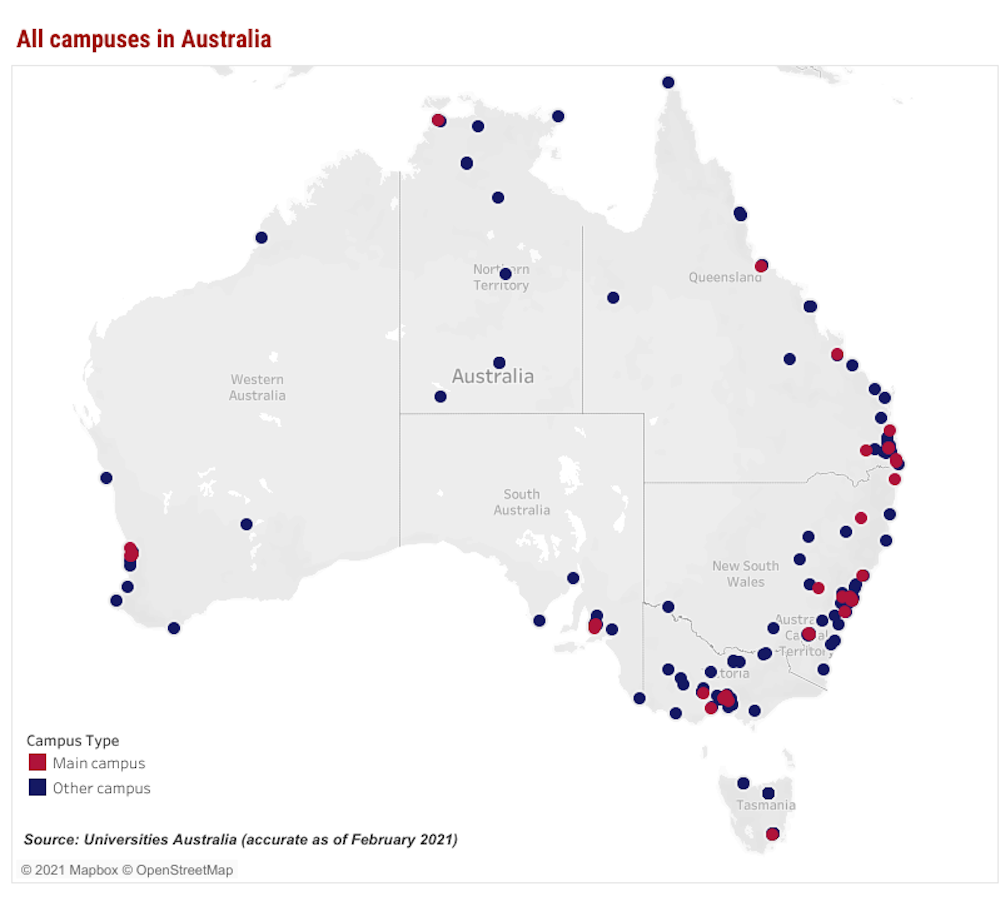 Universities Australia
Read more:
Why regional universities and communities need targeted help to ride out the coronavirus storm
Online study is often mooted as an alternative, but it often has poorer outcomes than on-campus study. Internet connectivity in regional areas can be a problem, too. And online study can be isolating; new students in particular often need interaction and support to succeed.
To reduce these systemic inequities, we need to do regional education differently.
We’ve had a glimpse of the solutions
In response to the pandemic, many universities have moved coursework and community engagement activities fully online. Lectures, tutorials, seminars, workshops and even graduations have gone on-screen. While not the same as face-to-face interaction, these online engagements have had the unexpected benefit of opening access for those who previously couldn’t participate at all.
Universities have learned to use video conferencing and online platforms in new ways to maximise interactivity for students at a distance. In some cases “hybrid” activities mix face-to-face and digital participation all at once: some participants gather in the room and others join from the screen.
Read more:
Digital learning is real-world learning. That's why blended on-campus and online study is best
When done well, with good technology and good manners, hybrid interactions are fluid and the hierarchy between “here” and “there” disappears. These hybrid activities suggest a new way to approach the challenge of providing university education across distance.
For the first time, regional students and communities have had access to activities and resources previously available only on capital city campuses. So long as internet connections are reliable, it no longer matters if the student is five kilometres from the city centre or 500.
Now, with universities planning to move back to campuses, we find ourselves at a vital crossroad. To bring campuses back to life, students are being urged back into classrooms. Video links disappear. Expectations of a physical presence on city campuses return.
Read more:
Where are the most disadvantaged parts of Australia? New research shows it's not just income that matters
A once-in-a-lifetime shot at equitable education
For regional students, this “return to campus” means we risk reverting to inequity as usual. Policymakers and universities must not miss this window of opportunity to reduce longstanding inequities for regional students. We have a chance to retool our approach to make the future of higher education an equitable one.
On a vast lightly populated continent like Australia, there will never be a university campus near every town. Yet university education can be hybrid, multi-sited and inclusive. There can be local places for students to gather and interact, and hybrid classrooms where students can join their preferred course without moving house.
A few towns already host spaces where regional students can enjoy in-person interactions with other students and academics. These also provide free work spaces and fast internet speeds – which students might not have at home. Regional university campuses, country university centres, regional study hubs and even online centres and libraries can provide the infrastructure for a hybrid and multi-sited university presence that includes regional students on equal footing.
Universities Australia
Read more:
Why regional universities and communities need targeted help to ride out the coronavirus storm
Online study is often mooted as an alternative, but it often has poorer outcomes than on-campus study. Internet connectivity in regional areas can be a problem, too. And online study can be isolating; new students in particular often need interaction and support to succeed.
To reduce these systemic inequities, we need to do regional education differently.
We’ve had a glimpse of the solutions
In response to the pandemic, many universities have moved coursework and community engagement activities fully online. Lectures, tutorials, seminars, workshops and even graduations have gone on-screen. While not the same as face-to-face interaction, these online engagements have had the unexpected benefit of opening access for those who previously couldn’t participate at all.
Universities have learned to use video conferencing and online platforms in new ways to maximise interactivity for students at a distance. In some cases “hybrid” activities mix face-to-face and digital participation all at once: some participants gather in the room and others join from the screen.
Read more:
Digital learning is real-world learning. That's why blended on-campus and online study is best
When done well, with good technology and good manners, hybrid interactions are fluid and the hierarchy between “here” and “there” disappears. These hybrid activities suggest a new way to approach the challenge of providing university education across distance.
For the first time, regional students and communities have had access to activities and resources previously available only on capital city campuses. So long as internet connections are reliable, it no longer matters if the student is five kilometres from the city centre or 500.
Now, with universities planning to move back to campuses, we find ourselves at a vital crossroad. To bring campuses back to life, students are being urged back into classrooms. Video links disappear. Expectations of a physical presence on city campuses return.
Read more:
Where are the most disadvantaged parts of Australia? New research shows it's not just income that matters
A once-in-a-lifetime shot at equitable education
For regional students, this “return to campus” means we risk reverting to inequity as usual. Policymakers and universities must not miss this window of opportunity to reduce longstanding inequities for regional students. We have a chance to retool our approach to make the future of higher education an equitable one.
On a vast lightly populated continent like Australia, there will never be a university campus near every town. Yet university education can be hybrid, multi-sited and inclusive. There can be local places for students to gather and interact, and hybrid classrooms where students can join their preferred course without moving house.
A few towns already host spaces where regional students can enjoy in-person interactions with other students and academics. These also provide free work spaces and fast internet speeds – which students might not have at home. Regional university campuses, country university centres, regional study hubs and even online centres and libraries can provide the infrastructure for a hybrid and multi-sited university presence that includes regional students on equal footing.
 Low-speed and unreliable internet connections frustrate many people trying to study online in regional Australia.
Shutterstock
Read more:
Will Australia's digital divide – fast for the city, slow in the country – ever be bridged?
However, effective hybrid classrooms require buy-in and participation from all sites – including city campuses. There has to be a commitment to investing resources in excellent, interactive digital learning. Local infrastructure and in-person academic support in regional towns need to be strengthened too.
As universities navigate the current landscape of scarcity and uncertainty, there is a real risk regional students will drop off the radar. Before rushing back to business as usual, let’s consider the alternative: equitable access to education, no matter where you live.
Low-speed and unreliable internet connections frustrate many people trying to study online in regional Australia.
Shutterstock
Read more:
Will Australia's digital divide – fast for the city, slow in the country – ever be bridged?
However, effective hybrid classrooms require buy-in and participation from all sites – including city campuses. There has to be a commitment to investing resources in excellent, interactive digital learning. Local infrastructure and in-person academic support in regional towns need to be strengthened too.
As universities navigate the current landscape of scarcity and uncertainty, there is a real risk regional students will drop off the radar. Before rushing back to business as usual, let’s consider the alternative: equitable access to education, no matter where you live.
Authors: Robyn Eversole, Professor and Director, RegionxLink, Centre for Social Impact, Swinburne University of Technology


















