

why defamation is still no joke, despite recent law changes
- Written by: Jacci Brady, PhD Candidate, School of Political and Social Sciences, The University of Melbourne
Changes to Australian defamation laws that came into effect this month in several states could provide some respite for political satire as a mode of political communication.
In recent years, the defamation lawsuit risk for Australian comedians has been real.
The treatment of YouTube personality Jordan Shanks and his producer Kristo Langker is a case in point. FriendlyJordies, Shanks’ popular YouTube channel, had mockingly depicted NSW Deputy Premier John Barilaro as Mario, the fictional video game character who wins races by cheating. Shanks’ satirical stunts and commentary included content about alleged incompetence and corruption.
In response, Langker was arrested by no less than the Fixated Persons Investigations Unit of the NSW police, which is normally concerned with rooting out extremists and terrorists, and subjecting them to psychological assessment. Furthermore, Shanks is now being sued by Barilaro for defamation.
How will new defamation laws protect satirists?
The reformed defamation laws came into effect on July 1 in New South Wales, Queensland, Victoria and South Australia. They will become nationally uniform by the end of this year.
The reformed laws now include a public interest defence and a serious harm provision, both of which promise room for manoeuvre for political satirists.
The changes mean more protection for satire highlighting matters of interest to the public. The only exception is that representations can’t make accusations without factual basis. And the new serious harm provision means that satirical insult does not automatically equate to reputational damage.
How this will be tested in law remains to be seen, particularly as it relates to the implied right to freedom of political expression. These legal reforms may be welcome relief, reducing some risk to satirists.
But in terms of power relations, the defamation issue may still come down to who has the money to mount a defence. For grassroots and citizen satirists without the funds to access legal advice, this is still problematic.
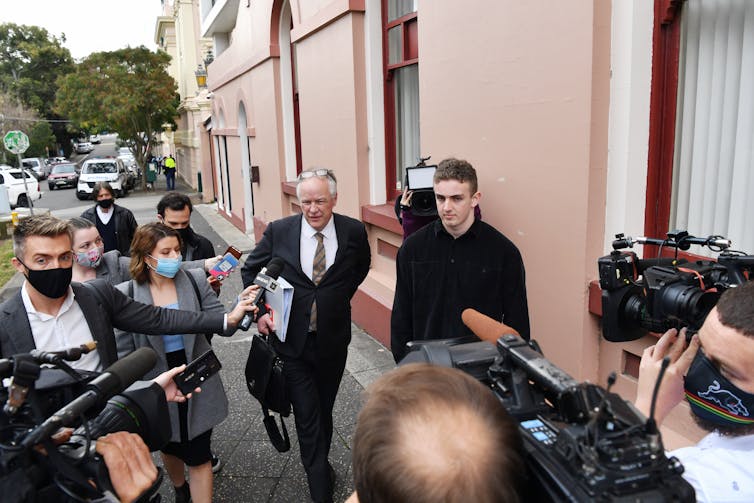 Music student Kristo Langker has been charged with stalking John Barilaro, an allegation he denies.
Dean Lewins/AAP
Music student Kristo Langker has been charged with stalking John Barilaro, an allegation he denies.
Dean Lewins/AAP
Limits to the modern court jester
Whether or not one approves of Shanks’ potentially racist depiction of Barilaro, the actions against him and his producer do seem to be disproportionate and a far cry from the past.
For example, back in 2004, in a stunt that resonated with the satirical series The Chaser’s War on Everything, a man named Patrick Coleman distributed pamphlets in Townsville with the words “Get to know your local corrupt type coppers”. He was arrested and convicted under vagrancy laws for use of insulting language in a public place (among other charges).
Read more: Friday essay: why is Australian satire so rarely risky?
However, the High Court overturned the charge of insulting police, saying the police should be expected to resist the sting of insults directed at them.
Indeed, tolerance for even more risqué political satire stretches a long way back, from the no-holds-barred comedy of The Big Gig and The Comedy Company, to the rogue and surreal inversion of Australian politics and culture in the series DAAS Kapital.
In the past, many politicians have even supported or engaged in satire themselves, such as former Victorian Premier Joan Kirner’s self-mocking performance on The Late Show in 1993.
Joan Kirner singing Joan Jett’s ‘I Love Rock n’ Roll’ on the Late Show.There have also been notable instances of resistance, too. In the late 1990s, Pauline Hanson mounted legal challenges against the work of satirist Simon Hunt, aka Pauline Pantsdown. ABC’s The Glasshouse was also cancelled in 2006 — some say at the request of John Howard — arguably because the political commentary got too pointed for the prime minister’s office.
Attempts to criminalise impersonations before
In recent years, the concerns of increasingly sensitive politicians seem to have found greater weight in law.
In 2017, Attorney-General George Brandis fired a serious warning shot at those who may dare to satirise government officials.
The government’s proposed legislation would have replicated existing laws that already made proper impersonation illegal and was an extremely broad-brush approach to defining impersonation. In his submission to the parliamentary inquiry reviewing the changes to the law, Melbourne Law School professor Jeremy Gans warned about legislative overreach.
He pointed out the draft legislation could have led to the criminalisation of satirical conduct as political expression,
and to say otherwise is silly, confusing and (perhaps) ambiguous as to which party will bear the evidential burden on this issue.
While those reforms didn’t get up, they may be reflective of a broader desire on the part of government to sanitise public political comment.
Comedian Max Gillies impersonating former Prime Minister Bob Hawke.Continued risks to satirists, despite the changes
Attempts such as this to regulate satire are concerning in multiple ways. First, they enhance the powers of already powerful governmental officials relative to more vulnerable actors.
Even with the new changes to defamation laws, many up-and-coming satirists without the legal backing and expertise of media or production companies will still face challenges to safely practice their craft.
And satirists will almost certainly continue to experience heightened pressure to self-censor due to the risk of lawsuits. This undermines a key medium for articulating legitimate political critique and protest.
Comedian, writer and broadcaster Wendy Harmer once observed that what we see on TV and in other media “tells you where your society is at”.
If media artists are too afraid to express what our communities feel through satire for fear of government or legal reprisal, then surely we come to know less about who we are.
Authors: Jacci Brady, PhD Candidate, School of Political and Social Sciences, The University of Melbourne


















