

How can the new Closing the Gap dashboard highlight what indicators and targets are on track?
- Written by: Janine Mohamed, Distinguished Fellow, George Institute for Global Health
The 2021 Close the Gap report declared the national agreement on Closing the Gap “a game changer” that sets a new standard for how governments work with Aboriginal and Torres Strait Islander organisations and communities.
The national agreement was signed a year ago and put its signatories on a 12-month timetable for action.
Since then, the Productivity Commission has released a new dashboard for reporting on the government’s progress across 17 key socioeconomic indicators and on priority reforms when the data is available. The first report based on this data has been released today.
We are now at a crucial moment, with the federal, state and territory governments and the Coalition of Aboriginal and Torres Strait Islander Peaks due to hand down their implementation plans and begin the task of annually reporting on their actions.
So, what will the new report provide and what else do we need to ensure the national agreement lives up to its promise for improved Aboriginal and Torres Strait Islander health and wellbeing?
Data on expanded socioeconomic targets
The minister for Indigenous Australians, Ken Wyatt, said the dashboard will bring all the data together
so that people can readily see the current situation and trajectories of indicators for each target, providing a level of transparency and access that we haven’t had before.
At this stage, the dashboard includes data on the 17 socioeconomic targets outlined in the national agreement, expanding on the original seven Closing the Gap targets on life expectancy and other health issues.
The expanded targets, which our people had urged for years, include the wider social and cultural determinants of health, such as language, housing, child protection, family violence, social and emotional wellbeing, and land and water access and rights.
These targets provide a focus on critical areas of need that have been long neglected in government policy.
Targets 10, 11 and 12, for instance, seek to address over-representation of Aboriginal and Torres Strait Islander peoples in the criminal justice and child protection systems. This is crucial given the failures to implement the recommendations of the 1991 Royal Commission into Aboriginal Deaths in Custody.
Outcome Area 16 is to ensure Aboriginal and Torres Strait Islander cultures and languages are “strong, supported and flourishing.”
However, it appears the target only addresses languages, calling for a sustained increase in the number and strength of Aboriginal and Torres Strait Islander languages being spoken by 2031. The dashboard reports there are 123 currently spoken, but only 14 languages considered “strong”.
While language is a vital component of culture, it is only one of the cultural determinants of health for Aboriginal and Torres Strait Islander peoples.
Therefore, there is an opportunity to further expand the data and reporting for this target to include other components of culture, such as cultural knowledge, expression and continuity, and strong kinship systems.
The reliability of Aboriginal and Torres Strait Islander data is also an issue. For example, the life expectancy indicator requires both census and mortality data, but the most recent census may undercount Aboriginal and Torres Strait Islander peoples by approximately 17%.
In addition, there is evidence that misclassification of Aboriginal and Torres Strait Islander deaths is increasing over time, potentially inflating life expectancy and artificially closing the gap. Therefore, improving the quality of data will be beneficial to all.
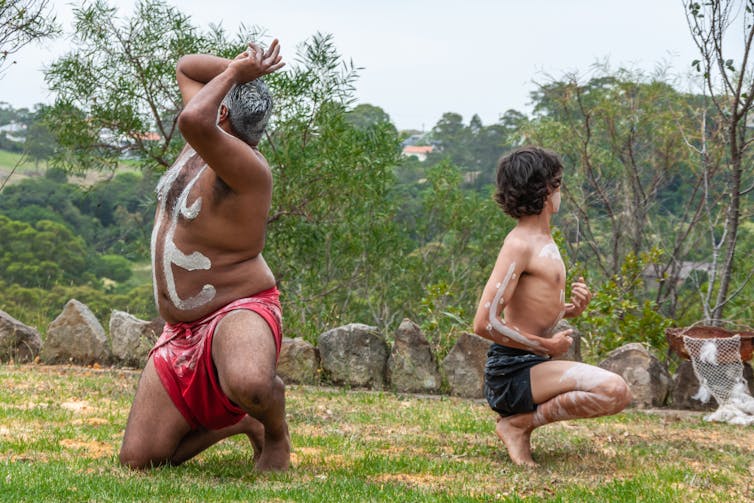 The continuation of cultural knowledge, expression, and strong kinship systems needs to be a priority with Closing the Gap targets.
Claudine Van Massenhove/ Shutterstock
The continuation of cultural knowledge, expression, and strong kinship systems needs to be a priority with Closing the Gap targets.
Claudine Van Massenhove/ Shutterstock
Exploring new ways to track progress
The dashboard is a positive step, but just reporting on the 17 targets alone cannot deliver the change we need.
It is imperative we track progress on the four priority reform areas in the national agreement. They are:
sharing decision-making through formal partnership arrangements with Aboriginal and Torres Strait Islander organisations
building the Aboriginal and Torres Strait Islander community-controlled sector
improving mainstream institutions and government organisations
sharing access to data and increasing the amount of Aboriginal and Torres Strait Islander-led data.
These reforms provide momentum for a critical shift in the current approach to data reporting and most significantly, the way all governments and mainstream organisations work with us.
Addressing racism in these reforms
According to the dashboard, data to address the indicators for each priority reform is currently under development.
For example, in the third priority reform area is a target to decrease the proportion of Aboriginal and Torres Strait Islander people who have experiences of racism.
Data will include the numbers of Aboriginal and Torres Strait Islander people “reporting experiences of racism” and those who feel “culturally safe in dealing with government, mainstream institutions and agencies”. However, this data is yet to be collected by governments, let alone reported on.
And significant work remains to be done across government institutions and agencies to ensure they better understand what racism is and implement strategies to prevent racism from occurring.
Why stories and truth-telling also matter
A recommendation from the 2021 Close the Gap report was to invest in local Aboriginal and Torres Strait Islander data development and infrastructure to help communities collect better data and control what is done with it.
For the database to fully play the critical role intended, Aboriginal and Torres Strait Islander peoples need to have access to and control of the data that it draws on, particularly at the local community level.
For us, data are not simply numbers. This data represents our story as peoples, so the numbers need to be humanised and embodied through both story-telling and truth-telling.
Read more: First Nations families need support to stay together, before we create another Stolen Generation
We can look to the work of Mabu Liyan by the Yawuru people who stepped away from a Western-centric view of health and, with their communities, defined what wellbeing and a good life mean to them.
This is an excellent example of communities filling gaps in the data and collecting information that is important to them, an approach that needs to become the rule rather than the exception.
The Productivity Commission’s database is a great step forward and we eagerly await further developments, knowing they will have a stronger focus on Aboriginal and Torres Strait Islander language and narratives to assist in interpreting the data.
However, the database still relies on data from a Western-centric world view, and we are yet to see details from governments about how they plan to meet both the targets and reforms in the national agreement.
A comprehensive way to access data on Closing the Gap progress is helpful, but human commitment and transparency is what will achieve change. This work requires nationally reported planning, a commitment to monitoring and evaluation, and mechanisms for gathering data on actions taken and outcomes achieved.
Better data, including data owned by communities themselves, and better ways of working with us are the missing pieces of the puzzle. They need to be fully embraced and implemented if we are to truly have “a game changer”.
Authors: Janine Mohamed, Distinguished Fellow, George Institute for Global Health


















