

Rapid antigen testing isn't perfect. But it could be a useful part of Australia's COVID response
- Written by: Deborah Williamson, Professor of Microbiology, The Peter Doherty Institute for Infection and Immunity
Since the start of the pandemic, COVID-19 testing in Australia has been performed using highly sensitive PCR (polymerase chain reaction) tests.
But this conventional model of testing, which involves swabbing by a health-care professional and transporting samples to a laboratory for analysis, has important bottlenecks. Recent reports indicate people have been waiting several hours just to have a swab taken.
With the current COVID outbreaks in Australia, there’s been a renewed focus on alternative testing methods to PCR — in particular rapid antigen testing.
New South Wales this week announced it would begin using rapid antigen tests in schools to allow year 12 students to return to the classroom safely, as well as in essential workplaces.
So what are rapid antigen tests, are they effective, and what role should they play in Australia’s response to COVID-19?
What are antigen tests?
Antigen tests detect protein on the surface of SARS-CoV-2 (the virus that causes COVID-19) directly from a sample taken with a swab inserted into the nose.
Because antigen tests do not amplify parts of the virus’ genetic code, they are less sensitive than PCR tests.
The main advantages of antigen tests over PCR tests include their lower cost and their speed. Most antigen tests are designed to be used at the point of care, with results available in about 15 minutes. They cost roughly A$5 to A$20 per test.
Read more: Why do some COVID-19 tests come back with a 'weak positive', and why does it matter?
How effective are they?
In countries such as the United Kingdom and United States, antigen tests have been used widely to complement PCR testing during the pandemic.
So far, the strongest published evidence to support the use of antigen tests is in symptomatic people within the first few days of their symptoms starting, when the amount of virus in nasal secretions is highest.
In other words, antigen tests are most accurate when the viral load is highest and when a person is likely to be most infectious. If an antigen test is taken either too early or too late in the course of infection, it may not detect the virus.
There are conflicting data on the performance of antigen tests in people without symptoms. A Cochrane review looking at results across several studies found the sensitivity of antigen tests (the likelihood of a positive result if someone is infected with the virus) was between 40% and 74% in people without symptoms. So a fair proportion of people tested may receive a negative test when they really have the virus.
With this in mind, compared to a “one-off” antigen test, repeated antigen testing (for example, daily) may improve the detection of virus, particularly in people who don’t have symptoms, or when there’s a low level of disease in the community.
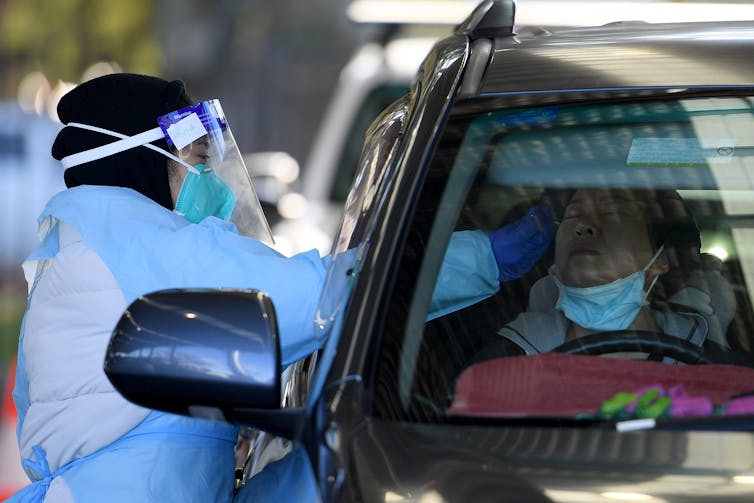 Traditional PCR testing is vulnerable to delays.
Dan Himbrechts/AAP
Traditional PCR testing is vulnerable to delays.
Dan Himbrechts/AAP
Importantly, “real-world” overseas studies looking at antigen testing have varied widely in the types of tests it was compared with, the populations tested, and how much disease was circulating in the community at the time of the study.
This means it’s very hard to extrapolate information from overseas directly to Australia.
We need to trial rapid antigen testing in Australia to get reliable local information
The Therapeutics Goods Administration has so far approved 20 rapid antigen tests for use in Australia.
But antigen tests can only be supplied to accredited laboratories, medical practitioners, health-care professionals working in residential and aged-care facilities, or health departments. The commercial supply of COVID-19 antigen kits for self-testing at home is prohibited.
One way we could properly evaluate the use of antigen tests in Australia is through a series of clinical trials.
These could include trials of returning travellers undertaking daily self-testing in home quarantine, or repeated testing of groups of workers in potentially high-risk workplaces (for example, food distribution centres, construction sites or aged care).
Read more: The positives and negatives of mass testing for coronavirus
Lessons from HIV
A precedent for community-based self-testing for an infectious disease in Australia is HIV. There were initially concerns the antibody test used for home HIV testing was not sensitive enough, and not as good as the gold standard laboratory test. There were also concerns people wouldn’t know how to deal with a positive test.
But the implementation of HIV self-testing over the past couple of years has been broadly successful. Education campaigns help people understand the limitations of the test, while there are effective processes in place to support people who return a positive result.
Although COVID-19 and HIV are very different diseases, the HIV experience offers useful lessons on how to implement home testing for a high-impact disease in a low-prevalence setting, while ensuring testing is accessible and convenient for all, including marginalised groups.
 Other countries have been using rapid antigen tests as part of their COVID response.
Shutterstock
Other countries have been using rapid antigen tests as part of their COVID response.
Shutterstock
It’s not perfect, but it could be useful
One fundamental proviso for the use of widespread antigen testing is that we have to be prepared to accept a degree of risk. We know these tests are less sensitive than the current diagnostic “gold standard”, meaning it’s almost certain they will miss some cases of COVID-19.
PCR testing undoubtedly underpins our high-quality laboratory response to COVID-19 in Australia. But our capacity to sustain PCR testing at the level we will eventually need for communities to function normally and for international borders to reopen is uncertain.
We urgently need pragmatic real-world trials of new testing strategies to help us understand how best to return to a “COVID-normal” life.
Read more: Why are some COVID test results false positives, and how common are they?
Authors: Deborah Williamson, Professor of Microbiology, The Peter Doherty Institute for Infection and Immunity


















