

National Cabinet's plan out of COVID aims too low on vaccinations and leaves crucial questions unanswered
- Written by: Danielle Wood, Chief executive officer, Grattan Institute
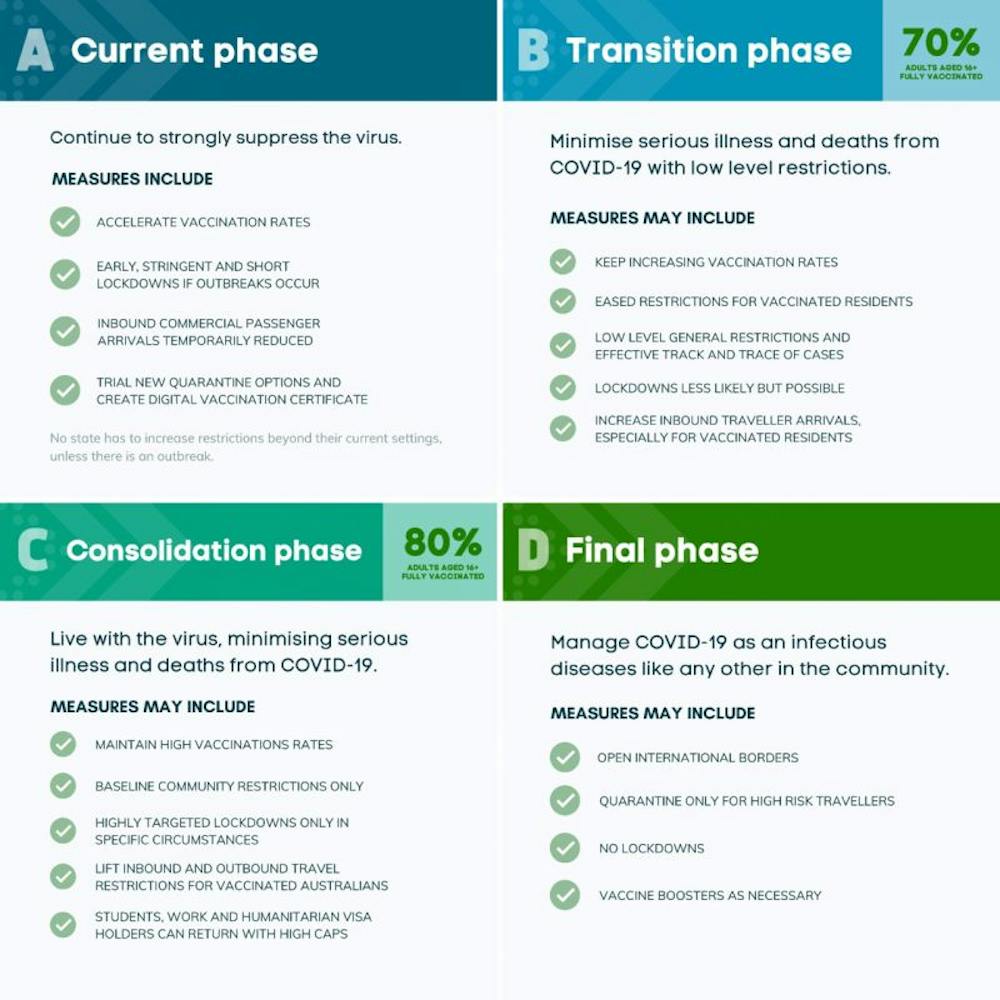
At Friday’s National Cabinet meeting, our nation’s leaders put some meat on the bones of their 4-stage plan to reopen Australia.
The plan includes target vaccination thresholds and some details on restrictions that might be lifted at each stage. So far so good.
Read more: Vaccination rate needs to hit 70% to trigger easing of restrictions
But the plan raises two major concerns.
First, the reopening threshold is low. We won’t know until we see the modelling, but it looks like the National Cabinet is taking a gamble that the outcomes of re-opening will be at the more rosy end of plausible scenarios.
Second, many important details are still missing, including the timing of each stage and, crucially, the steps the government is taking to get more jabs in arms.
The vaccine coverage thresholds for re-opening look low
The key stage of the plan is stage C. In stage C, the government commits to no more mass lockdowns, and vaccinated Australians can leave the country and return without quarantine.
 ScreenShot from Scott Morrison's LinkedIn page
The government says we need 80% of Australians over 16 vaccinated before we get to stage C.
The over-16 qualifier matters a lot. The virus doesn’t care who is eligible. Children can still transmit the virus and so transmissibility depends on vaccine rates across the population.
Getting to 80% of Australians over 16 I equates to just under 65% of all Australians – far lower than the 80% threshold Grattan Institute recommends for starting to re-open international borders.
Read more:
Is it more infectious? Is it spreading in schools? This is what we know about the Delta variant and kids
The Doherty Institute modelling that informed the plan has not been released. The institute likely presented a range of scenarios. The Australian public have a right to understand the health outcomes in each and the way in which National Cabinet weighed the uncertainty in the modelling.
Committing to a vaccine coverage threshold that is too low risks a rapid surge in COVID cases that could overwhelm our hospitals and impose a high death toll. State governments would almost certainly impose lockdowns to contain this type of spread, pushing “real” reopening further back.
Coverage too low to loosen restrictions for the vaccinated
The steps discussed in stage B also contribute to a greater risk of a disorderly re-opening. Stage B envisages loosening some quarantine requirements and public health restrictions for vaccinated residents.
The main concern is that stage B kicks in at 70% of the eligible population (56% of the total population).
Under almost any scenario, the reproduction number for the Delta strain of the virus is still well above 1 at this point. That means each infected person on average infects more than one other person.
Relaxing international arrival and quarantine restrictions for vaccinated adults – who can still transmit the virus (albeit less so than the unvaccinated) – means more Delta will get in. And allowing exemptions from public health measures for vaccinated residents means the measures to contain the spread of the virus will be less effective.
Read more:
Yes, you can still get COVID after being vaccinated, but you're unlikely to get as sick
With only 56% of the population vaccinated, any uncontrolled spread will translate into high rates of serious illness and hospitalisation.
Our governments will be walking a very fine line indeed.
No details on ramping up the vaccine program
The other major concern is the lack of detail about how the National Cabinet plans to ramp up the vaccine program, and timeframes for doing so.
The most concerning line of the prime minister’s Friday evening press conference was “it is all up to us” – suggesting success is largely out of the government’s hands.
Getting enough jabs into arms as quickly as humanly possible is a job for government. We need a step change in the planning and professionalism of the rollout if we are going to have any hope of making these targets in a reasonable timeframe.
Grattan’s Race to 80 report, released last week, set out the necessary steps.
On logistics, it means delivering vaccines not just through GPs but via state-run mass vaccination hubs, pharmacists, schools, workplaces, and through pop-up clinics at community halls, public transport stations, and sporting events.
On messaging, it means high-quality national campaigns but also more targeted messaging for hesitant and harder-to-reach groups, including women, young people, and those from culturally and linguistically diverse communities.
Read more:
Diverse spokespeople and humour: how the government's next ad campaign could boost COVID vaccine uptake
It looks like National Cabinet has not yet considered the crucial question of whether we need vaccine passports in high-risk settings such as restaurants and major events, to encourage people to get the vaccine and to reduce the risks of superspreading events.
And there is no plan to vaccinate children, even though Australia’s regulator, the Therapeutic Goods Administration (TGA), has already approved Pfizer for 12-to-16 year olds.
More to do
Australia can’t afford much more delay. The key planks of the logistics, messaging, and incentive campaigns need to be in place very soon if we are going to substantially increase the pace of the rollout as more Pfizer doses arrive in coming months.
At the same time, governments should release the Doherty modelling to help Australians understand the expected health outcomes under each of the four stages.
Vaccinations are the route back to normal life. This means all Australians have a stake in making sure our governments get this plan right.
Read more:
Vaccine Rollout 2.0: Australia needs to do 3 things differently
ScreenShot from Scott Morrison's LinkedIn page
The government says we need 80% of Australians over 16 vaccinated before we get to stage C.
The over-16 qualifier matters a lot. The virus doesn’t care who is eligible. Children can still transmit the virus and so transmissibility depends on vaccine rates across the population.
Getting to 80% of Australians over 16 I equates to just under 65% of all Australians – far lower than the 80% threshold Grattan Institute recommends for starting to re-open international borders.
Read more:
Is it more infectious? Is it spreading in schools? This is what we know about the Delta variant and kids
The Doherty Institute modelling that informed the plan has not been released. The institute likely presented a range of scenarios. The Australian public have a right to understand the health outcomes in each and the way in which National Cabinet weighed the uncertainty in the modelling.
Committing to a vaccine coverage threshold that is too low risks a rapid surge in COVID cases that could overwhelm our hospitals and impose a high death toll. State governments would almost certainly impose lockdowns to contain this type of spread, pushing “real” reopening further back.
Coverage too low to loosen restrictions for the vaccinated
The steps discussed in stage B also contribute to a greater risk of a disorderly re-opening. Stage B envisages loosening some quarantine requirements and public health restrictions for vaccinated residents.
The main concern is that stage B kicks in at 70% of the eligible population (56% of the total population).
Under almost any scenario, the reproduction number for the Delta strain of the virus is still well above 1 at this point. That means each infected person on average infects more than one other person.
Relaxing international arrival and quarantine restrictions for vaccinated adults – who can still transmit the virus (albeit less so than the unvaccinated) – means more Delta will get in. And allowing exemptions from public health measures for vaccinated residents means the measures to contain the spread of the virus will be less effective.
Read more:
Yes, you can still get COVID after being vaccinated, but you're unlikely to get as sick
With only 56% of the population vaccinated, any uncontrolled spread will translate into high rates of serious illness and hospitalisation.
Our governments will be walking a very fine line indeed.
No details on ramping up the vaccine program
The other major concern is the lack of detail about how the National Cabinet plans to ramp up the vaccine program, and timeframes for doing so.
The most concerning line of the prime minister’s Friday evening press conference was “it is all up to us” – suggesting success is largely out of the government’s hands.
Getting enough jabs into arms as quickly as humanly possible is a job for government. We need a step change in the planning and professionalism of the rollout if we are going to have any hope of making these targets in a reasonable timeframe.
Grattan’s Race to 80 report, released last week, set out the necessary steps.
On logistics, it means delivering vaccines not just through GPs but via state-run mass vaccination hubs, pharmacists, schools, workplaces, and through pop-up clinics at community halls, public transport stations, and sporting events.
On messaging, it means high-quality national campaigns but also more targeted messaging for hesitant and harder-to-reach groups, including women, young people, and those from culturally and linguistically diverse communities.
Read more:
Diverse spokespeople and humour: how the government's next ad campaign could boost COVID vaccine uptake
It looks like National Cabinet has not yet considered the crucial question of whether we need vaccine passports in high-risk settings such as restaurants and major events, to encourage people to get the vaccine and to reduce the risks of superspreading events.
And there is no plan to vaccinate children, even though Australia’s regulator, the Therapeutic Goods Administration (TGA), has already approved Pfizer for 12-to-16 year olds.
More to do
Australia can’t afford much more delay. The key planks of the logistics, messaging, and incentive campaigns need to be in place very soon if we are going to substantially increase the pace of the rollout as more Pfizer doses arrive in coming months.
At the same time, governments should release the Doherty modelling to help Australians understand the expected health outcomes under each of the four stages.
Vaccinations are the route back to normal life. This means all Australians have a stake in making sure our governments get this plan right.
Read more:
Vaccine Rollout 2.0: Australia needs to do 3 things differently
Authors: Danielle Wood, Chief executive officer, Grattan Institute


















