

Muscles are important, but stiff tendons are the secret ingredient for high-speed performance
- Written by: Anthony Blazevich, Professor of Biomechanics, Edith Cowan University
The fastest sprinter is the world right now is Lamont Marcell Jacobs, who won Olympic gold in the men’s 100-metre sprint with a time of 9.80 seconds. You might be surprised to learn that most of the explosive power displayed by Jacobs and other elite athletes doesn’t come from their muscles, or even from their minds – it comes from somewhere else.
Muscles are important, but the real secret is using training and technique to store and reuse elastic energy in the best way possible – and that means making the most of your tendons. By understanding how this power is produced, we can help people walk, run and jump into older age and how to walk again after injury or illness.
Muscles are remarkably powerful. The average human calf muscle weighs less than 1 kilogram, but can lift a load of 500kg. In some cases, our calf muscles have even been shown to handle loads approaching a tonne (1,000kg)!
But muscles have a major performance issue: they can’t produce much force when they’re shortening at high speed. In fact, when we move at our fastest, muscles can’t theoretically shorten fast enough to help us at all - so how is it that we can move so quickly?
Muscles are strong, but slow
Muscles produce most of their force through the interactions of two proteins: actin and myosin. The rotating, globular “head” region of the long myosin filament attaches to the rod-like actin to pull it along in a sweeping motion, like an oar producing force to pull a boat along the water. So actin and myosin filaments form powerful mini motors.
Trillions of these mini motors together the large forces we need every day to walk upstairs, carry our shopping bags, or take the lid off a jar.
Trillions of actin and myosin proteins work together to make your muscles contract and your body move.The head region of myosin is only 20 nanometres long. It’s so small that there’s no point comparing its size to a human hair, because it would barely even cross a handful of DNA molecules laid side by side.
Because it’s so short and only pulls actin a small distance in each stroke, a large number of strokes are needed to shorten a muscle by any distance. It’s like using first gear to get up a hill in a car or on a bike – good for force, but not for speed.
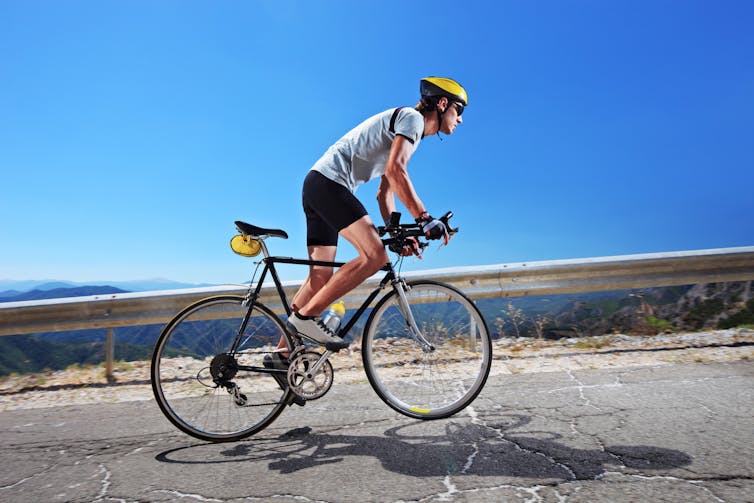 At the molecular level, your muscles are a bit like first gear on a bike: great for force, not so good for speed.
Ljupco Smokovski / Shutterstock
At the molecular level, your muscles are a bit like first gear on a bike: great for force, not so good for speed.
Ljupco Smokovski / Shutterstock
And the faster the muscle shortens, the less time each myosin is attached to actin, which reduces force even further. At a certain shortening speed, muscles can’t produce any force at all.
We can measure the power athletes produce during running and jumping, and we can estimate the power a muscle should produce by its size and the type of fibres it contains. When we compare these two values, we find that muscles can’t even produce half the power generated in sprinting or vertical jumping. And in overarm throwing, muscles can produce only 15% of the total power.
Read more: Health Check: why do my muscles ache the day after exercise?
Energy return systems
So if the muscles aren’t producing the power to move a body at high speed, where is it coming from? Humans, like most other animals on Earth, make use of an “energy return system”: something that can store energy and release it rapidly when needed.
Our energy return systems are made of a relatively long, stretchy tendon attached to a strong muscle. When the muscle produces force it stretches the tendon, storing elastic energy. The subsequent recoil of the tendon then generates a power far superior to our muscles. Our tendons are power amplifiers.
Tendons store energy when they stretch and quickly release it when they contract again.There are several techniques we can use to increase energy storage. The most important is to first move in the opposite direction to the desired movement (a “countermovement”) so the muscle force is already high when the proper movement begins. Most of us learn this strategy when we’re young, when we first dip down before we jump upwards, or we draw our bat or racquet backwards before swinging it forwards.
The technique we use is key to maximising our elastic potential, and Olympic athletes spend years trying to optimise it.
Tendons that are stiffer or stretched further will store more energy and then recoil with greater power. During running, the greatest power is produced at the ankle joint, so it makes sense that sprint runners and the best endurance runners have stiffer Achilles’ tendons than us mere mortals.
They also have the muscle strength to stretch them. We haven’t yet accurately measured the stiffness of shoulder tendons in athletes, but we might assume they are built similarly.
Can we improve our energy return system?
The capacity to store and release elastic energy is partly determined by genetics, but it’s also something we can improve through training. Not only can training improve your technique, heavy strength training and other methods can also make your tendons stiffer.
As we develop from childhood to adulthood, we learn to make better use of elastic energy to produce more power and use it more efficiently. As we age further, our tendon stiffness and power output decrease, and it costs us more energy to move.
People with less stiffness in their Achilles’ tendon (and the accompanying lower strength in the calf muscles) have slower walking speeds. As walking speed is strongly associated with mortality and morbidity in the elderly, maintaining tendon stiffness may be important to our health and longevity.
Read more: Health Check: in terms of exercise, is walking enough?
The greatest power during walking, running and jumping is produced at the ankle joint. This is an important target for athletes, but also for anyone who wants to maintain their walking capacity as they age.
Good ways to keep your ankle muscles conditioned include calf raises on a step, squat to calf raise exercises, and walking up and down hills whenever you get the chance.
If you feel game, you might even join a gym and enjoy the numerous ways to strengthen your calf and Achilles’ tendon, and lots of other muscles too.
Authors: Anthony Blazevich, Professor of Biomechanics, Edith Cowan University


















