

how a fringe group of Christians hijacks faith in a war against science
- Written by Robyn J. Whitaker, Senior Lecturer in New Testament, Pilgrim Theological College, University of Divinity
“The blood of Jesus is my vaccine” read one of the signs at a recent protest against lockdown regulations in Sydney. While our tendency might be to roll our eyes at such ridiculous anti-science views, these sentiments have a long and complicated history in the Christian tradition.
On social media platforms, a small number of Christians are offering a pastiche of biblical symbols to link the idea of Jesus’s blood and protection. In one video, a man claims we know the blood of Jesus will protect Christians in the 21st century from COVID because the blood of the Passover lamb protected the Israelites in Egypt (Exodus 12). As an analogy, it is a stretch.
Kolina Koltai, a vaccine misinformation researcher with the University of Washington’s Center for an Informed Public, points out that appealing to people’s beliefs and values in spreading vaccine misinformation is particularly potent. Such views can be extremely hard to combat, because doing so is perceived as an attack on someone’s core beliefs.
While for some, Jesus’s “blood” is spiritually invoked through prayer, other misinformation links the protective power of Jesus more explicitly to taking communion (or the Eucharist). Taking communion daily, such people claim, prevents you from getting sick from COVID.
Communion is a Christian ritual in which token amounts of bread and wine are consumed to recall Jesus’s last meal with his disciples before dying on a cross. While different Christian traditions hold a variety of theological views, at the heart of communion is the idea that bread and wine are ritually shared as a way to spiritually connect, to have “communion”, with Jesus and with one another. The bread symbolises Jesus’s body and the wine his blood. Drinking communion wine then is drinking the blood that saves, according to these fringe views.
Melbourne Anglican priest Peter French told me that, in the past year, he has had to refuse requests from people who want to buy communion bread and wine from his church in the belief that taking it daily will prevent them from contracting COVID. Anglicans, we should note, do not teach that communion will protect you from sickness and the Archbishop of Canterbury has urged people to be vaccinated.
Read more: God, plagues and pestilence – what history can teach us about living through a pandemic
The association of the Eucharist and healing were around long before COVID. In 2013, Pope Francis addressed exactly this issue in a sermon stating the Eucharist is not a “magic rite”, but a way to encounter Jesus.
Where does this association of communion and healing come from? Nowhere explicitly, yet the Christian tradition has a long association of communion and health metaphors.
In the second century, Bishop Ignatius wrote the Eucharist is the “medicine of immortality” and the “antidote” to death. Ignatius’s “medicine” is one that brings eternal life rather than freedom from physical suffering.
In the third century, Bishop Cyprian claimed the blood of Jesus has pharmacological benefits, being “health-giving” and superior to the benefits of ordinary wine. The medicinal effects of wine were widely known in antiquity, often being a safer drink than water. But here we have Christians claiming something more for the wine that represents Jesus’s blood, even if their claim is still primarily a spiritual one.
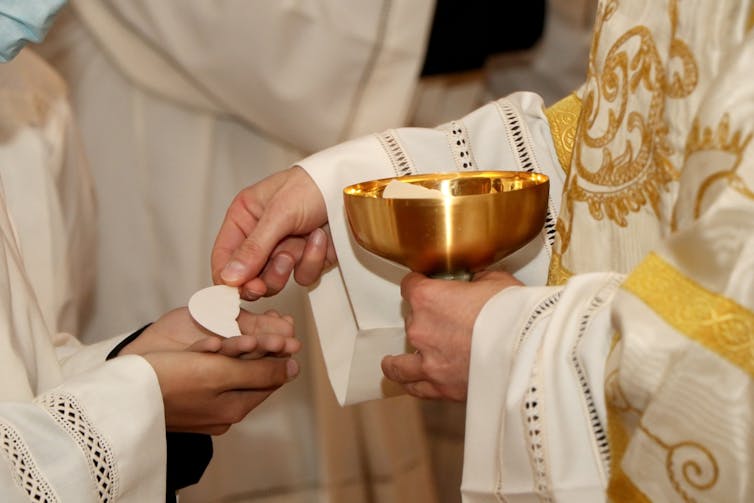 In the Christian churches, taking communion is a way to be closer to Jesus, not a magical cure for COVID.
Shutterstock
In the Christian churches, taking communion is a way to be closer to Jesus, not a magical cure for COVID.
Shutterstock
Andrew McGowan, professor at Yale Divinity School, has written extensively on the history of the Eucharist. He says:
The Eucharist is always an enacted sign of the love and regard for community shown by Jesus, not a talisman for personal gain or benefit.
In this sense, it is only like the vaccine in that it exists for the good of the whole community, not ourselves as individuals.
McGowan notes there are more early Christians stories indicating that wrongly taking the Eucharist could do you harm than there are ones suggesting communion will bring healing. In several post-biblical apocryphal sources, bread and wine are shared after a healing miracle as a means of thanksgiving and confirming faith, but it does not bring physical healing.
Similarly today, communion is regularly administered to the sick or dying. It serves as a reminder of Jesus’s salvific action to people of faith, not as a magic pill or healing potion.
Indeed, traditional Christian churches usually anoint the sick with oil for healing or have other prayers for healing that do not involve communion. However, one can see how superstitious ideas developed linking recovery from illness to the body and blood of Jesus. To do so is to conflate spiritual well-being and physical health. While spiritual health can correlate with other forms of health (mental, physical), it is not the same thing.
Read more: Pray, but stay away: holding on to faith in the time of coronavirus
The vast majority of religious leaders are urging people to be vaccinated. No serious Christian teaches that taking communion will magically protect a person against illness.
Yet, the line between taking the Eucharist (the blood of Jesus) for spiritual wholeness and taking it as a magical potion that will protect one physically remains thin enough to be abused by irresponsible people touting conspiracy theories.
To do so is preying on the vulnerable, a most anti-Christian activity in the guise of religion.
Authors: Robyn J. Whitaker, Senior Lecturer in New Testament, Pilgrim Theological College, University of Divinity

















