

Bed rest in hospital can be bad for you. Here's what nurses say would help get patients moving
- Written by Danny Hills, Associate Professor, Deputy Dean, Federation University Australia
If you or a loved one is unlucky enough to be in hospital, you might think the best thing to do is rest in bed as much as possible. But while rest is important, lying or sitting in bed too much can actually make many conditions worse.
Researchers have developed mobility recommendations for some hospital settings but in practice, most patients still aren’t active enough.
To find out more, we asked 138 nurses from five Australian states about the challenges they face trying to to get patients moving more, and what changes would help. We also did some in-depth interviews with a sample of nurses involved in the study.
Our results, published in the Journal of Clinical Nursing, showed there is much we can do. Managers and team leaders have an important role in empowering nurses because our study found nurses do not always feel able to reduce sedentary behaviour in their patients.
The dangers of sedentary behaviour in hospital
Lying or sitting too much while in hospital can lead to deconditioning (such as loss of strength, joint function and mobility), pressure injuries, blood clots, infections, prolonged hospital stays and unplanned hospital re-admissions.
In rehabilitation settings, where a person is recovering from conditions such as stroke, amputation or arthritis, older adults spend as little as 5% of the day upright.
In acute settings — where a patient in hospital may require surgery or treatments to repair a fracture, remove a tumour or relieve nerve pain — it can be much worse. Older adults spend a median of just 3% of their day standing or walking.
These are staggering figures but the good news is even small increases in activity and movement can help prevent the rapid loss of muscle mass and strength that comes from lying down or sitting too long in hospital.
Our study found nurses have a key role in supporting patients’ mobility and in reducing their sedentary behaviour.
 Nurses in this study told us that workload and lack of time were significant barriers to encouraging reduced sedentary behaviour.
Shutterstock
Nurses in this study told us that workload and lack of time were significant barriers to encouraging reduced sedentary behaviour.
Shutterstock
What are the barriers?
Perhaps unsurprisingly, nurses in this study told us workload and lack of time to encourage reduced sedentary behaviour were significant barriers.
However, they also told us there was a perception among family and sometimes patients themselves that they needed to rest and that older people had earned the right to sit back and relax.
This was especially the case when people were unwell or had complex needs. As one nurse said:
For example, ‘Dad’s in his 80s, does he need to do this?’ It is a common mindset of the family of an older person.
So how much exercise should you get while in hospital? There’s no “one size fits all” answer. For some patients, it might just mean getting out of bed and walking to the bathroom, getting dressed or moving around a room. For others, it might mean walking around hospital hallways or doing more specialised movement programs such as My Therapy.
What would help?
Nurses told us that help from family in getting patients up and moving would be a huge bonus.
Families can also help by providing really comfortable shoes and clothing. We know patients are less likely to participate if they are not comfortable.
Another said:
We involved family members at mealtimes [by walking to] the lounge and it has improved nutritional intake by bringing in [special] food and contributing to the social aspects. One brought Italian food and they loved it.
Some patients, however, have only family members or visitors who are, themselves, older and unable to assist the patient with walking. Or, a patient may have no visitors at all.
Working closely with other members of the care team yields results, with one saying:
Going to a team meeting is good […] they say to the patient, this is what we are aiming for, do you agree that you will sit up for lunch every day […] it’s a team effort.
Another told us:
I like to read the physio notes every day and then just have an idea what their actual functional goals and actual functional levels are like. Encouraging people to achieve those tiny little goals like ‘oh, we walked to the toilet’, ‘oh, we brushed our teeth at the sink’.
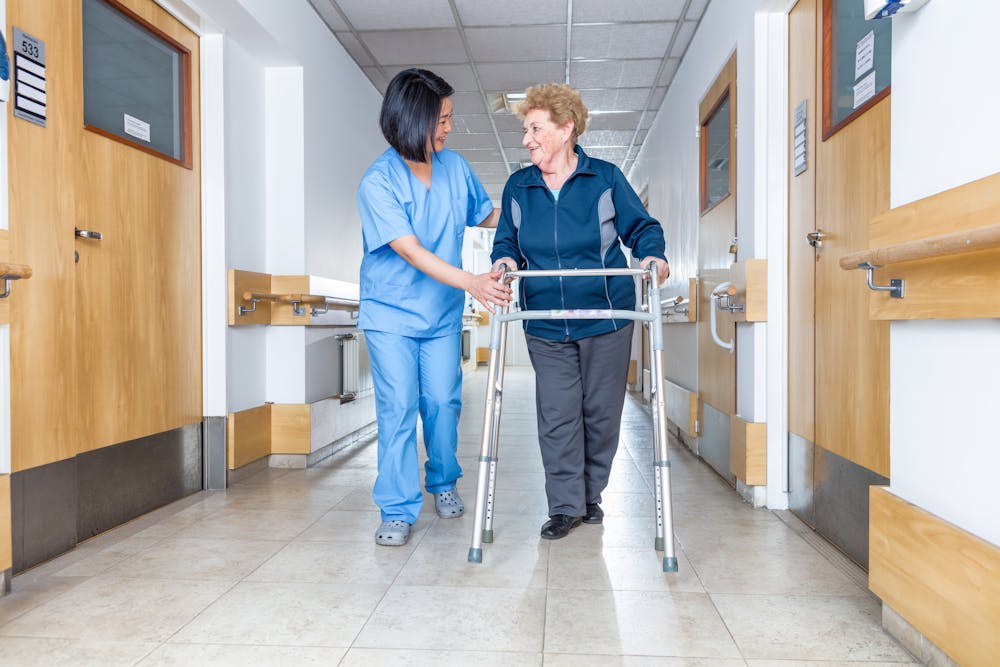 Nurses told us that help from family in getting patients up and moving would be a huge bonus.
Shutterstock
Nurses told us that help from family in getting patients up and moving would be a huge bonus.
Shutterstock
One nurse spoke of the value of interventions aimed at getting patients more active, such as the UK’s End PJ Paralysis program.
[…] although not very well promoted, [it] was a great help. Many resources went into it. With our model of care, there was a social aspect that was a great success, they started friendship groups, lots of activities, we had the Melbourne Cup down in the lounge, and they watched the tennis together. It’s been so positive. We used to really encourage them to go just once, now they want to go all the time. But some nurses still need to learn it’s not about wheeling people down there.
In other words, it’s about walking, not wheeling.
A nurse leader said:
It’s staggering how much time they [patients] spend alone. There’s a potential connection here. Isolation and boredom is one thing. If we tackle the boredom, we tackle the sedentary behaviour, there is a link, and we will solve the social isolation. Enabling nurses to be the coach for getting people up, and there’s definitely an educational aspect.
Creative and sustainable solutions
Our study shows that reducing sedentary behaviour in hospitals is often complex and there are important roles for nurse leaders and organisations in working together on creative and sustainable solutions.
As influential British doctor, Richard Asher, put it in his oft-quoted poem about the danger of sedentary behaviour in hospitals:
Teach us to live that we may dread;
unnecessary time in bed.
Get people up and we may save;
patients from an early grave.
Read more: Sitting for too long could increase your risk of dying – even if you exercise
Authors: Danny Hills, Associate Professor, Deputy Dean, Federation University Australia

















