

'How high above sea level am I?' If you've googled this, you're likely asking the wrong question — an expert explains
- Written by Shayne McGregor, Associate professor, Monash University
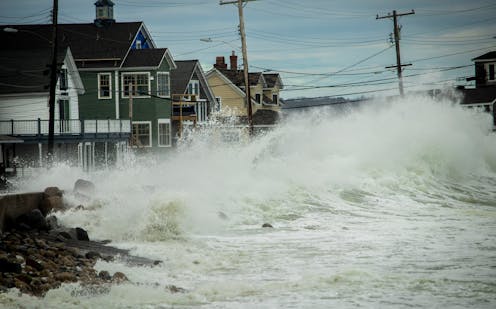
The latest report from the United Nations Intergovernmental Panel on Climate Change is confronting. It finds global mean sea levels rose by about 20 centimetres between 1901 and 2018. In fact, sea levels have risen faster over the last hundred years than any time in the last 3,000 years.
This acceleration is expected to continue. A further 15-25cm of sea level rise is expected by 2050, with little sensitivity to greenhouse gas emissions between now and then. Beyond 2050, however, the amount of sea level rise will largely depend on our future emissions.
In a low-emissions scenario, we can expect sea levels to rise to about 38cm above the 1995–2014 average by the year 2100. In a high-emissions scenario this is expected to more than double to 77cm.
In either case, who will feel the effects of sea level rise? And how much does your location’s height above sea level really matter? It’s a question a lot of you have been googling since the report’s release. But the answer isn’t straightforward.
Sea level rise isn’t uniform
Since satellites began measuring sea surface height almost three decades ago we have learned sea level rise is not uniform across the globe.
The map on the left in this video shows daily sea level variations since 1993, while the curve on the right shows the month-by-month global mean sea level.In fact, sea levels can vary quite substantially on a year-to-year and decade-to-decade basis. However, we know much of this regional variability is driven by surface wind changes — and will typically decrease over long periods.
So while the IPCC report’s projections are for global mean sea level for the year 2100, most coastal locations will experience a sea level rise within 20% of the projections (which are subject to change beyond 2050 depending on global emissions).
Flood zones and drainage
Elevation above the high tide is an important factor in determining how at risk a particular location is of experiencing flooding due to sea level rise.
In low elevation coastal zones, physical distance to the coast and certain topographic features in the area such as sand dunes, wetlands and human built structures like levies and flood walls can act as a buffer to sea level rise.
That said, current and projected sea level rise may still pose a significant risk to regions with these buffers, as there are many ways by which sea level rise can lead to flooding.
For instance, as sea levels rise water from the sea can inundate storm water drainage systems and end up flooding inland regions with elevations below (or which will eventually be below) sea level. This is because drainage largely depends on gravity, and some storm water systems don’t have flood gates to stop water entering from the ocean.
Here we see Bobbin Head in NSW flood during a king tide. This problem will become more pronounced as sea levels rise and will require clever engineering solutions, such as drainage pumps to push water back out to sea.There are also cases where man-made features intended to help protect people from sea level impacts can be breached, resulting in flooding. One prominent example was the New Orleans flooding that occurred during Hurricane Katrina, when the man-made flood levee system suffered many failures
The tidal range around Australia varies from less than 1m in some parts such as southwest Australia, to more than 8m in other parts such as the northwest.
The tidal range in an area determines how quickly flooding impacts will increase as sea levels rise. If two regions have the same elevation, as the high tide rises past the regions’ elevation, the region with a smaller tidal range will likely struggle with more flooding and for longer than the region with a larger tidal range.
Beach erosion increases risk
Yet all of the above hasn’t considered the fact our beaches are naturally mobile systems which respond to change. This is why the relationship between an assets elevation above the high tide mark and risk of flooding is less straightforward at low elevation coastal zones — where 11% of Australia’s population lives.
When sea levels rise, the shape of the coastline changes with it and can move inland to a great extent. If sea levels rise by 1m, the coast can erode inland by 1km or more. This can potentially create risk for properties even if they are currently above the height of the projected sea level rise.
Australia has many retreating coastlines, often forming striking erosional landforms such as The Great Ocean Road region.
Read more: The world may lose half its sandy beaches by 2100. It’s not too late to save most of them
However, the response of the coastline can also be moderated by natural and human factors. In some regions, coastal elevation is actually increasing due to sediment being deposited, or tectonic uplift raising the coast as fast (or even faster) than rising sea levels.
In Australia, this is especially pronounced in estuaries with a riverine supply of sediments and where vegetation such as mangroves, saltmarshes and dune vegetation help collect sediment in their root systems.
We know sea level rise is with us for the long haul. And it’s now inevitable we will have to adapt to changes along our coasts. We’re already using a number of approaches to counteract projected sea level rise in Australia, including:
- sand renourishment of beaches
- the formation of more seagrass, saltmarsh and mangrove habitats
- construction of seawalls and other hard coastal protection measures.
But it’s important to note we still have a choice for how much and how quickly sea levels will rise beyond 2050. So perhaps, instead of googling your current elevation, a more pragmatic approach would be to think of what you can do to help protect your own coasts and reduce your carbon footprint.
Authors: Shayne McGregor, Associate professor, Monash University

















