

Why lotteries, doughnuts and beer aren't the right vaccination 'nudges'
- Written by Meg Elkins, Senior Lecturer with School of Economics, Finance and Marketing and Behavioural Business Lab Member, RMIT University
Money, doughnuts and beer. As high-tech and effective as our COVID vaccines are, getting enough people to take them to achieve herd immunity may come down to some very Homer Simpson-esque tools of persuasion.
Across the US, governments and private organisations are trying out carrots to lift flagging vaccination rates.
California, for example, has tried a US$116 million incentive program offering US$50 gift cards for every first vaccination and 10 prizes of US$1.5 million. On the other side of the country, New Yorkers have been offered US$100 as well as inducements such as the chance win a full university scholarship.
It’s a smörgåsbord for behavioural researchers to pick over, with lessons for nations such as Australia, which is now at the point of discussing incentive options. These include the federal Opposition’s proposal to pay the fully vaccinated A$300 and the Grattan Institute’s proposal for a national lottery giving away ten $1 million prizes a week for eight weeks from Melbourne Cup Day to Christmas.
But are these really the right approaches?
Data from the Melbourne Institute shows cash incentives of up $100 would only marginally increase vaccination rates. The researchers aren’t confident $300 will make that much difference.
And while economic research in the past strongly endorses lotteries as an incentive, there are questions about their effectiveness with COVID vaccination rates. An analysis of Ohio’s vaccination lottery, for example, found no evidence it was associated with increased rates of adult COVID-19 vaccinations.
While the researchers — from the Boston University School of Medicine — concede their study may be “underpowered”, they do make a strong point that more evidence is needed to support the “widespread and potentially costly adoption” of such incentives.
Read more: Our survey results show incentives aren't enough to reach a 80% vaccination rate
According to Joshua Liao, head of the Value & Systems Science Lab at the University of Washington:
Financial incentives can be pragmatic and effective, and good design may help reduce the potential problems with cash prizes. But we should be careful not to confuse short-term effectiveness (more vaccination now) with longer-term goals (greater engagement in vaccination into the future).
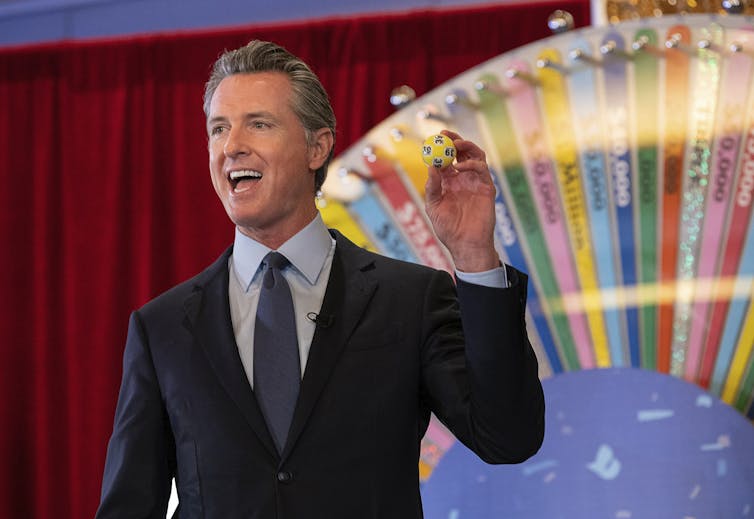 California governor Gavin Newsom at the California Lottery Headquarters draws numbers for the state’s US$16.5 million vaccine incentive program on June 4 2021. The goal was to lift vaccinations ahead of the planned June 15 end to almost all virus-related restrictions.
Paul Kitagaki Jr./The Sacramento Bee/AP
California governor Gavin Newsom at the California Lottery Headquarters draws numbers for the state’s US$16.5 million vaccine incentive program on June 4 2021. The goal was to lift vaccinations ahead of the planned June 15 end to almost all virus-related restrictions.
Paul Kitagaki Jr./The Sacramento Bee/AP
This warning would seem to apply doubly to vaccination inducements such as free doughnuts and free beer. There is a strong relationship between vaccine hesitancy and ideas of purity. As one study participant put it:
It’s about creating a good energy in your life, creating good energy with your relations, with your work and giving yourself good food which comes from the earth, not from a packet. All of those things contribute to health; it’s not just about vaccinating.
Given such views, the problem with gimmicks like doughnuts and beer should be evident.
Making it easy, attractive, social, timely
So what to do?
This seems the right time to turn to the four principles identified by the UK’s Behavioural Insights Team for shifting behaviour through “nudges”.
A nudge works differently to an incentive. In the words of nudge theory’s great popularisers, Richard Thaler and Cass Sunstein, a nudge is:
any aspect of the choice architecture that alters people’s behaviour in a predictable way without forbidding any options or significantly changing their economic incentives. To count as a mere nudge, the intervention must be easy and cheap to avoid. Nudges are not mandates. Putting fruit at eye level counts as a nudge. Banning junk food does not.“
The Behavioural Insights Team’s four principles, known the EAST framework, are fairly straightforward.
Make it easy. A common way to make a behaviour easy is to make it the default. Organ donor schemes that require opting out, for example, have dramatically higher participation rate than those requiring donors to opt in.
Make it attractive. An example is painting flies on urinals to improve males’ aim and reduce cleaning costs.
 The best behavioural nudges are easy, attractive, social and timely.
Marcel Derweduwen/Shutterstock
The best behavioural nudges are easy, attractive, social and timely.
Marcel Derweduwen/Shutterstock
Make is social. An example is the nudge hotels give you to reuse your towels, with a message along the lines of: "Most other guests staying at this hotel reuse towels.”
Make it timely. This involves prompting people when they are most receptive — such as when moving house to consider change their energy account, or at the beginning of the new year to join a gym.
The personal approach
How to apply these principles to the COVID vaccines? One possibility is demonstrated by a large experiment (involving more than 47,000 participants) showing simple messages could nudge people to get an influenza shot.
At the cost of two text messages to patients prior to their next doctor’s appointment, researchers found one message theme — letting the patient know a flu shot was “reserved” for them — increased vaccinations by 11% .
These type of personalised approaches won’t necessarily translate to COVID, of course. If someone believes a COVID vaccine is an experimental gene therapy that might change their DNA and render them sterile, there’s probably nothing that can be done to change their opposition.
But key to all nudges is recognising context matters. As the Behavioural Insights Team notes: “Something that works well in one area of policy might not work quite so well in another.”
We need more personalised approaches. Too much of our discussion about vaccine hesitancy has been imagining the problem in rational terms. But perceptions about COVID-19 and vaccines are driven by emotion, not reason. The more we factor that emotion in, the better our responses will be.
Authors: Meg Elkins, Senior Lecturer with School of Economics, Finance and Marketing and Behavioural Business Lab Member, RMIT University

















