

After its first suspected Delta variant community case, New Zealand goes into short, sharp nationwide lockdown
- Written by Michael Plank, Professor in Applied Mathematics, University of Canterbury
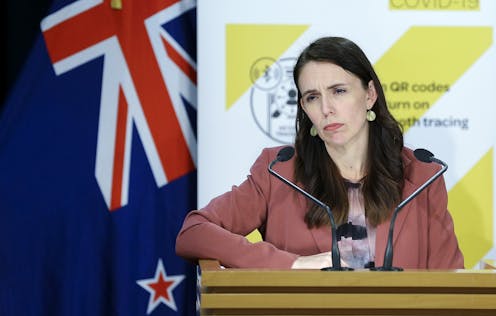
New Zealanders are back in their bubbles after Prime Minister Jacinda Ardern announced a three day alert level 4 lockdown for the entire country, and a seven day period for Auckland, following the confirmation of a community case — most likely infected with the Delta variant.
This is the first community case since February and it’s more than a year since the last country-wide lockdown.
The infected man was unvaccinated and is thought to have been infectious since Thursday. He travelled to the Coromandel for the weekend, and tracing is now underway to establish all close and casual contacts and the Ministry of Health has published locations of interest.
During the lockdown, schools and businesses will remain closed, people will have to stay at home, except for supermarket shopping, exercise in the neighbourhood and necessary medical treatment or testing.
We won’t know for sure it is the Delta variant until genome sequencing results come back, but 100% of COVID-19 cases in MIQ facilities over the past few weeks have been Delta infections, and it’s a safe bet this community case is too.
The government warned last week New Zealanders should expect a swift and sharp response if a case of the Delta variant was detected in the community, because it’s so infectious and can spread much more quickly. It may also cause more severe illness.
Moving the whole country to Alert Level 4 is definitely the right move and will give us the best chance of nipping this outbreak in the bud before it can get too large.
Delta is a game changer
We measure the spread of COVID-19 using the reproduction number (R number), which is the average number of people someone with the virus infects. If the R number is bigger than 1, the outbreak is growing and case numbers will climb. If it’s less than 1, the number of cases is on the way down.
After New Zealand went into alert level 4 in March 2020, our best estimate of the reproduction number was between 0.3 and 0.55. During Auckland’s alert level 3 lockdown last August, we estimated R was between 0.55 and 0.75. At the time this was great news — it meant that alert level 3 was enough to control outbreaks without the need for more restrictive rules.
Delta changed all that. We know from data overseas that this variant is about twice as transmissible as the strain of COVID-19 we were dealing with in 2020.
Read more: What are COVID-19 variants and how can you stay safe as they spread? A doctor answers 5 questions
This doesn’t necessarily mean Delta doubles the R number – it depends on the types of contact and the restrictions that are in place. But doubling the R number is a reasonable first approximation.
Unfortunately, this means it’s likely an alert level 3 lockdown would not be enough to contain a Delta outbreak.
Luck will play its part
Currently, about 18% of New Zealanders are fully vaccinated and another 14% have had their first dose. This will reduce the R number by perhaps 15-20% nationally. But that’s not enough to bring it below 1 at level 3.
These are all ballpark numbers and there are lots of assumptions and approximations involved. But altogether, it means alert level 3 would likely not be enough to control an outbreak once it has become established.
Alert level 4 should be enough if we all play our part. But if the R number is close to 1, case numbers could be slow to come down.
Read more: Is Delta defeating us? Here's why the variant makes contact tracing so much harder
There is a lot of luck involved in the early stages of an outbreak. What happens next will depend partly on whether we’ve had a superspreading event and whether the virus has been spreading in groups with high contact rates or low vaccine coverage.
We’ll get a lot more information from the contact tracing, genome sequencing and testing results over the next few days. If we are lucky, there will be a close link to the border with minimal exposure to the community. If this is the case, we could get away with just a handful of cases.
But if the virus has been spreading undetected for a significant period of time, there could easily be more than 100 people infected by now and a strict lockdown is our only available option.
New South Wales is a warning
Although the case lives in Auckland, the virus could be anywhere in the country. We know the infected man has travelled to the Coromandel region, and it’s likely he will have come into contact with people from other parts of New Zealand. The national alert level change buys us some time to see results of testing and contact tracing to assess how widely the outbreak has spread.
One thing we’ve learned from watching Sydney over the past two months is that half-measures can quickly lead to disaster. While we wait for more information, our best option is to go hard now and then relax later if it turns out we have avoided the worst.
If we wait until we know how many cases are out there are, there’s a risk things could get a whole lot worse. With Delta there are no second chances.
If we all play our part, there’s every reason to think this outbreak can eventually be crushed. How long that takes will depend on how many other people have been infected.
In the meantime, it’s time for the team of five million to come together once again to stay home and save lives — and tune in once again for Director-General of Health Ashley Bloomfield’s afternoon press conferences for the latest updates.
Authors: Michael Plank, Professor in Applied Mathematics, University of Canterbury

















