Like sightseeing in Paris – a new model for brain communication
- Written by: Caio Seguin, PhD candidate, University of Melbourne
Many of our most common, debilitating and socially expensive health problems involve our brains – such as dementia, depression and drug addiction.
We know that regions of our brain are constantly sending and receiving electrical signals through a vast network of nerve connections, and that this exchange of information is crucial for all aspects of brain function.
Read more: How injuries change our brain and how we can help it recover
Yet scientists don’t know how signals find their way through the complex maze of connections in order to go from one region of the brain to another.
In our recently published paper, we propose a communication model to explain how brain networks can be navigated to achieve efficient information transfer.
We’ll use an analogy to explain.
Find the Eiffel Tower
Imagine you are on vacation in Paris. You leave your hotel one morning hoping to walk to the Eiffel Tower. Two options to get there come to mind.
You could use your map of the city (or, more likely, your phone), and calculate the quickest, most direct route to get to your destination.
Alternatively, you might be adventurous and decide to try to find your own way to the Eiffel Tower without using a map. Assuming that you can see the famous tower in the distance, you could walk in the direction that seems to bring you closer to it, using this strategy to choose where to go each time you reach the intersection of two streets.
While this approach might be more exciting, it will probably take you longer to get to the tower. Also, it’s possible that you could get lost, and never get there at all.
The traditional models of brain network communication are akin to a tourist who walks around Paris with a map. They presume that signals travel along the quickest and most direct route between two brain regions, following directions given by a central map of all nerve interconnections.
Read more: Take it from me: neuroscience is advancing, but we're a long way off head transplants
This would certainly have advantages for us – quick routes mean faster and more reliable communication.
However, this idea has recently been questioned, because there is no evidence that such a map exists anywhere in the brain.
Our research shows that the brain can be navigated without a map, much like a tourist might find their way to the Eiffel Tower based only on landmarks and surroundings.
It turns out that brain networks are organised in a way that allows for a simple navigation strategy. To go from one starting region (that is, the hotel) to a destination region (the Eiffel Tower), signals can move along to the next connected region that brings them closest to the destination. Following this simple rule, signals can gradually get closer and closer to their destination by moving from region to region, until they arrive at the desired location in the brain.
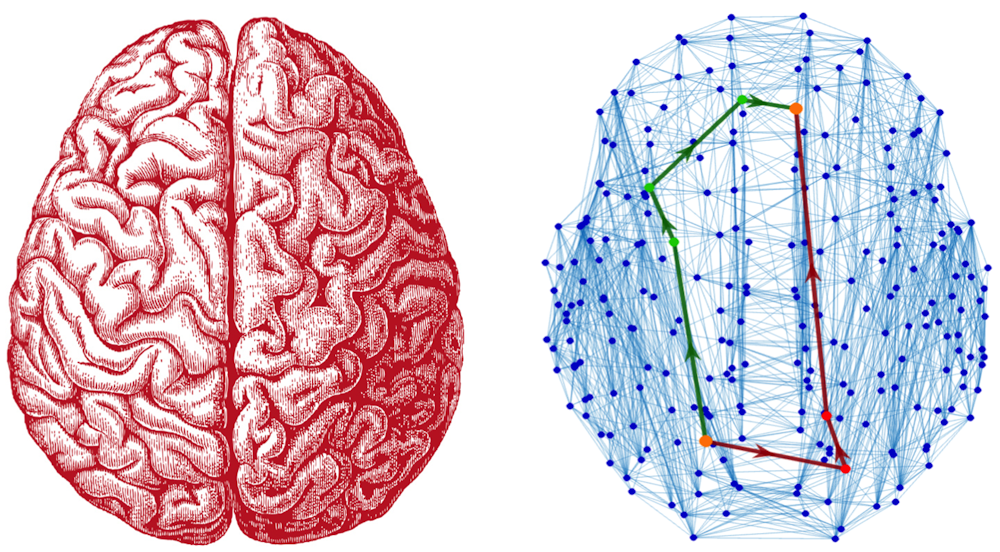 Network model of the brain (right), alongside a pictorial representation of brain anatomy (left; from Wikimedia Commons). In the network model, the red path shows the quickest way to travel between the highlighted regions, only using three connections of the network. The green path shows the route identified by our navigation strategy, which use four connections. The red path is faster, but it was computed using a map of all connections. The green path was computed without a map, following our navigation strategy.
Author provided
Network model of the brain (right), alongside a pictorial representation of brain anatomy (left; from Wikimedia Commons). In the network model, the red path shows the quickest way to travel between the highlighted regions, only using three connections of the network. The green path shows the route identified by our navigation strategy, which use four connections. The red path is faster, but it was computed using a map of all connections. The green path was computed without a map, following our navigation strategy.
Author provided
We found that this strategy can identify successful navigation routes between more than 90% of all possible pairs of brain regions. Also, these routes were, on average, 70-80% as quick as the fastest routes computed from a central map of all neuronal interconnections.
In other words, according to our new model, brain signals might work like people navigating around a large city like Paris - but without getting lost on the way, and almost as quickly as if they followed the instructions of a map or GPS.
Modelling the brain as a network
How did we come up with this model?
In the case of the human brain, we can find out how different regions are interconnected using an approach called diffusion magnetic resonance imaging (dMRI).
Using this technique, we build network models of the brain known as “connectomes”, which tell us about the nerve fibres that connect different regions of the brain.
A tractogram showing all white matter nerve fibres in the brain. These nerve fibres connect all regions in the brain, allowing for signals to travel between them.
Representing the brain as a network helps scientists understand big picture organisational and functional properties of the brain.
We studied how efficiently the brains of humans, macaques (a kind of monkey) and mice can be navigated. For all species, we found that the way their brain networks are organised allows for efficient navigation between regions, without the need for a central map of connections.
Read more: Neuroscience in pictures: the best images of the year
Unfortunately, today’s brain imaging technology doesn’t allow us to see individual communication events happening in the brain. What we propose is a model of brain network communication that matches what we currently know about the structure and function of mammalian brains.
An important shortcoming of our Paris analogy is that while you may be able to walk to the Eiffel Tower without a map, we assumed that you could see it from afar. Similarly, our communication model assumes that brain regions “know” how far from each other they are in the brain.
While what is “known” by elements in the brain remains to be determined, our work shows that a central map is not necessary for efficient neural communication.
We need to know more
The exchange of electrical signals across brain regions underpins consciousness, perception and higher cognition. Changes to the way neural communication happens may be related to mental health issues and other brain disorders.
Communication models such as the one we have proposed, together with the development of technologies to track the propagation of electrical signals, will take us closer to deciphering how the brain works in health and disease.
Authors: Caio Seguin, PhD candidate, University of Melbourne
Read more http://theconversation.com/like-sightseeing-in-paris-a-new-model-for-brain-communication-96983