

Poorly ventilated schools are a super-spreader event waiting to happen. It may be as simple as opening windows
- Written by Geoff Hanmer, Honorary Professional Fellow, University of Technology Sydney
Infections of the Deltra strain are increasing across Australia. A significant number of recent outbreaks have been in schools.
In the earlier waves of the COVID outbreak, in 2020, evidence showed children were getting COVID at much lower rates than adults, and the advice from experts was to keep schools open. But a series of papers later showed children were at similar risk of infection to adults.
This is even worse with Delta. According to the US Centers for Disease Control, the Delta variant is about twice as infectious as the earlier strains. And preliminary data suggest children and adolescents are at greater risk of becoming infected with this variant, and transmitting it.
The World Health Organization has recognised SARS-CoV-2, the virus that causes COVID-19, is airborne. The evidence for aerosol transmission is now enough for the Australian Infection Control Expert Group (ICEG), which advises the federal government, to have recently amended its earlier advice that COVID-19 was only spread by contact and droplets:
ICEG has also recognised broader circumstances in which there may be potential for aerosol transmission […] ICEG […] notes the risk may be higher under certain conditions, such as poorly ventilated indoor crowded environments.
“Poorly ventilated indoor crowded environments” accurately describes conditions at many schools. Even in lockdown, schools are still open for children of essential workers and classrooms in use can have relatively high occupancy.
In or out of lockdown, poorly ventilated schools are a super-spreader event waiting to happen.
How are schools ventilated?
Most schools are naturally ventilated. This means windows must be open to deliver fresh air which will dilute and disperse airborne pathogens.
It is not a coincidence the current Australian outbreaks are happening in winter, when naturally ventilated buildings, including most schools, are more likely to have their windows shut to keep the heat in.
Some schools, particularly those with open learning spaces, have buildings too deep for natural ventilation and are mechanically ventilated. This may involve air conditioning, but not all air conditioning includes ventilation. For instance, a split system air conditioner typically recirculates air inside a space whereas ventilation introduces fresh air into the building.
Read more: The pressure is on for Australia to accept the coronavirus really can spread in the air we breathe
Mechanically ventilated buildings are supposed to have around 10 litres per second (l/s) of fresh air per person. But the temptation to throttle back fresh air to save energy and money is ever present. And even with 10 l/s per person coming in, there may be places with poor ventilation. This includes stairwells, lifts, corridors and assembly spaces.
As aerosols may persist in the air for hours, schools with poor ventilation become a high risk for transmission and kids can take it back to their families.
We have been measuring ventilation in schools and other buildings in Sydney, Canberra, Brisbane and Adelaide using a carbon dioxide (CO2) meter. This is because C02, which is exhaled by humans, is a good proxy for the level of ventilation in a space.
Outside air is about 400-415 ppm (parts per million) of CO2 and well-ventilated indoor environments are typically below 800 ppm with best practice around 600 ppm.
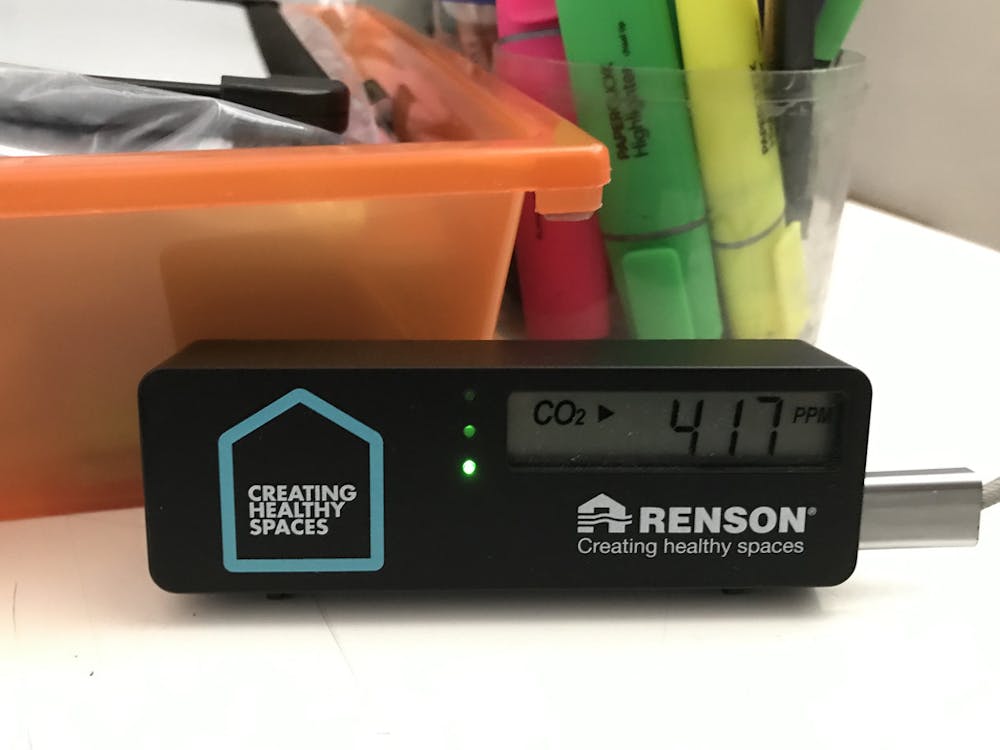 This measurement of a classroom in an older-built school shows safe CO2 levels.
Author provided
This measurement of a classroom in an older-built school shows safe CO2 levels.
Author provided
Our informal measurements show many newer mechanically ventilated buildings are not well ventilated. Perhaps counter-intuitively, older style naturally ventilated school buildings with leaky wooden windows on both sides of the room and high ceilings often appear to perform well.
Just looking at a building is not a reliable guide to how well ventilated it is.
What schools need to do
We can do several things to ensure schools are well ventilated. The first is to ensure the school has access to a CO2 meter and takes action where CO2 is above 800 ppm.
If the building has windows and doors, open them. This may require kids and teachers putting on an extra layer of clothing, turning up the heating, providing supplementary heaters and making revised security arrangements.
Anything required to keep people safe and thermally comfortable in a well ventilated space is likely to be much cheaper than dealing with an outbreak.
Serviceable standalone NDIR sensor-type CO2 meters can be bought online for less than A$100. More sophisticated networkable devices are available for under A$500.
Read more: Australian children are learning in classrooms with very poor air quality
If the space is mechanically ventilated, a school will need to get a mechanical engineer to work out how the system can be improved. In the meantime, staff could try opening doors, using fans to mix air in large volume spaces or move activities outside.
Where improvements in ventilation are not immediately possible, portable air purifiers can reduce the amount of virus in the air. An air purifier will need at least a HEPA (high-efficiency particulate absorbing) filter to be effective and has to be matched to the size of the room. A typical classroom may need two devices to work and a large open plan space may need several.
In future, we will need to change building regulations to deliver safe, clean air in schools. For now, we just need to do the best we can. It may be as simple as opening the windows.
Authors: Geoff Hanmer, Honorary Professional Fellow, University of Technology Sydney

















