

Einstein's too hard for school science? No, students love learning real modern physics
- Written by David Blair, Emeritus Professor, ARC Centre of Excellence for Gravitational Wave Discovery, OzGrav, The University of Western Australia
Why are middle school students losing interest in physics? Why is Australia falling behind in science, technology, engineering and mathematics (STEM)?
We in the Einstein-First project think we have the answer. It is because students’ internet experience of science is in complete conflict with the school curriculum.
Read more: Why don't we teach Einstein's theories in school?
For National Science Week, I spoke to 650 students aged from 5 to 11. I asked if they had heard of black holes. At least 80% raised their hands.
Where do we find black holes in the school curriculum? We don’t. You can’t talk about black holes using 19th-century physics because they are all about curved space and warped time.
Students have made it clear to us they think science at school is about “old stuff”.
This is why we must modernise the curriculum. We must replace 19th-century concepts with 21st-century concepts, and teach everyone the language of modern physics, starting in primary school.
Today we launch our book Teaching Einsteinian Physics in Schools. It is designed to spearhead a revolution in school science starting from year 3.
Young students grasp Einsteinian concepts
Einstein’s discoveries in 1905 started a conceptual revolution. The final steps, Einstein’s theory of gravity in 1915 and de Broglie’s 1924 discovery that all matter and radiation have a combination of waviness and bulletiness (normally called wave particle duality), radically changed physicists’ ideas of space, time, matter and radiation. These discoveries are the foundational concepts for almost all modern technology.
Read more: Explainer: what is wave-particle duality
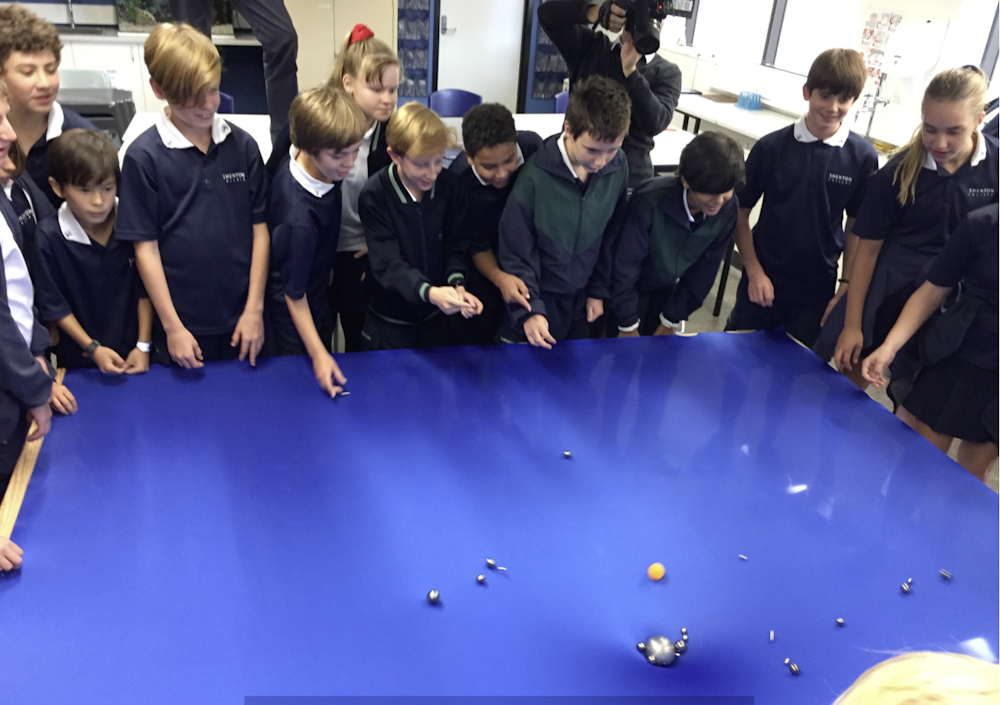 Students explore orbits on a spacetime simulator.
Einstein-First, Author provided
Students explore orbits on a spacetime simulator.
Einstein-First, Author provided
Ten years ago I asked: “Is it possible to teach Einsteinian concepts in primary school?” Colleagues said: “Of course not. You have to learn Newton’s physics first!”
I responded bluntly! Newtonian physics is wrong, both conceptually and factually. It says things can travel arbitrarily fast and gravity travels instantaneously, time is the same everywhere, mass and energy are independent of each other, and the universe runs like clockwork.
Our team ran an initial trial teaching Einsteinian physics in a primary school. Our most astonishing discovery was that children were not astonished: they just took the ideas in their stride. This led to eight years of trials in a variety of primary and high schools.
We taught the students that light comes as photons that have a combination of waviness and bulletiness, that space is curved by matter and this changes geometry, and that time is different on top of a mountain. None of this particularly surprised them.
And the children loved it. One year 3 teacher said:
“By the end they were using vocabulary and clearly understanding concepts that would normally not be introduced until high school. It was really hard to drag them away from their activities. What was surprising was that they so easily accepted concepts that most adults and teachers find very difficult.”
Activity-based learning works — and it’s fun
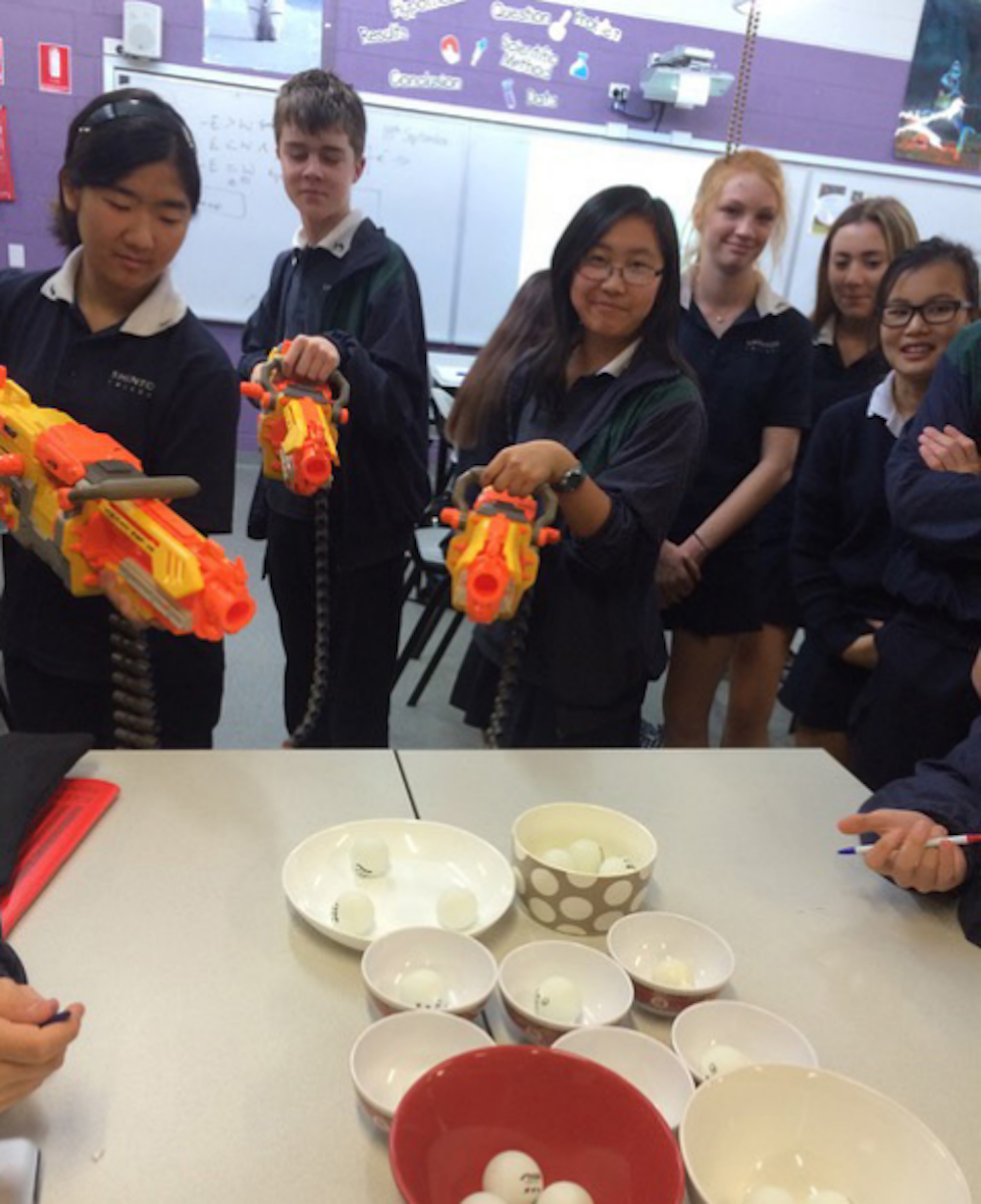 Students use nerf guns to learn about how photons eject electrons.
Einstein-First, Author provided
Students use nerf guns to learn about how photons eject electrons.
Einstein-First, Author provided
The children love the activity-based learning. And they love toys, so we use toys wherever possible.
We use Nerf gun bullets as toy photons, ping-pong balls as toy electrons and toy molecules made of magnetic tennis balls and ping-pong balls. Sometimes we use toy cars as photons and use objects with increasing mass to increase their bulletiness (i.e. momentum). These toys allow experiments such as the dissociation of toy molecules by toy UV photons to explain why UV light can break our DNA and cause skin cancer, and why radio (and 5G!) photons are safe because they have much less bulletiness.
Einsteinian physics has enormous explanatory power, whether at the level of quantum interactions or gravity. Einsteinian gravity describes space as an elastic fabric. We use lycra as our two-dimensional toy spacetime. The stretching of space and time is easily measured and almost all gravitational phenomena can be observed by rolling various balls on the lycra, as the video below shows.
Students from year 3 and up have taken part in trials of the Einsteinian physics program.Read more: Curious Kids: why is there gravity?
Students at all levels love to play with these spacetime simulators. They study how photon trajectories are deflected when space is curved, how gravity gradient forces tear up comets, how orbits change their orientation in space (called precession), how stars and planets form and how galaxies get their shapes. As a year 7 teacher said:
“[It] makes it much easier to talk to students about interesting things, like the latest black hole discovery.”
Lessons that make sense of our world
The absorption of infrared photons by CO₂ molecules drives climate change. Toy molecules held together by magnets allow students to explore the different ways a CO₂ molecule vibrates compared with an O₂ molecule, and learn how photon absorption causes this.
We combine our toys with real but relatively low-cost devices, such as solar panels, electric drills, LED lights and laser pointers.
Laser pointers allow the waviness of light to be explored in a whole range of interference experiments. Solar panels demonstrate bulletiness, photons ejecting electrons, and are ideal for almost all electricity and energy studies at primary and middle school. A solar panel can drive a 12V electric drill, which can be used for lifting, creating frictional heat and using energy that comes from converting photons to a stream of electrons – the photoelectric effect for which Einstein won the Nobel Prize.
Helping teachers overcome their fears
The biggest obstacle to introducing Einsteinian physics is the scare factor for teachers. People still claim it’s too difficult for teachers. We have found if we put the activity first, like geometry on woks for example, teachers with no science background easily grasp the concept that the shape of space can be measured doing geometry.
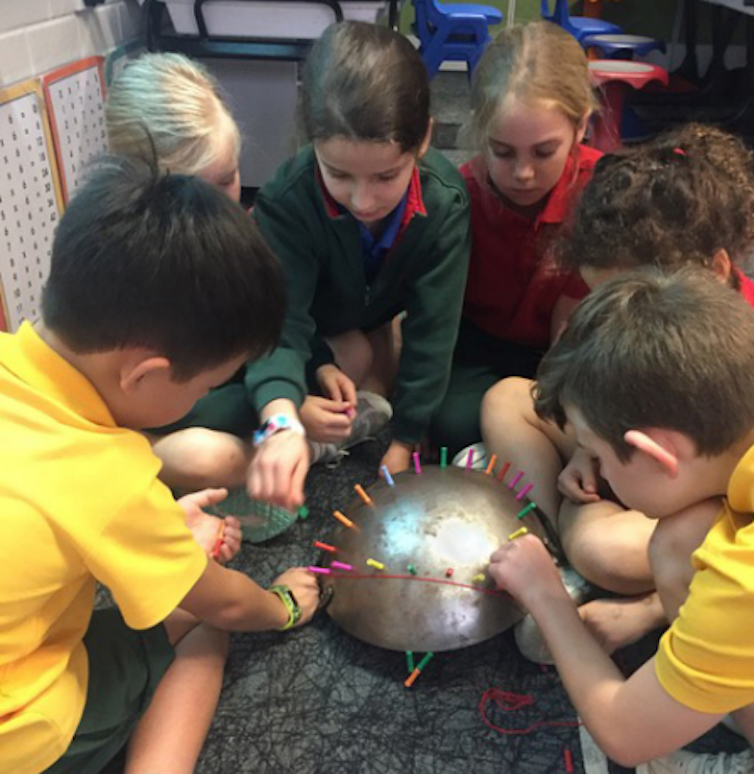 Learning about geometry on curved space using an upturned wok.
Einstein-First, Author provided
Learning about geometry on curved space using an upturned wok.
Einstein-First, Author provided
Teaching Einsteinian Physics in Schools is based on international experience involving more than 20 authors. It is presented at the level needed for school teachers, including some material for senior high school.
It is free of scary equations because these, whether Einsteinian or Newtonian, have no place in the school curriculum. Instead we teach lots about how to deal with the huge numbers and tiny numbers we must envisage to deal with the universe, as well as probability and “the maths of arrows” (vectors) because these powerful concepts are important for everyone.
Most students will not specialise in physics. The goal of Einstein-First is that all students should finish the compulsory years of science with the basic knowledge and vocabulary of our best understanding of the physical universe.
Read more: We must include more women in physics — it would help the whole of humanity
After trialling our year 7 program on gravity, a teacher reported:
“The lessons feature the modelling of concepts with hands-on ‘concrete’ materials, an instructional approach that provides multisensory learning opportunities allowing all students to be successfully included.”
“Girls benefit especially from the way the program is presented with group learning and activities. It is not intimidating, and teachers like myself enjoy the program because it makes my teaching feel much more worthwhile.”
“The notable thing about the Einsteinian physics lessons is that students are fully engaged, disruption is rare, and students with learning difficulties are practically indistinguishable from mainstream students.”
Authors: David Blair, Emeritus Professor, ARC Centre of Excellence for Gravitational Wave Discovery, OzGrav, The University of Western Australia

















