

Feedback from supervisors can be a good or bad experience. Here’s how to get it right
- Written by Ritesh Chugh, Senior Lecturer – Information Systems and Analysis, CQUniversity Australia
Giving good feedback is an art. It can be challenging for supervisors and managers, whether in an educational setting or any other workplace. Our newly published review of the past decade’s research on this issue confirms the key elements of improving feedback are to make it meaningful, constructive, timely and regular.
Feedback is centred on giving information about actual performance against set requirements. Good feedback enables people to learn from both successes and weaknesses in performance.
Focusing only on people’s shortcomings does not help learning, but hinders it. Bad feedback can be destructive.
An earlier review found one feedback intervention out of every three actually decreased performance. Postgraduate students’ experiences of feedback from research supervisors mirrors employees’ experiences of feedback from managers. Our analysis of the past decade of academic literature on feedback to postgraduate research students confirms the problem is widespread.
And large numbers of people are affected. Australia has more than 66,500 higher degree research students. In the US, 55,703 doctorates were awarded in 2019.
Poor feedback to such students leads to a negative experience. But there is not one feedback strategy that works positively for all situations.
 Effective feedback is built on a relationship of trust, with the supervisor often likened to a ‘critical friend’.
Shutterstock
Effective feedback is built on a relationship of trust, with the supervisor often likened to a ‘critical friend’.
Shutterstock
Read more: Universities are failing their students through poor feedback practices
What are the common problems?
Our study found the problems in giving and receiving feedback related to content, process, people and expectations.
Low-quality feedback with inadequate information or vague content from managers does not lead to better work performance. Equally, managers and supervisors need to find a good balance between overwhelming their supervisees with too much feedback and not providing enough or infrequent and delayed feedback.
Feedback does not stand alone – it is part of the broader relationship between supervisor and supervisee. A lack of trust is harmful for the giving and receiving of feedback.
Feedback is a two-way process between the giver and receiver – both parties contribute to the experience. Some individuals actively seek feedback. Others try to avoid it at all costs.
Not all feedback receivers are willing to take feedback on board. On the other hand, many feedback givers lack appropriate feedback skills or awareness of their own style of feedback, including its timing and tone. Often, feedback is less than effective because of a mismatch of expectations between givers and receivers.
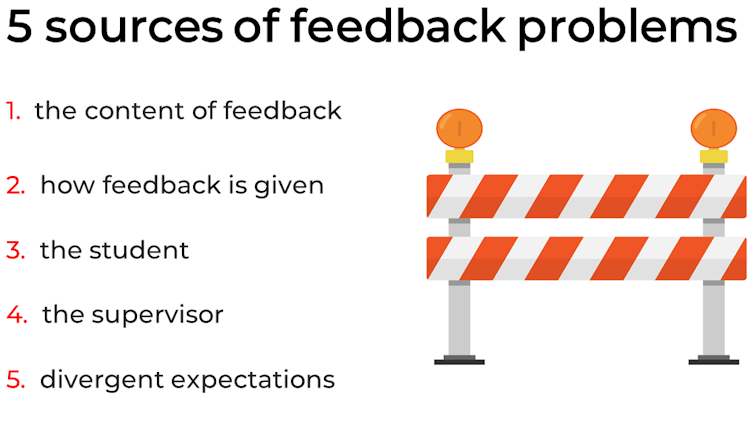 Source: Chugh et al, Supervisory feedback to postgraduate research students: a literature review (2021). Image: Shutterstock, Author provided
Read more:
How our obsession with performance is changing our sense of self
The need for a ‘critical friend’
Providing effective feedback is essential to improve learning and performance. Managers and research supervisors continually give and receive feedback. But, before giving feedback, supervisors should manage expectations and negotiate supervision arrangements. These include how often and when to give feedback, as well as the length and depth of feedback content.
In all organisations, supervisors should aim for a positive supervisory relationship. Such relationships are based on trust, respect, open communication and shared meaning.
Supervisors’ style of feedback often parallels their own experiences, whether it was helpful or not. As feedback can often be misunderstood, supervisors should critically reflect on their feedback style so it becomes a satisfying two-way process.
Constructive regular feedback should highlight both strengths and weaknesses. It should also suggest improvements. Fifty-seven percent of employees prefer to hear corrective feedback that provides suggestions for improvement and points out things that weren’t done optimally.
So, supervisors can assume the role of a “critical friend” who is encouraging and supportive but provides candid feedback on performance.
Using technologies such as videoconferencing, messaging, social media and email can help in providing timely feedback.
Our review sums up the research findings on the characteristics of effective feedback as:
“suggestive and constructive, brief, frequent and regular, actionable, specific and tailored, explicit, honest but empathetic and tactful, formal, supportive and encouraging, advising, appreciative and respectful but critical”.
Source: Chugh et al, Supervisory feedback to postgraduate research students: a literature review (2021). Image: Shutterstock, Author provided
Read more:
How our obsession with performance is changing our sense of self
The need for a ‘critical friend’
Providing effective feedback is essential to improve learning and performance. Managers and research supervisors continually give and receive feedback. But, before giving feedback, supervisors should manage expectations and negotiate supervision arrangements. These include how often and when to give feedback, as well as the length and depth of feedback content.
In all organisations, supervisors should aim for a positive supervisory relationship. Such relationships are based on trust, respect, open communication and shared meaning.
Supervisors’ style of feedback often parallels their own experiences, whether it was helpful or not. As feedback can often be misunderstood, supervisors should critically reflect on their feedback style so it becomes a satisfying two-way process.
Constructive regular feedback should highlight both strengths and weaknesses. It should also suggest improvements. Fifty-seven percent of employees prefer to hear corrective feedback that provides suggestions for improvement and points out things that weren’t done optimally.
So, supervisors can assume the role of a “critical friend” who is encouraging and supportive but provides candid feedback on performance.
Using technologies such as videoconferencing, messaging, social media and email can help in providing timely feedback.
Our review sums up the research findings on the characteristics of effective feedback as:
“suggestive and constructive, brief, frequent and regular, actionable, specific and tailored, explicit, honest but empathetic and tactful, formal, supportive and encouraging, advising, appreciative and respectful but critical”.
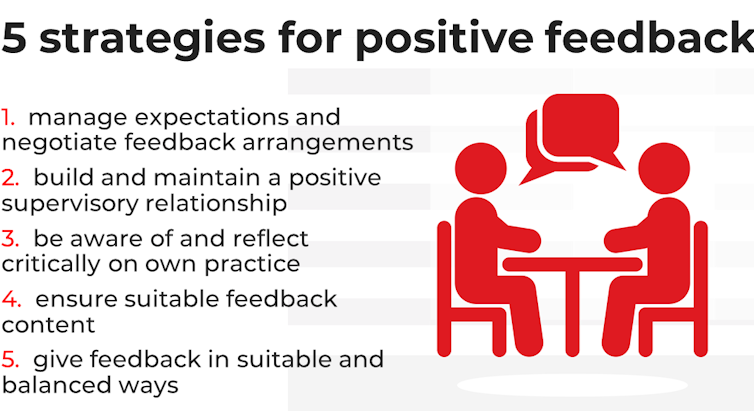 Source: Chugh et al, Supervisory feedback to postgraduate research students: a literature review (2021). Image: Shutterstock, Author provided
Read more:
Informal feedback: we crave it more than ever, and don't care who it's from
A 3-way process of improving feedback
Improving the feedback environment can lead to benefits that include higher work satisfaction. For example, in higher education, the triad of institutions, supervisors and students/supervisees can all help improve feedback processes. The same is true of the triad of the organisation, supervisors/managers and employees in other workplaces. Each has a role to play in making feedback effective.
Institutions and organisations can provide administrative, technical and financial support to supervisors. Training, mentoring and personal development opportunities can help both supervisors and supervisees succeed.
Supervisors need to engage in professional development, regularly communicate with their supervisees, be culturally sensitive and use a blend of the previously outlined feedback strategies.
Supervisees should develop reflective skills and engage critically with feedback as integral to their learning and improvement.
No ‘one size fits all’, but key principles apply
Every supervisory relationship is different. However, developing a constructive feedback culture is critical. In the supervisor-supervisee relationship, lessons need to be learnt from problems in the process, and a mix of positive feedback strategies can be adopted.
As our study shows, there is no “one size fits all” approach to providing feedback. Ultimately, supervisors and managers should ensure feedback is supervisee-centred, focuses on improvements and is actionable.
Source: Chugh et al, Supervisory feedback to postgraduate research students: a literature review (2021). Image: Shutterstock, Author provided
Read more:
Informal feedback: we crave it more than ever, and don't care who it's from
A 3-way process of improving feedback
Improving the feedback environment can lead to benefits that include higher work satisfaction. For example, in higher education, the triad of institutions, supervisors and students/supervisees can all help improve feedback processes. The same is true of the triad of the organisation, supervisors/managers and employees in other workplaces. Each has a role to play in making feedback effective.
Institutions and organisations can provide administrative, technical and financial support to supervisors. Training, mentoring and personal development opportunities can help both supervisors and supervisees succeed.
Supervisors need to engage in professional development, regularly communicate with their supervisees, be culturally sensitive and use a blend of the previously outlined feedback strategies.
Supervisees should develop reflective skills and engage critically with feedback as integral to their learning and improvement.
No ‘one size fits all’, but key principles apply
Every supervisory relationship is different. However, developing a constructive feedback culture is critical. In the supervisor-supervisee relationship, lessons need to be learnt from problems in the process, and a mix of positive feedback strategies can be adopted.
As our study shows, there is no “one size fits all” approach to providing feedback. Ultimately, supervisors and managers should ensure feedback is supervisee-centred, focuses on improvements and is actionable.
Authors: Ritesh Chugh, Senior Lecturer – Information Systems and Analysis, CQUniversity Australia

















