Meet the diverse group of plant-eating dinosaurs that roamed Victoria 110 million years ago
- Written by Stephen Poropat, Adjunct Researcher, Swinburne University of Technology
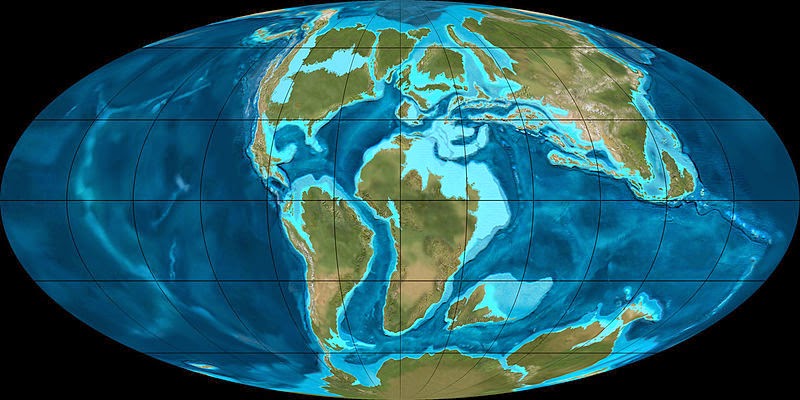
During the Early Cretaceous period, 110 million to 107 million years ago, Australia was much further south than it is today. Yet fossils from several sites on the Otway Coast in Victoria show dinosaurs were common in the region.
The most abundant were ornithopods — small plant-eaters with beaks and cheeks full of teeth. But until recently, it was unclear exactly how many species coexisted at the same time.
So far, five ornithopod species have been named from the Cretaceous of Victoria. There are three from the Otway Coast: Atlascopcosaurus loadsi, Diluvicursor pickeringi and Leaellynasaura amicagraphica; and two from the Bass Coast: Qantassaurus intrepidus and Galleonosaurus dorisae.
The rocks exposed on the Bass Coast (and the fossils they contain) are around 15 million to 20 million years older than those on the Otway Coast. During this interval, Australia’s climate warmed dramatically.
There’s substantial evidence of glaciation in South Australia about 125 million years ago, but by 110 million years ago, warm weather-loving crocodile relatives were roaming happily in Victoria.
As such, it was presumed the Bass Coast’s Qantassaurus and Galleonosaurus — which lived in older, colder conditions — probably never crossed paths with the Otway Coast’s Leaellynasaura, Atlascopcosaurus and Diluvicursor. But is that true?
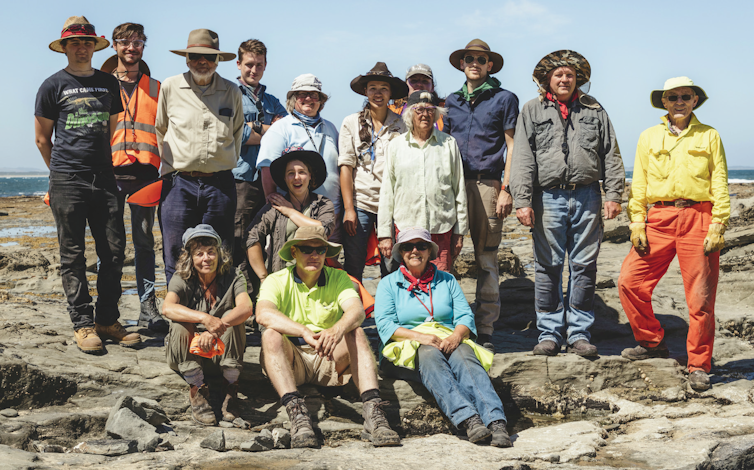 The Dinosaur Dreaming team back in 2019. Ruairidh Duncan is in the back row, fourth from the left.
Wendy White/Dinosaur Dreaming
The Dinosaur Dreaming team back in 2019. Ruairidh Duncan is in the back row, fourth from the left.
Wendy White/Dinosaur Dreaming
Eric The Red West
Thanks to research led by my former student Ruairidh Duncan, we’re now in a better position to answer this question. For his Honours project, Ruairidh studied fossils from a site on Cape Otway called Eric the Red West (ETRW).
In 2005, a partial ornithopod skeleton was discovered at ETRW. This skeleton was named Diluvicursor pickeringi in 2018 and comprised only a tail, a partial shin, ankle, and a hind foot.
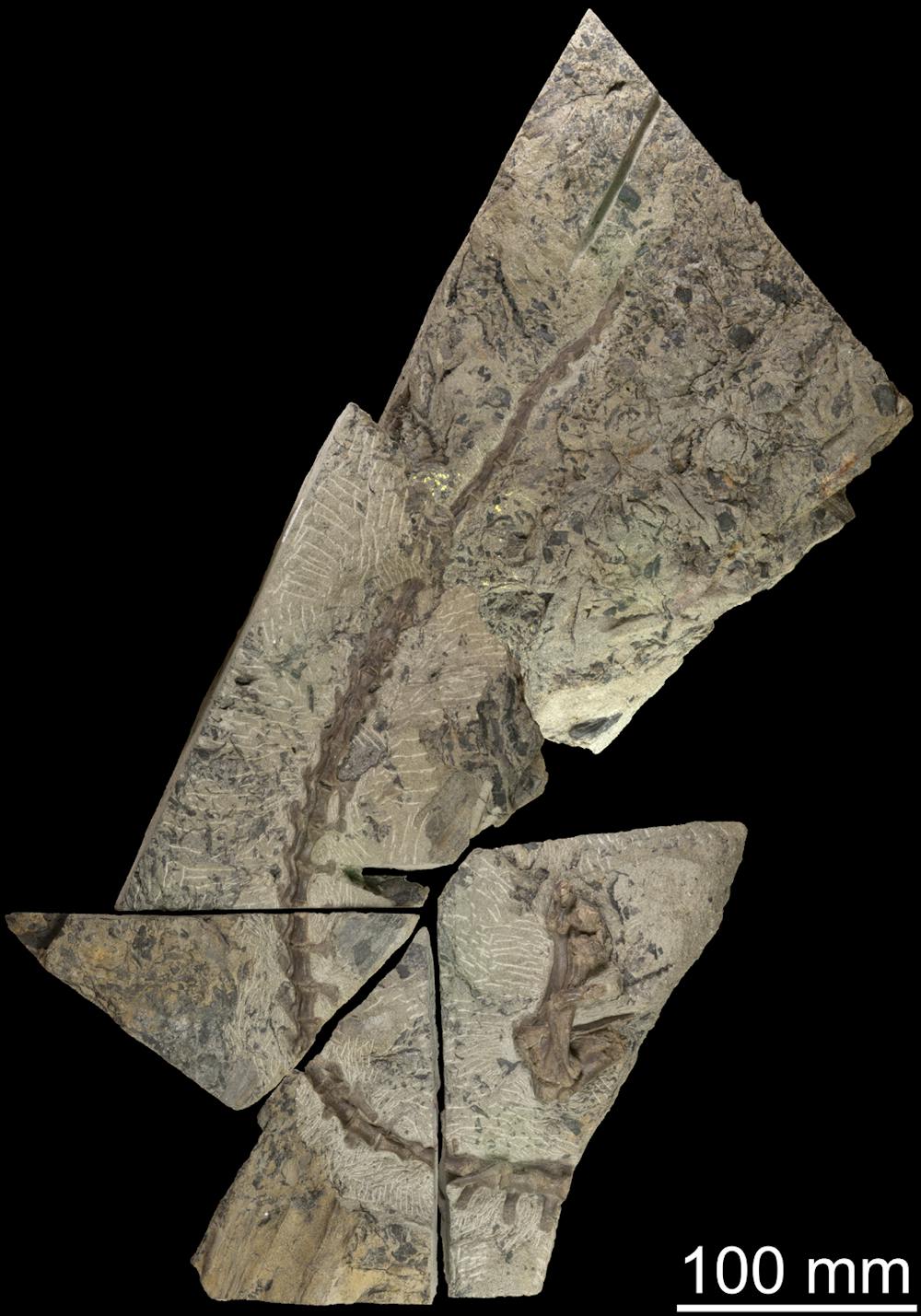 The original specimen of Diluvicursor pickeringi, comprising a tail, a partial shin and ankle, and a hind foot.
Stephen Poropat/Museums Victoria
The original specimen of Diluvicursor pickeringi, comprising a tail, a partial shin and ankle, and a hind foot.
Stephen Poropat/Museums Victoria
Several additional digs by a group of volunteers called Dinosaur Dreaming saw the site produce many more ornithopod bones, including some jawbones. Until Ruairidh studied these jawbones, we had no idea whether they belonged to existing species or new ones.
A little help from technology
Most of the ornithopod jawbones from ETRW were broken in half when they were discovered. This is not unusual, as the bones are softer than the rock in which they are encased.
However, depending on how they were broken, one half of a jawbone might have had rock removed only from the tongue side, and its matching half might have had rock removed only from the cheek side.
Although this allowed the two halves of the jaw to click together nicely, it meant Ruairidh couldn’t observe most of his specimens as complete bones from either the tongue or cheek side. Well, not without some help from technology.
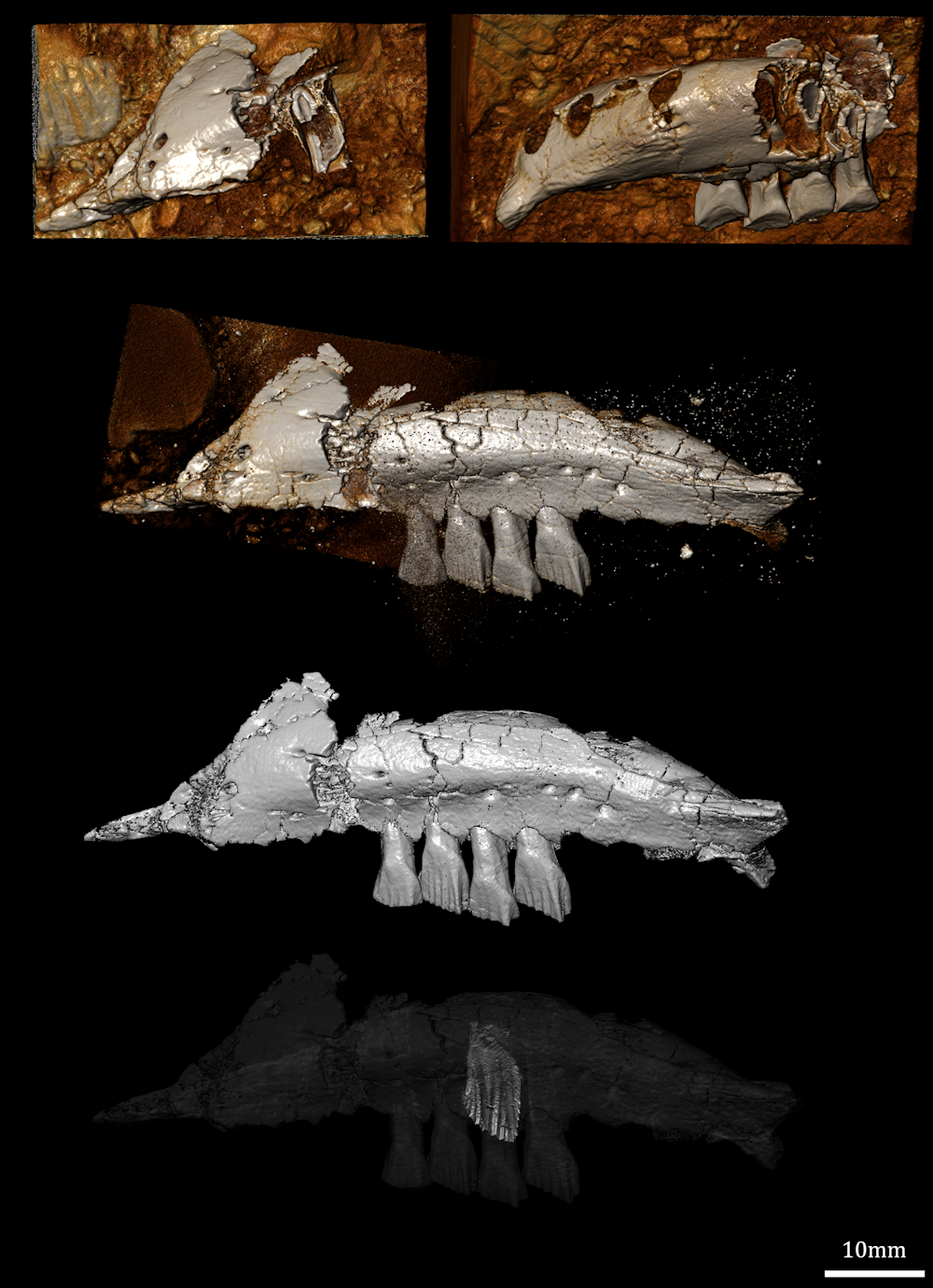 Digital reconstruction of an ornithopod jaw (cf. Galleonosaurus dorisae) from micro-CT data. Top: the two halves of the jaw, one with the cheek side exposed, the other with tongue side exposed. Top middle: the two halves connected, without rock removed. Bottom middle: free at last, the 3D reconstruction of the jaw. Bottom: A replacement tooth inside the jaw.
Ruairidh Duncan
Digital reconstruction of an ornithopod jaw (cf. Galleonosaurus dorisae) from micro-CT data. Top: the two halves of the jaw, one with the cheek side exposed, the other with tongue side exposed. Top middle: the two halves connected, without rock removed. Bottom middle: free at last, the 3D reconstruction of the jaw. Bottom: A replacement tooth inside the jaw.
Ruairidh Duncan
Monash University’s Alistair Evans micro-CT scanned several ornithopod specimens retrieved from the ETRW site. Just like medical CT scanners, micro-CT scanners generate a series of 2D cross-sectional images through a 3D object (but on a smaller scale).
The scans allowed Ruairidh to digitally remove the rock from his specimens — which were all less than ten centimetres long — and reconstruct each one in 3D.
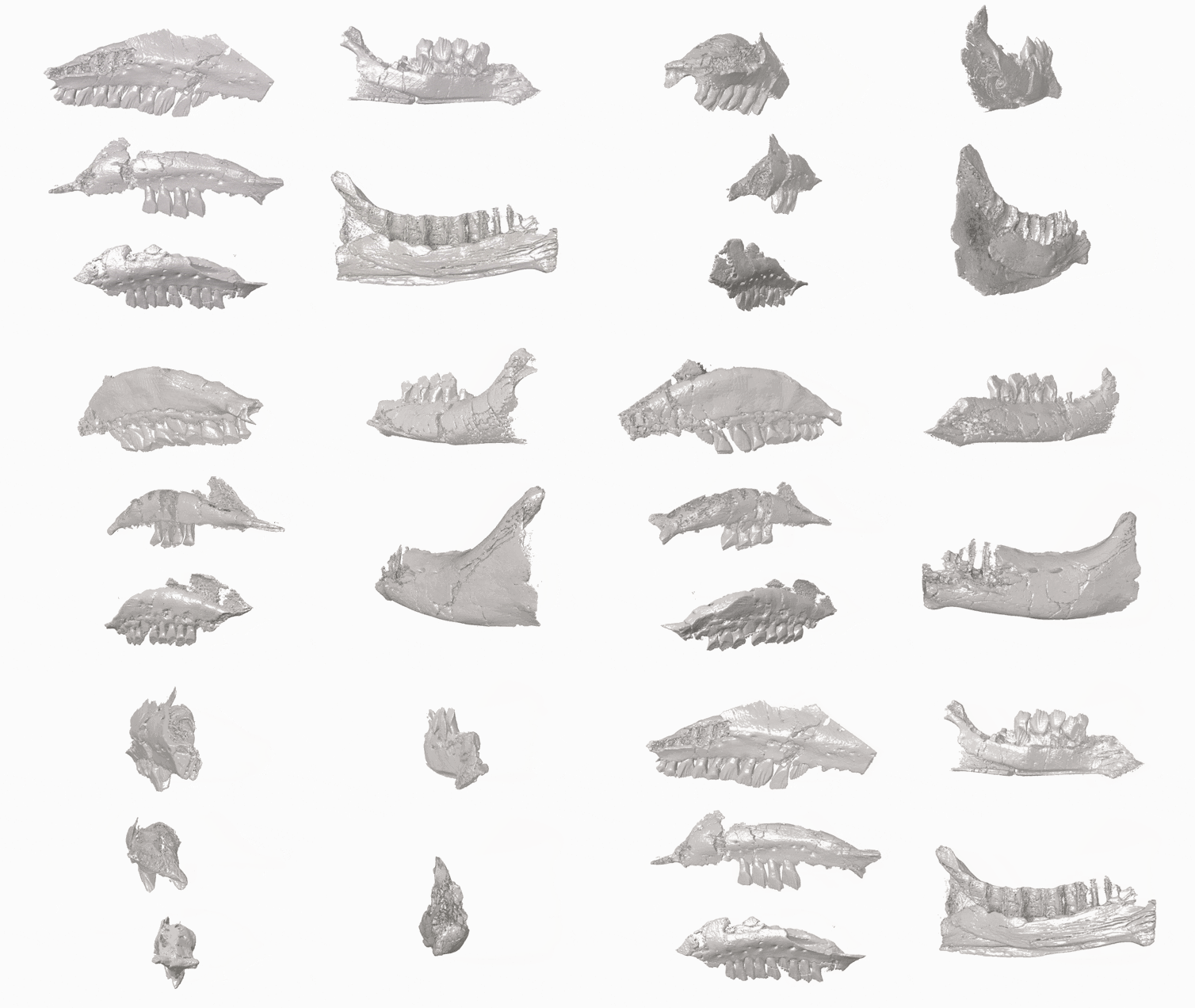 3D models of ornithopod dinosaur jawbones from ETRW. Left column shows upper jawbones, right column shows lower jawbones. Top left: Atlascopcosaurus loadsi. Middle left: cf. Galleonosaurus dorisae. Bottom left: Leaellynasaura amicagraphica. Top and bottom right: indeterminate dentaries.
Ruairidh Duncan
3D models of ornithopod dinosaur jawbones from ETRW. Left column shows upper jawbones, right column shows lower jawbones. Top left: Atlascopcosaurus loadsi. Middle left: cf. Galleonosaurus dorisae. Bottom left: Leaellynasaura amicagraphica. Top and bottom right: indeterminate dentaries.
Ruairidh Duncan
Read more: The march of the titanosaurs: the Snake Creek Tracksite unveiled
An unexpected Galleonosaurus
Ruairidh analysed the ornithopod jawbones from the ETRW site and compared them with the other Victorian ornithopod species. (Three of the five ornithopods known from Victoria were already named and described on the basis of upper jawbones, which enabled a direct comparison).
He found one upper jawbone was attributable to Atlascopcosaurus (the most complete specimen known of this species) and another to Leaellynasaura (the first adult specimen known of this species).
We had expected the final two bones might belong to a Diluvicursor. Instead, we were surprised to discover they were closely comparable with Galleonosaurus — the species previously only known from the Bass Coast, with rocks that were roughly 15-20 million years older than those exposed at ETRW.
In other words, we’d found evidence of an ornithopod species that had remained almost unchanged for at least 15 million years!
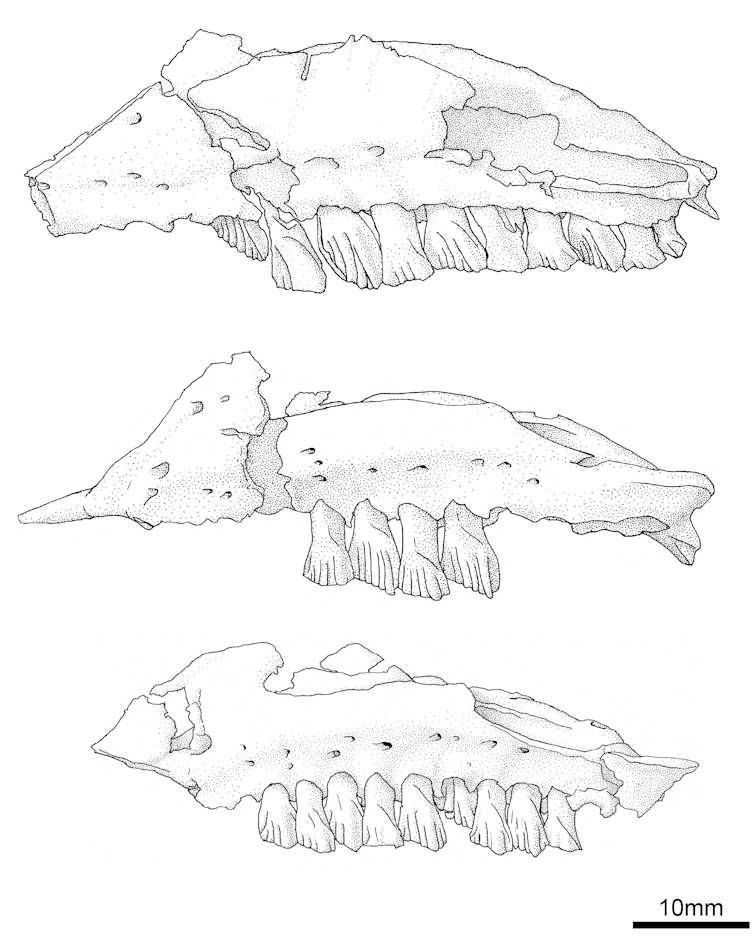 Line drawings of ornithopod jaws from ETRW. Top: Atlascopcosaurus loadsi. Middle: cf. Galleonosaurus dorisae. Bottom: Leaellynasaura amicagraphica.
Ruairidh Duncan
Line drawings of ornithopod jaws from ETRW. Top: Atlascopcosaurus loadsi. Middle: cf. Galleonosaurus dorisae. Bottom: Leaellynasaura amicagraphica.
Ruairidh Duncan
Possible explanations
The presence of an ornithopod so similar to Galleonosaurus at ETRW implies that very little change in tooth and jaw anatomy (and presumably diet) took place in these dinosaurs in almost 20 million years, despite marked climatic change.
This might mean their favourite plants changed little in abundance throughout this time, in which case they would have faced little pressure to change the shape or structure of their teeth and jaws.
It remains impossible to compare the jawbones from ETRW with the only specimen of Diluvicursor pickeringi — as no jawbones were found with it.
But perhaps the absence of a unique jawbone type for Diluvicursor might mean this species is actually the same as one of the other species which are represented by jawbones. If so, it’s most likely Atlascopcosaurus or the Galleonosaurus-like species; a very different tail and foot have been tentatively assigned to Leaellynasaura.
Unfortunately, determining this will hinge on discovering an ornithopod skeleton matching that of Diluvicursor, associated with a skull matching the jaws of Atlascopcosaurus or Galleonosaurus.
And given that more than 40 years of digging for dinosaurs in Victoria has revealed only four partial ornithopod skeletons, we might be waiting a while.
Nonetheless, Ruairidh’s research has demonstrated three different ornithopod species were happily living in southeast Australia, within the Antarctic Circle about 110 million to 107 million years ago — when the world was generally much warmer than it is today.
To date, the ETRW site has produced an abundance of fossil evidence, including plants (mostly conifers, ferns and early flowering plants), bony fish, lungfish, plesiosaurs, pterosaurs, huge-clawed megaraptorid theropods, Australia’s only toothless and long-necked elaphrosaurine theropod, and even ancient mammals.
It has only produced one ornithopod skeleton: the aforementioned Diluvicursor. But who knows what we might find next?
Read more: Introducing Australotitan: Australia's largest dinosaur yet spanned the length of 2 buses
Authors: Stephen Poropat, Adjunct Researcher, Swinburne University of Technology