

Pfizer vaccinations for 16 to 39-year-olds is welcome news. But AstraZeneca remains a good option
- Written by Catherine Bennett, Chair in Epidemiology, Deakin University
Prime Minister Scott Morrison yesterday announced the Pfizer vaccine would become available to all Australians aged 16 to 39 from August 30.
This represents a vote of confidence in our vaccine supply, which has been riddled with issues since the rollout began. It gives us a fighting chance to reach current targets, which suggest 70% of eligible Australians could be fully vaccinated by November, and 80% by December.
Importantly, given what we know about the high rates of COVID infections in younger people, and the significant role they’re playing in transmission, this is good news. Boosting vaccination rates in this group will be a crucial step towards controlling the virus.
And with some young adults in different states already eligible for the Pfizer vaccine (depending on where they live, their job, and so on), this move will hopefully serve to reduce confusion.
Why vaccinating younger adults is important
Throughout New South Wales’ current COVID outbreak, we’ve heard young people are being disproportionately infected. We’re hearing this in Victoria too.
In part, this is because this group is generally more mobile, both in the nature of their work and social lives. Of course, the latter shouldn’t be relevant under lockdown conditions, but younger adults are also more likely to live in shared households with essential workers from different workplaces.
While 20 to 39-year-olds have made up the highest proportion of cases throughout the pandemic, the growing numbers of older adults now vaccinated could go some way to explaining why younger adults and children are making up an even greater proportion of infections of late.
Worryingly, data from the NSW outbreak also suggests young people are making up a higher proportion of patients admitted to hospital with COVID-19 compared to earlier in the pandemic.
Given young adults make up a high number of cases, it follows they are big drivers of transmission. The Doherty Institute’s recent modelling described young and working age adults as “peak transmitters” of COVID-19, and advocated vaccinating people in their 20s and 30s would reduce overall spread.
It made sense to prioritise people at highest risk of severe outcomes from COVID-19, as well as those in high-risk jobs, for vaccination earlier on. But there’s a fair bit of catch up to do now to get these younger age groups vaccinated.
For example, 33.5% of 35 to 39-year-olds have received one dose of a COVID vaccine, compared to 86.1% of 75 to 79-year-olds. Some 25% of 25 to 29-year olds have had a first dose, compared to 76.1% of 65 to 69-year-olds.
Opening up Pfizer for everyone aged 16 to 39 will allow us to boost numbers in those younger age groups and in turn, reduce infections and transmission.
 Vaccinating young people will be one key way of reducing COVID transmission.
Shutterstock
Vaccinating young people will be one key way of reducing COVID transmission.
Shutterstock
Don’t dismiss AstraZeneca
This news should be impetus for anyone currently eligible for Pfizer who hasn’t got it yet (predominantly adults in their 40s and 50s) to make an appointment as soon as possible. Because it’s only going to get harder once millions more people become eligible.
For people aged 16 to 39 who are champing at the bit for a Pfizer vaccine, it’s important to be aware you probably won’t be able to get one the day bookings open. It may well be that you have to wait weeks for an appointment.
So if you were already considering getting the AstraZeneca vaccine, or if you’ve already booked an appointment, stick with that.
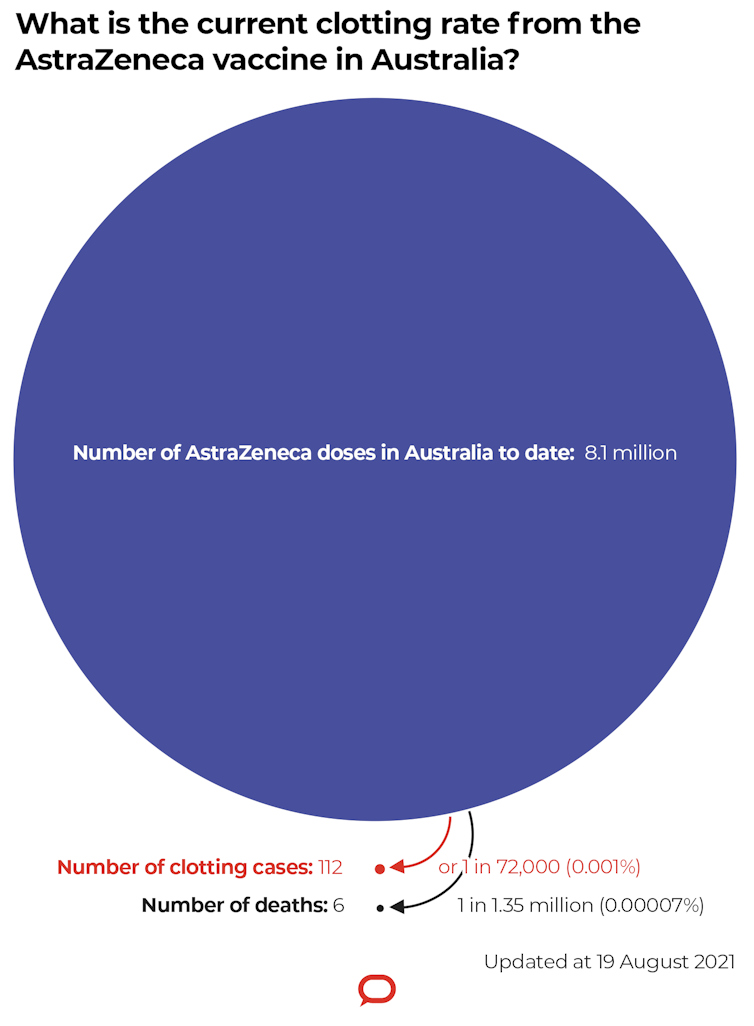
It’s a highly effective vaccine, the risk of any complication is incredibly small, and the benefits are significant — particularly in areas like Sydney, where we’re seeing high community transmission and young people fighting the virus in ICU.
 tga.gov.au
What about a ‘mix and match’ approach?
While supply of Pfizer is increasing, and we expect to start receiving Moderna next month, daily demand for these mRNA vaccines is still outpacing supply.
One possible way to address this would be to give some people a first dose of AstraZeneca, and then a second dose of Pfizer. This would allow us to start vaccinating more people sooner and stretch the Pfizer supply further.
This “mix and match” approach is already being explored in a number of countries. Data are showing not only is it effective, but it could provide better protection than two doses of the same vaccine.
Ensuring everyone has the rights that come with vaccination
Vaccination is becoming increasingly important, not only in the face of current Delta outbreaks, but for personal movements and freedoms as rules are introduced that recognise the lower risk of infection among the vaccinated.
For example, people travelling from NSW into Western Australia need to prove they’ve had at least one dose of a COVID vaccine.
Read more:
Could a France-style vaccine mandate for public spaces work in Australia? Legally, yes, but it's complicated
Meanwhile, some countries around the world are requiring proof of vaccination to visit the likes of museums, cinemas and to dine indoors — activities that might not be open at all in the absence of vaccination.
Broadening the vaccine rollout to younger people now ensures they will have time to access vaccination and won’t be disadvantaged by any such rules down the track.
tga.gov.au
What about a ‘mix and match’ approach?
While supply of Pfizer is increasing, and we expect to start receiving Moderna next month, daily demand for these mRNA vaccines is still outpacing supply.
One possible way to address this would be to give some people a first dose of AstraZeneca, and then a second dose of Pfizer. This would allow us to start vaccinating more people sooner and stretch the Pfizer supply further.
This “mix and match” approach is already being explored in a number of countries. Data are showing not only is it effective, but it could provide better protection than two doses of the same vaccine.
Ensuring everyone has the rights that come with vaccination
Vaccination is becoming increasingly important, not only in the face of current Delta outbreaks, but for personal movements and freedoms as rules are introduced that recognise the lower risk of infection among the vaccinated.
For example, people travelling from NSW into Western Australia need to prove they’ve had at least one dose of a COVID vaccine.
Read more:
Could a France-style vaccine mandate for public spaces work in Australia? Legally, yes, but it's complicated
Meanwhile, some countries around the world are requiring proof of vaccination to visit the likes of museums, cinemas and to dine indoors — activities that might not be open at all in the absence of vaccination.
Broadening the vaccine rollout to younger people now ensures they will have time to access vaccination and won’t be disadvantaged by any such rules down the track.
Authors: Catherine Bennett, Chair in Epidemiology, Deakin University

















