

how selective breeding may help the world's reefs survive ocean heating
- Written by Emily Howells, Senior Research Fellow in Marine Biology, Southern Cross University
A single generation of selective breeding can make corals better able to withstand extreme temperatures, according to our new research. The discovery could offer a lifeline to reefs threatened by the warming of the world’s oceans.
Our research, published in Science Advances, shows corals from some of the world’s hottest seas can transfer beneficial genes associated with heat tolerance to their offspring, even when crossbred with corals that have never experienced such temperatures.
Across the world, corals vary widely, both in the temperatures they experience and their ability to withstand high temperatures without becoming stressed or dying. In the Persian Gulf, corals have genetically adapted to extreme water temperatures, tolerating summer conditions above 34℃ for weeks at a time, and withstanding daily averages up to 36℃.
These water temperatures are 2-4℃ higher than any other region where corals grow, and are on a par with end-of-century projections for reefs outside the Persian Gulf.
This led us to ask whether beneficial gene variants could be transferred to coral populations that are naïve to these temperature extremes. To find out, we collected fragments of Platygyra daedalea corals from the Persian Gulf, and cross-bred them with corals of the same species from the Indian Ocean, where summer temperatures are much cooler.
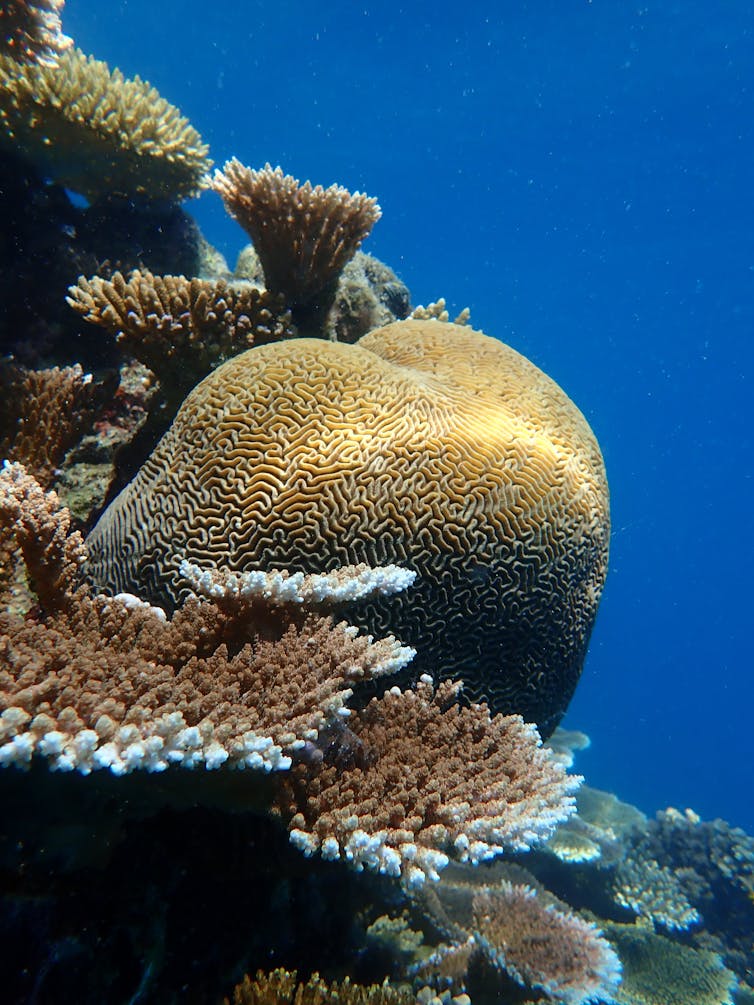 Platygyra, a brain-shaped coral found in many parts of the world.
Emily Howells, Author provided
Platygyra, a brain-shaped coral found in many parts of the world.
Emily Howells, Author provided
We then heat-stressed the resulting offspring (more than 12,000 individual coral larvae) to see whether they could withstand temperatures of 33°C and 36°C — the summer maximums of their parents’ respective locations.
Immediate gains
We found an immediate transfer of heat tolerance when Indian Ocean mothers were crossed with Persian Gulf fathers. These corals showed an 84% increase in survival at high temperatures relative to purebred Indian Ocean corals, making them similarly resilient to purebred Persian Gulf corals.
Genome sequencing confirmed that gains in heat tolerance were due to the inheritance of beneficial gene variants from the Persian Gulf corals. Most Persian Gulf fathers produced offspring that were better able to withstand heat stress, and these fathers and their offspring had crucial variants associated with better heat tolerance.
Conversely, most Indian Ocean fathers produced offspring that were less able to survive heat stress, and were less likely to have gene variants associated with heat tolerance.
Survival of the fittest
Encouragingly, gene variants associated with heat tolerance were not exclusive to Persian Gulf corals. Two fathers from the Indian Ocean produced offspring with unexpectedly high survival under heat stress, and had some of the same tolerance-associated gene variants that are prevalent in Persian Gulf corals.
This suggests that some populations have genetic variation upon which natural selection can act as the world’s oceans grow hotter. Selective breeding might be able to accelerate this process.
Read more: Heat-tolerant corals can create nurseries that are resistant to bleaching
We are now assessing the genetic basis for heat tolerance in the same species of coral on the Great Barrier Reef and in Western Australia. We want to find out what gene variants are associated with heat tolerance, how these variants are distributed within and among reefs, and whether they are the same as those that allow corals in the Persian Gulf to survive such extreme temperatures.
This knowledge will help us understand the potential for Australian corals to adapt to rapid warming.
Although our study shows selective breeding can significantly improve the resilience of corals to ocean warming, we don’t yet know whether there are any trade-offs between thermal tolerance and other important traits, and whether there are significant genetic risks involved in such breeding.
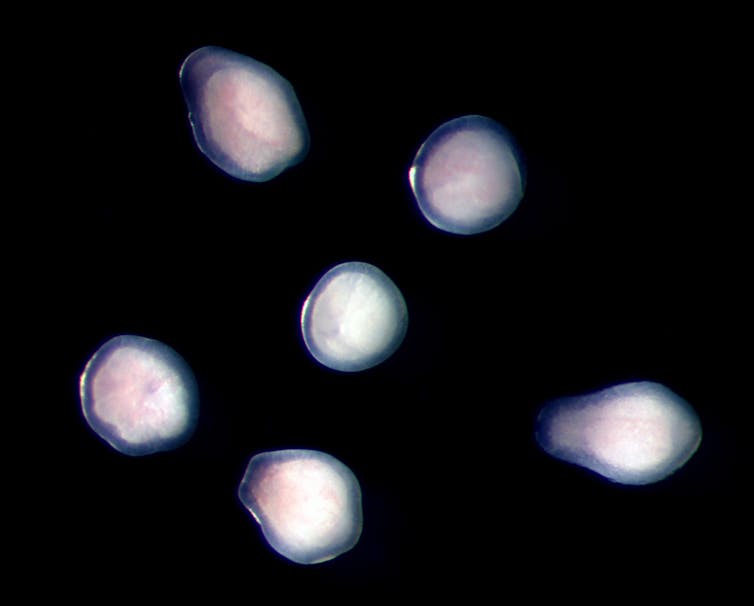 Platygyra larvae. It remains to be seen whether the genetic benefits of heat-tolerance genes persist throughout life.
Emily Howells, Author provided
Platygyra larvae. It remains to be seen whether the genetic benefits of heat-tolerance genes persist throughout life.
Emily Howells, Author provided
Our study was done on coral larvae without the algae that live in close harmony with corals after they settle on reefs. So it will also be important to examine whether the genetic improvements to heat tolerance continue into the corals’ later life stages, when they team up with these algae.
Of course, saving corals from the perils of ocean warming will require action on multiple fronts — there is no silver bullet. Selective breeding might provide some respite to particular coral populations, but it won’t be enough to protect entire ecosystems, and nor is it a substitute for the urgent reduction of greenhouse emissions needed to limit the oceans’ warming.
Authors: Emily Howells, Senior Research Fellow in Marine Biology, Southern Cross University

















