

Can't get your kid to wear a mask? Here are 5 things you can try
- Written by Rebecca English, Senior Lecturer in Education, Queensland University of Technology
Let’s face it, none of us actually enjoys wearing a mask. And it’s even harder when you’re a parent trying to get your kids masked up, as well as yourself.
Victoria, New South Wales and the Australian Capital Territory now require everyone over the age of 12 to wear a mask whenever they leave their home, unless they are exercising. This mandate includes in high schools in NSW and Victoria.
In parts of Queensland and South Australia, children 12 to 17 years also need to wear a face mask if they’re indoors and can’t socially distance.
Children should not wear masks while exercising. And children under two years old should also not wear masks, as they are a choking and suffocation risk.
Parents can decide if children between the ages of five and 12 should wear a mask. But, the World Health Organization says children under five years old should not be required to wear masks.
There is ample evidence showing masks help keep children and young people safe. Plus, unlike the earlier stages of the pandemic when kids weren’t contracting or transmitting the virus as much as adults, we are now seeing many cases in children of the Delta variant. Although, thankfully, serious disease among young people is still rare.
Here are five things you can do to encourage your kids to wear a mask.
1. Model wearing one
One of the best things you can do to encourage your kids to mask up is to model mask wearing. Show your child it is OK to wear a mask; it is “normal”.
 Show your child it’s normal, and not scary to wear a mask.
Shutterstock
Show your child it’s normal, and not scary to wear a mask.
Shutterstock
2. Empathise with their feelings
If your child is reluctant to wear a mask, you can empathise with their feelings. Nobody likes wearing masks. Children rely on facial gestures to communicate, and many have sensory issues that can make wearing masks uncomfortable. Reflecting back to your child that you know this is hard for them helps them feel understood.
Find out why they don’t want to wear a mask. It might be they get sore ears or a headache. If so, masks that tie behind the head can be helpful. If it’s fogged glasses, a better fitting mask, or a mask clip, may help.
The internet is full of mask hacks to help make masks more comfortable. Some are as simple as using hair clips in the loops to extend the length of the mask.
3. Help them understand the science
Kids may be more willing to wear a mask if they understand why they need to. When children understand why a behaviour is important to their health, they are more likely to comply. Older children may be interested in the science of mask wearing.
There are many resources — including easy to understand YouTube videos — that can help.
You could get your kids to watch a video, like this one.Remind your kids that doing things they want, like seeing their friends at school, relies on them wearing a mask.
4. Make it a game
Younger children may be helped by making the mask wearing a bit of a game, which can include making up silly poems about wearing masks. Or you could encourage your child to see themselves as a superhero protecting others by wearing a mask.
Younger children can imagine they’re a superhero helping others.You could also give your child the chance to choose a mask or decorate their own, turning it into a craft activity. This will make the child comfortable with the mask and give them a sense of ownership over it.
5. Ask others for help
Children require good fine motor skills to put on, and keep on, a mask. If you want your child to be wearing a mask at school, you could talk to the teacher, teacher aide or guidance officer to see if they can help.
Teachers can make sure the mask is on properly, and help your child to adjust the mask as needed.
For children with a disability
If your child has a learning disability, developmental delay or is on the autism spectrum, asking them to wear a mask, and keep it on, may be harder.
Making it a game or making it fun may also work for these children. And there’s evidence that tolerance training, where you gradually expose your child to mask wearing providing praise when the child is able to complete a step, can help.
But it may be impossible to force compliance and it may be dangerous in some circumstances. There are exemptions for people who have any medical condition that makes wearing masks unsuitable.
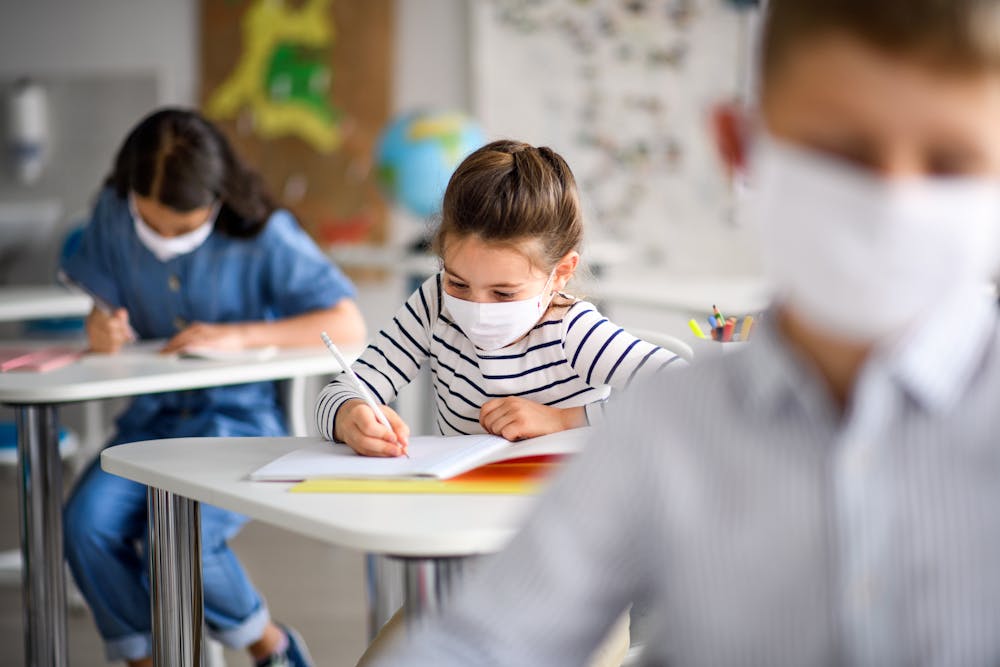 You could ask a teacher to help your child wear their mask properly at school.
Shutterstock
You could ask a teacher to help your child wear their mask properly at school.
Shutterstock
Lastly, ask yourself these questions
If your child isn’t legally required to wear a mask, but you’re still wondering, ask yourself these questions:
are there high levels of virus in my community?
is my child going to be indoors with poor ventilation and lots of people?
does my child have a medical condition that might make COVID-19 more risky for them or are they going to be around people who have a medical condition that makes them more susceptible to COVID-19?
If the answers to any of these questions are “yes”, that would lend weight to encouraging mask wearing.
If the answers to any of these questions are “no”, this would lend weight towards not requiring mask wearing.
Read more: Children need playgrounds now, more than ever. We can reduce COVID risk and keep them open
But if your child is under 12, or has a developmental or another kind of disability, it’s also important to consider whether they can put the mask on and take it off safely by themselves, and whether you or someone else can supervise them while they are wearing a mask. If not, it may be better they don’t wear one.
Authors: Rebecca English, Senior Lecturer in Education, Queensland University of Technology
Read more https://theconversation.com/cant-get-your-kid-to-wear-a-mask-here-are-5-things-you-can-try-166648

















