

how personal morals can be harnessed for climate action
- Written by Jacqueline Lau, Research Fellow, ARC Centre of Excellence for Coral Reef Studies, James Cook University
There’s no shortage of evidence pointing to the need to act urgently on climate change. Most recently, a report by the Intergovernmental Panel on Climate Change confirmed Earth has warmed 1.09℃ since pre-industrial times and many changes, such as sea-level rise and glacier melt, cannot be stopped.
Clearly, emissions reduction efforts to date have fallen abysmally short. But why, when the argument in favour of climate action is so compelling?
Decisions about climate change require judging what’s important, and how the world should be now and in future. Therefore, climate change decisions are inherently moral. The rule applies whether the decision is being made by an individual deciding what food to eat, or national governments setting goals at international climate negotiations.
Our research reviewed the most recent literature across the social and behavioural sciences to better understand the moral dimensions of climate decisions. We found some moral values, such as fairness, motivate action. Others, such as economic liberty, stoke inaction.
 Those who prioritise economic liberty may be less willing to take climate action.
Shutterstock
Those who prioritise economic liberty may be less willing to take climate action.
Shutterstock
Morals as climate motivators
Our research uncovered a large body of research confirming people’s moral values are connected to their willingness to act on climate change.
Moral values are the yardstick through which we understand things to be right or wrong, good or bad. We develop personal moral values through our families in childhood and our social and cultural context.
But which moral values best motivate personal actions? Our research documents a study in the United States, which found the values of compassion and fairness were a strong predictor of someone’s willingness to act on climate change.
According to moral foundations theory, the value of compassion relates to humans’ evolution as mammals with attachment systems and an ability to feel and dislike the pain of others.
Fairness relates to the evolutionary process of “reciprocal altruism”. This describes a situation whereby an organism acts in a way that temporarily disadvantages itself while benefiting another, based on an expectation that the altruism will be reciprocated at a later time.
Read more: Ordinary people, extraordinary change: addressing the climate emergency through 'quiet activism'
Conversely, a study in Australia found people who put a lower value on fairness, compared to either the maintenance of social order or the right to economic freedom, were more likely to be sceptical about climate change.
People may also use moral “disengagement” to justify, and assuage guilt over, their own climate inaction. In other words, they convince themselves that ethical standards do not apply in a particular context.
For example, a longitudinal study of 1,355 Australians showed over time, people who became more morally disengaged became more sceptical about climate change, were less likely to feel responsible and were less likely to act.
Our research found the moral values driving efforts to reduce emissions (mitigation) were different to those driving climate change adaptation.
Research in the United Kingdom showed people emphasised the values of responsibility and respect for authorities, country and nature, when talking about mitigation. When evaluating adaptation options, they emphasised moral values such as protection from harm and fair distribution of economic costs.
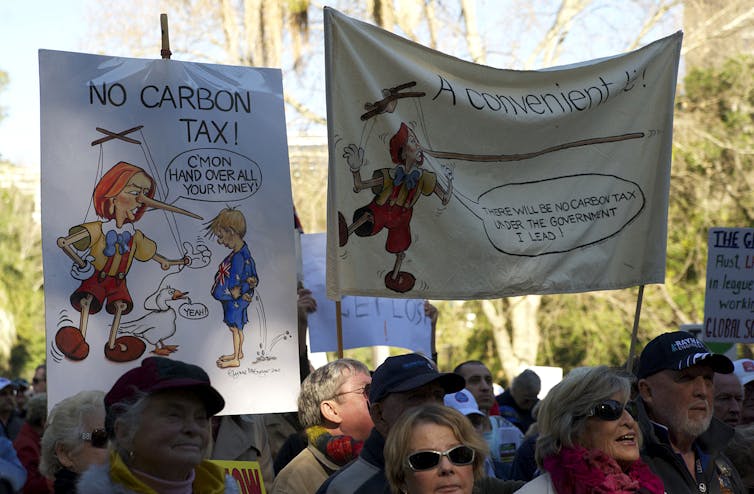 Moral reasoning helps shape climate beliefs, including climate scepticism.
Joel Carrett/AAP
Moral reasoning helps shape climate beliefs, including climate scepticism.
Joel Carrett/AAP
Framing climate decisions
How government and private climate decisions are framed and communicated affects who they resonate with, and whether they’re seen as legitimate.
Research suggests climate change could be made morally relevant to more people if official climate decisions appealed to moral values associated with right-wing political leanings.
A US study found liberals interpreted climate change in moral terms related to harm and care, while conservatives did not. But when researchers reframed pro-environmental messages in terms of moral values that resonated with conservatives, such as defending the purity of nature, differences in the environmental attitudes of both groups narrowed.
Indeed, research shows moral reframing can change pro-environmental behaviours of different political groups, including recycling habits.
In the US, people were found to recycle more after the practice was reframed in moral terms that resonated with their political ideology. For conservatives, the messages appealed to their sense of civic duty and respect for authority. For liberals, the messages emphasised recycling as an act of fairness, care and reducing harm to others.
Read more: Communicating climate change has never been so important, and this IPCC report pulls no punches
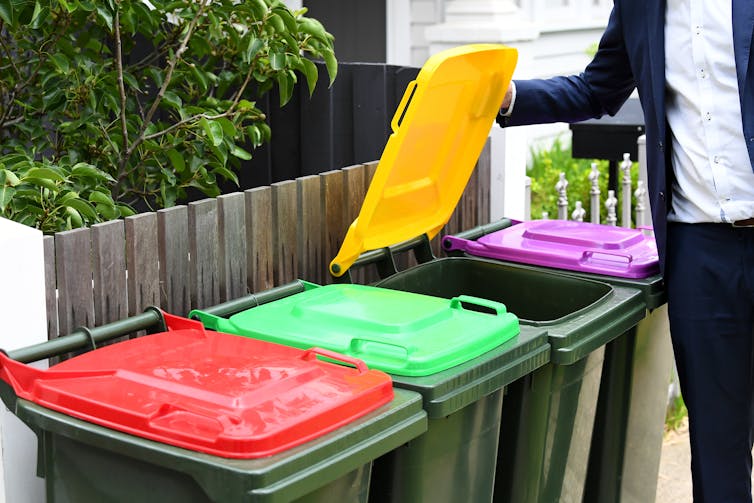 Reframing of messages can help encourage habits such as recycling.
James Ross/AAP
Reframing of messages can help encourage habits such as recycling.
James Ross/AAP
When moralising backfires
Clearly, morals are central to decision-making about the environment. In some cases, this can extend to people adopting – or being seen to adopt – a social identity with moral associations such as “zero-wasters”, “voluntary simplifiers” and cyclists.
People may take on these identities overtly, such as by posting about their actions on social media. In other cases, a practice someone adopts, such as cycling to work, can be construed by others as a moral action.
Being seen to hold a social identity based on a set of morals may actually have unintended effects. Research has found so-called “do-gooders” can be perceived by others as irritating rather than inspiring. They may also trigger feelings of inadequacy in others who, as a self-defense mechanism, might then dismiss the sustainable choices of the “do-gooder”.
For example, sociologists have theorised that some non-vegans avoid eating a more plant-based diet because they don’t want to be associated with the social identity of veganism.
It makes sense, then, that gentle encouragement such as “meat-free Mondays” is likely more effective at reducing meat consumption than encouraging people to “go vegan” and eliminate meat altogether.
Looking ahead
Personal climate decisions come with a host of moral values and quandaries. Understanding and navigating this moral dimension will be critical in the years ahead.
When making climate-related decisions, governments should consider the moral values of citizens. This can be achieved through procedures like deliberative democracy and citizen’s forums, in which everyday people are given the chance to discuss and debate the issues, and communicate to government what matters most to them.
Authors: Jacqueline Lau, Research Fellow, ARC Centre of Excellence for Coral Reef Studies, James Cook University

















