

Supporting menstrual health in Australia means more than just throwing pads at the problem
- Written by Erin C. Hunter, Lecturer in Global Health, University of Sydney
Menstruation has recently had a bit of a moment in Australia.
The Victorian and South Australian governments are now providing free pads and tampons in government schools, while New South Wales is trialling a pilot program to do the same.
Attention to menstruation is exciting and long overdue. But hurried efforts to provide free pads are not enough, particularly after decades of policy neglect.
To truly meet the needs of women, adolescent girls, and all people who menstruate, we must ask smart questions and develop evidence-based strategies for the long term.
What is menstrual health and how do we achieve it?
This year, a collaboration of global stakeholders and experts defined menstrual health as a state of complete physical, mental and social well-being in relation to the menstrual cycle.
The authors also shed light on the breadth of menstrual health needs. These extend well beyond access to pads, and highlight a number of things we need to consider if we’re going to better support menstrual health in Australia.
1. Information about the menstrual cycle
Knowledge about menstrual biology, reproduction and self-care practices is important. Understanding the body helps prevent distress and facilitates informed decision-making. This might include choice of menstrual product or decisions to seek medical support for period-related difficulties.
Studies in high-income countries have found women and girls don’t have enough information about menstruation, and research on menstrual disorders in Australia has found deficits in menstrual health literacy.
So we must ensure adolescents have comprehensive and timely education about menstruation in schools to promote body literacy and support their menstrual health.
 Research has found women and girls don’t necessarily have all the information they need when it comes to menstruation.
Shutterstock
Research has found women and girls don’t necessarily have all the information they need when it comes to menstruation.
Shutterstock
2. Materials and facilities to care for the body
Beyond having enough products to manage a period, menstrual health requires supportive spaces to change products, dispose of single-use materials (for example, pads and tampons) or wash reusable products (for example, menstrual cups). Spaces need to be comfortable and private.
In high-income countries, little attention has been given to whether school and workplace facilities are adequately meeting these needs. This is especially relevant as reusable products such as menstrual underwear and cups are growing in popularity.
3. Diagnosis, care and treatments for discomforts and disorders
Pleasingly, we’ve seen menstrual health research and action focusing on disorders, with endometriosis receiving increased investment in the most recent federal budget.
But 92% of adolescents and young women in Australia report painful periods.
We need to see comprehensive policy that acknowledges the breadth of menstrual needs, and the varied levels of pain and discomfort associated with menstruation.
Read more: I have painful periods, could it be endometriosis?
4. Positive and respectful environments
Menstruation continues to be stigmatised around the world. Social pressure to hide any sign of menstruation can dissuade girls and women from talking about their experiences or seeking support and advice. This can harm well-being.
Family members, education institutions, workplaces and government policies all have a role to play in creating environments that support those who menstruate.
For example, freedom to visit the toilet during the school day or to work flexibly around period pain can shape experiences of menstruation.
What’s the impact of unmet menstrual health needs?
A survey of young people in New Zealand found 8% reported missing school due to a lack of menstrual products.
A review of multiple studies estimated 12% of young women in high-income countries have missed school or university because of period pain.
We know from research in low-, middle-, and high-income countries there are a variety of other consequences of unmet menstrual health needs for physical, mental and social well-being.
But we have more to learn about the magnitude of these issues across populations and sub-groups.
Read more: Imagine having your period and no money for pads or tampons. Would you still go to school?
Providing free menstrual products may seem like a “silver bullet”. But evidence from low- and middle-income countries has shown providing such products is not enough to improve menstrual health.
This is also likely to be the case in high-income countries like Australia where stigma and inadequate education around menstruation remain challenges.
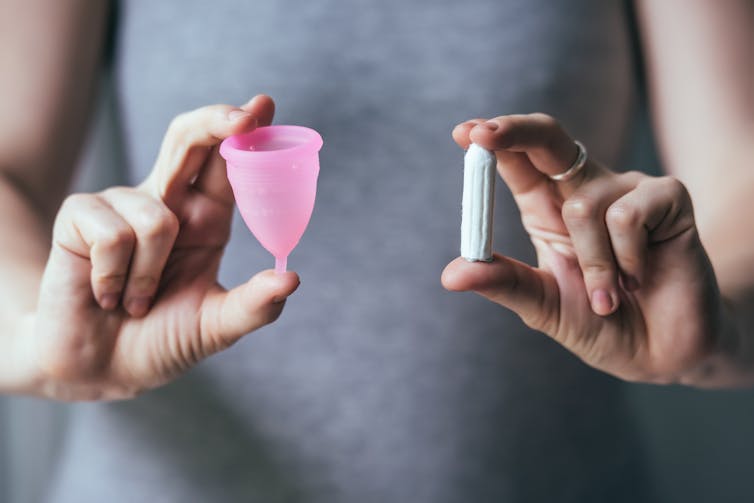 Pads and tampons are no longer the only way to manage periods.
Shutterstock
Pads and tampons are no longer the only way to manage periods.
Shutterstock
What are we overlooking?
A narrow focus on providing pads and tampons also risks suppressing menstrual product choice, and overlooks opportunities to support more environmentally friendly options.
Policies in Australia focus on providing single-use products, which are not very good for the environment. A menstruating person will use thousands of disposable pads and tampons over their lifetime — a large proportion of which is plastic waste.
Technologies such as menstrual underwear, reusable pads and menstrual cups present environmentally and economically sustainable alternatives. The median cost of a menstrual cup is A$32 and it can be used for up to ten years: that’s just 25 cents per period.
Australian adolescents’ feelings about reusable products remain largely unexplored. If research shows they’re receptive to these options, funding could be directed accordingly.
For example, installing wash basins or toilet hoses inside toilet cubicles in schools could facilitate the use of menstrual cups.
Read more: It's time to teach the whole story about ovulation and its place in the menstrual cycle
Menstruation matters
To inform effective policy responses, we need robust research exploring menstrual health needs in Australia and the extent to which these contribute to broader health and education outcomes.
And if we are to sustain the support of governments over the long term, we need evidence of what works. We must invest in developing effective responses and commit to evaluating the effects of our policies in supporting girls, women and all people who menstruate.
Authors: Erin C. Hunter, Lecturer in Global Health, University of Sydney

















