

New Zealand’s fossil record suggests more species lived in warmer waters. But the current rate of warming may break this pattern
- Written by Tom Womack, PhD Candidate, Te Herenga Waka — Victoria University of Wellington
 Marine organisms found in New Zealand’s past and present coastal waters.
Tom Womack, CC BY-ND
Marine organisms found in New Zealand’s past and present coastal waters.
Tom Womack, CC BY-ND
New Zealand may be relatively small, but its fossil record reveals a globally important ecological relationship between the number of species, their role in the ecosystem and ocean temperatures.
We used New Zealand’s exemplary fossil record of molluscs from the past 40 million years to examine how ocean temperatures influence the number of species. Our research shows a new, fundamental pattern.
We found an increase in species richness during periods with warmer ocean temperatures, as well as higher numbers of species filling similar ecological roles in New Zealand’s coastal cool-water ecosystems. The latter is a measure known as functional redundancy.
Such ecological redundancy can increase ecosystem resilience to environmental change. Taken at face value, our findings might be seen as encouraging news for New Zealand’s biodiversity in the face of global heating.
But our findings are based on natural changes in ocean temperature in the past. At the rate of current human-driven warming, the unfolding biodiversity crisis — hailed as the sixth mass extinction — is likely to play out differently from previous mass extinction events.
The impact on New Zealand’s future biodiversity is also likely to deviate from the patterns we can glean from the fossil record.
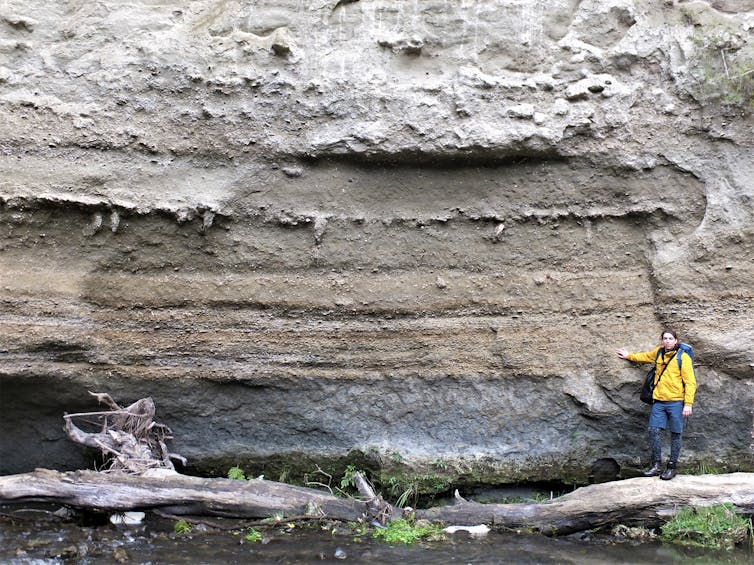 During past periods with warmer ocean temperatures, the number of marine species was likely higher.
James Crampton, CC BY-ND
During past periods with warmer ocean temperatures, the number of marine species was likely higher.
James Crampton, CC BY-ND
Measuring biodiversity
Biodiversity measures the variety of life on Earth, typically as the number or abundance of species. Past patterns of diversity can be used as a baseline for understanding how current human-induced changes are affecting it.
But biodiversity has many dimensions, and a simple count of the number of species only measures one aspect.
Recent research has highlighted the importance of ecosystem function, which describes the range of things organisms do in an ecosystem. Ecosystem function can be measured as functional richness.
For example, the common shellfish toheroa (Paphies ventricosa) and tuatua (Paphies subtriangulata) found along New Zealand’s shorelines are two different bivalve species. But both perform very similar ecological roles. They live on sandy beaches and filter microscopic food particles from the surf.
Read more: Ocean ecosystems take two million years to recover after mass extinction – new research
We refer to an increase in the number of species performing the same ecological role as high functional redundancy. This has been associated with better ecosystem resilience in the face of environmental change.
Conversely, the loss of species in an ecosystem with low functional redundancy is likely to lead to functional extinction, and as a result, ecosystem collapse.
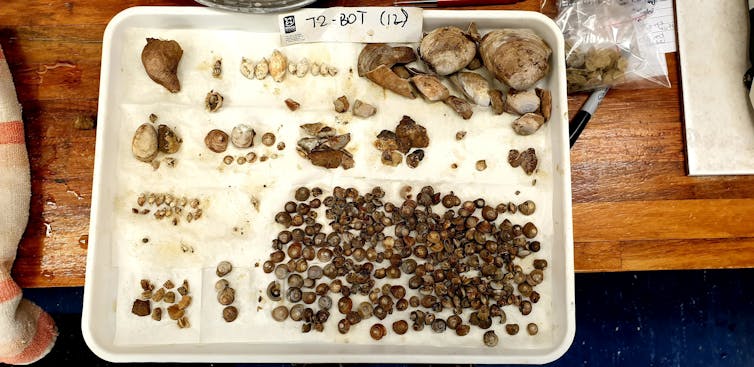 Our study is based on thousands of fossil collections from around New Zealand, similar to one shown here.
Tom Womack, CC BY-ND
Our study is based on thousands of fossil collections from around New Zealand, similar to one shown here.
Tom Womack, CC BY-ND
The results of our study are based on the geographic distribution of fossil species and the relationship to functional richness through geological time. This relationship implies that an increase in ocean temperature around New Zealand should lead to an increase in both the number of species living in our waters and functional redundancy.
This in turn suggests that during past warmer intervals, New Zealand’s ecosystems may have been more resilient to environmental change.
New Zealand’s fossil record of molluscs provides a baseline for what should be expected over hundreds of thousands to millions of years from natural ocean warming.
The observed link between functional redundancy and ocean temperature over the last 40 million years is consistent with observations from the modern, living marine fauna. The latter also shows increasing numbers of species and functional redundancy at warmer, lower latitudes. This suggests this pattern is a long-lived relationship of regional and global importance.
The future of New Zealand’s shallow marine ecosystems
The sixth mass extinction refers to the ongoing loss of global biodiversity as a direct cause of human activity.
As atmospheric carbon dioxide levels continue to rise in tandem with increased rates of habitat degradation, we commit currently surviving species to extinction far into the future. This is known as “extinction debt”.
But biodiversity is not evenly distributed across the Earth and individual regions may respond differently to environmental changes.
Read more: Ancient sea creatures spent years crossing the ocean on rafts – we've worked out how it was possible
What does this mean for the conservation of New Zealand’s biodiversity?
Although species richness is expected to increase from the isolated effect of climate warming in New Zealand over long timescales, an ecosystem can simultaneously gain species through species migration while losing native species through extinction.
Recent research also suggests that the unfolding sixth mass extinction is associated with the selective removal of functional groups, for example large predatory fish. This will likely lead to increased rates of functional extinction.
Studies of the global marine fossil record suggest relatively minimal losses of functional richness during even the largest extinction events in Earth’s history.
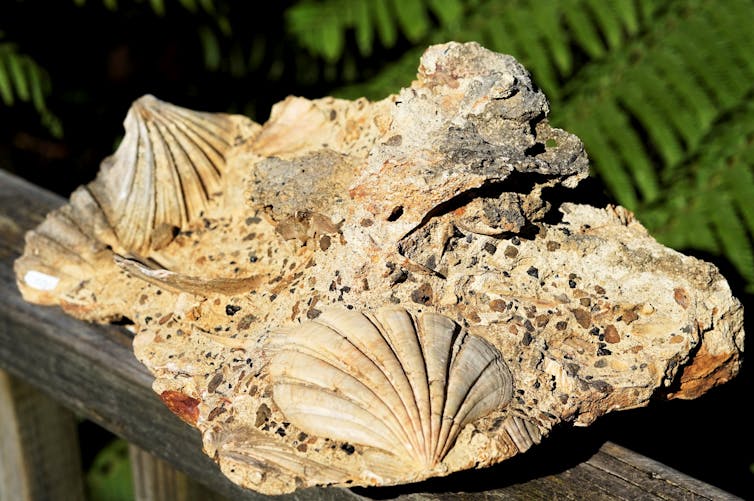 Fossilised scallops from the Chatham Islands, New Zealand.
Tom Womack, CC BY-ND
Fossilised scallops from the Chatham Islands, New Zealand.
Tom Womack, CC BY-ND
This is corroborated in New Zealand’s shallow marine fossil record, where large drops in species richness over the last 40 million years have resulted in minimal loss of functional richness. As a result, the sixth mass extinction could be different and have unforeseeable consequences.
For these reasons, New Zealand’s conservation needs to consider the long-term impact of climate change and focus not only on protecting native species but on preserving ecosystem function.
As we commit to further ocean warming and biodiversity loss, we increase the extinction debt of the future, both globally and regionally. There is growing evidence the impact of human activity, including global heating, will deviate from patterns predicted from natural environmental change in the past.
This is particularly important for temperate marine ecosystems. They are vulnerable to climate change, but cover a large proportion of the Earth’s marine realm. In New Zealand, these ecosystems are home to many endemic animals and plants — our taonga to protect.
Authors: Tom Womack, PhD Candidate, Te Herenga Waka — Victoria University of Wellington

















