

Yes, it is entirely possible for Australia to phase out thermal coal within a decade
- Written by John Quiggin, Professor, School of Economics, The University of Queensland
Australia has received seemingly contradictory messages about coal this week.
In a UK study published today in Nature, scientists found Australia must keep 95% of coal in the ground if we have any hope of stopping the planet warming beyond the crucial limit of 1.5℃.
These findings echo the message of senior United Nations official Selwin Hart, who earlier this week urged Australia to end the use of coal by 2030. He warned if the world doesn’t boost climate action urgently, Australia can expect more frequent and severe climate disasters such as droughts, heatwaves, fires and floods.
Meanwhile, markets for coal seem to be sending the opposite message.
The price of Newcastle thermal coal recently reached a record high of US$180 per tonne due to rising electricity demand in India, China and other Asian countries. That seems to suggest whatever the consequences, Australia and the world are not going to give up on coal or other carbon-based fuels.
But it’s a mistake to place too much weight on fluctuations in coal markets. Earlier this year, the price was about US$50 per tonne and seemed likely to fall further. The current price tells us nothing about the choices we face in reducing emissions by 2030.
It’s entirely feasible for Australia to phase out thermal coal by 2030 — we just need political will.
World economies must decarbonise
The authors of the new modelling study in Nature examined the world’s reserves of oil, gas and coal, and determined how much would have to be left untouched for at least a 50% chance of limiting global warming to 1.5℃.
Overall, it found nearly 60% of the world’s oil and fossil methane gas, and 90% of coal must remain unextracted by 2050. But the estimate for exporters like Australia is even higher.
This means production in most regions must peak now, or in the next decade, and that stronger policies are needed to restrict production and reduce demand.
The study reinforces how urgent it is to decarbonise economies. As Selwin Hart, the Special Advisor to the UN Secretary-General on Climate Action, noted in his speech to the Crawford Leadership Forum:
Decarbonisation of the global economy is quickly gathering pace. And there are huge opportunities to create more jobs, better health, and a stronger and fairer economy for those countries and companies that move first and fastest.
Is an end to coal feasible?
But would it really be possible for Australia to phase out coal by 2030, as Hart insists?
To consider this, it’s important to first distinguish between thermal coal and metallurgical coal. Thermal coal is used to generate electricity, while metallurgical coal is used in steelmaking.
Blast furnaces using metallurgical coal will ultimately be replaced by alternative technologies, such as using “green” hydrogen produced using clean electricity.
That process has begun, but it will take a long time, and can’t start until electricity generation is decarbonised. So, it makes sense to focus on phasing out thermal coal first.
But if decarbonisation of the global economy requires a rapid end to the use of thermal coal, why has its price suddenly surged?
A number of factors determine the thermal coal market, and fluctuations don’t tell us much about what the coal market will look like in 2030.
The recent increase in prices was caused by a combination of the rapid recovery from the pandemic recession, rising gas prices, weather-related disruptions to coal supply from Indonesia, and drought in China. It’s worth noting that despite high prices, the volume of seaborne thermal coal has actually declined.
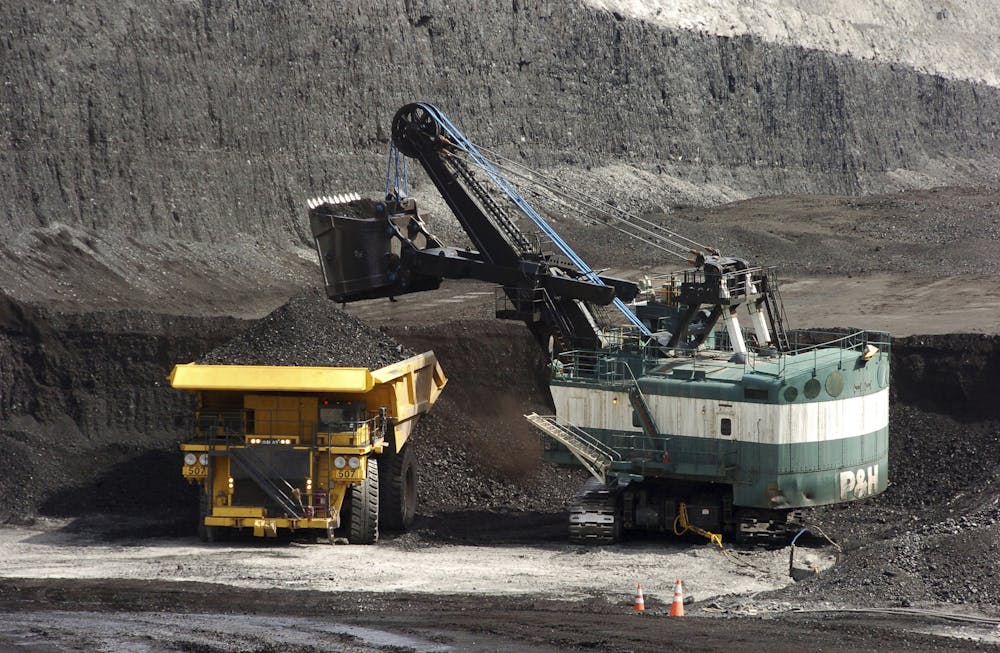 95% of Australia’s coal must stay in the ground to cap the planet’s warming at 1.5℃
(AP Photo/Matthew Brown, File
95% of Australia’s coal must stay in the ground to cap the planet’s warming at 1.5℃
(AP Photo/Matthew Brown, File
Ending thermal coal in Australia would be easy
Given a modest amount of political will, or just the end of obstructionism from the federal government, Australia could easily replace coal-fired electricity generation with a combination of solar and wind, backed by storage.
Most of Australia’s coal-fired power plants were commissioned in the 20th century with obsolete sub-critical technology, and would be approaching the end of their operational lives even in the absence of climate change concerns.
Bringing those dates forward to 2030 or earlier could be almost costless. We could easily double our current rate of installation of utility-scale solar and wind generation, if the federal government got out of the way and let the states tackle the job.
Only five coal plants have been commissioned this century. The Bluewater plant in Western Australia has already been written off as worthless because of competition from solar and wind power.
The remaining four, all in Queensland, have a total capacity of less than 3 gigawatts. Allowing for the fact solar photovoltaic (PV) only operates in daylight hours, this is about the same as one million 10-kilowatt rooftop solar installations (about average for new installations). Queensland already has more than 750,000 solar rooftops, and capacity for another million.
More notably, the cost of decarbonising electricity supply is a fraction of the amount we have collectively spent to respond to the problem of the COVID-19 pandemic. Not only is COVID a smaller threat in the long run than climate change but a comprehensive response to pandemics requires us to stabilise the climate and stop the destruction of natural environments.
Read more: How to transition from coal: 4 lessons for Australia from around the world
Managing the transition for the coal workforce would be more challenging, but still entirely feasible, as countries such as Spain and Germany have shown.
In a report I prepared for the Australia Institute last year, I found Australia could successfully transition the workforce with a mixture of measures including early retirement, retraining, and investments in renewable energy targeted at coal-dependent regions.
The cost of this would be around A$50 million a year, over ten years. That’s less than the estimated cost of a week of COVID lockdown in Sydney.
 It would take only a modest amount of political will to replace coal-fired electricity generation with renewables.
AAP Image/Mick Tsikas
It would take only a modest amount of political will to replace coal-fired electricity generation with renewables.
AAP Image/Mick Tsikas
But would this condemn developing countries to energy poverty?
The reality is it makes economic and environmental sense for all countries to shift away from coal.
The central government in China has committed to reach net zero carbon emissions by 2060. But many provincial governments still see investment in coal plants and other polluting industries as an engine of growth, not to mention a lucrative source of kickbacks and donations.
The picture in India is similarly complex. Coal remains the main source of electricity, but most electricity generation businesses have abandoned new investments in coal-fired power and many have stopped bidding for access to domestic coal supplies.
We can’t do much to influence energy policy in China and India. But a commitment to reduce and ultimately eliminate exports of thermal coal would not, as some have suggested, condemn these and other developing countries to poverty.
Rather, it would strengthen the hand of advocates of clean energy against the established interest groups that defend coal.
Authors: John Quiggin, Professor, School of Economics, The University of Queensland

















