

Saving these family-focused lizards may mean moving them to new homes. But that's not as simple as it sounds
- Written by Holly Bradley, PhD candidate, Curtin University
Am I not pretty enough? This article is part of The Conversation’s series introducing you to unloved Australian animals that need our help.
Spiny-tailed skinks (Egernia stokesii badia), known as meelyu in the local Badimia language in Western Australia, are highly social lizards that live together in family groups — an uncommon trait among reptiles.
They’re culturally significant to the Badimia people but habitat degradation and mining has put them under threat of extinction.
These sturdy, mottled lizards — which live in colonies in the logs of fallen trees and branches — are a candidate for what researchers call “mitigation translocation”.
That’s where wildlife are relocated away from high-risk areas (such as those cleared for urban development or mining) to lower risk areas.
It might sound simple. But research shows these mitigation translocation decisions are often made on an ad hoc basis, without a long-term strategic plan in place.
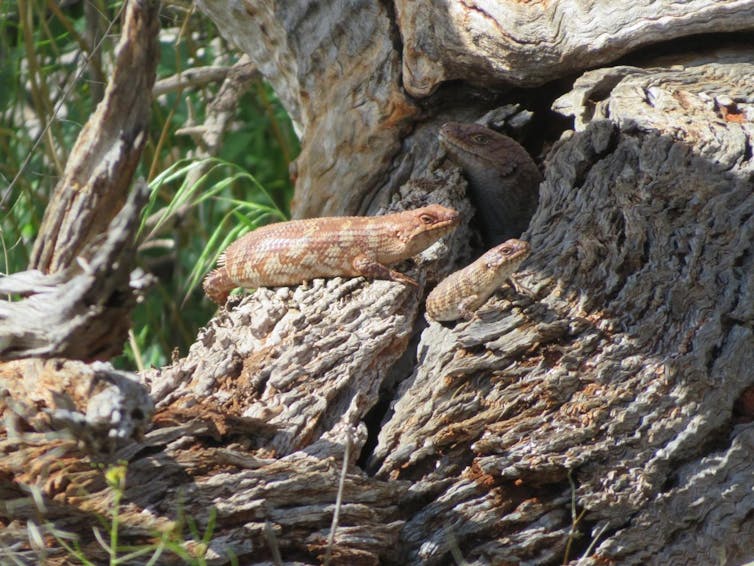 Example of the range in individual size/age occupying the same permanent log pile structure within the Mid West region of Western Australia.
Holly Bradley, Author provided
Example of the range in individual size/age occupying the same permanent log pile structure within the Mid West region of Western Australia.
Holly Bradley, Author provided
Not enough pre-planning or follow-up
There has been much research into assisted relocation of larger, charismatic mammals and birds. But other animals, such as reptiles with a less positive social image, have been less widely studied.
Our recent research has found there is often little pre-planning or follow-up to monitor success of mitigation translocations, even though reptile mitigation translocations do take place, sometimes on a large scale.
In fact, fewer than 25% of mitigation translocations worldwide actually result in long-term self-sustaining populations.
Mitigation translocation methods are also not being improved. Fewer than half of published mitigation translocation studies have explicitly compared or tested different management techniques.
Mitigation translocation studies also rarely consider long-term implications such as how relocated animals can impact the site to which they are moved — for example, if the ecosystem has limited capacity to support the relocated animals.
But it’s not just about ecosystem benefits. Preservation of species such as meelyu also has cultural benefits — but mitigation translocation can only be part of the solution if it’s done strategically.
Read more: Hundreds of Australian lizard species are barely known to science. Many may face extinction
The meelyu: a totem species
As part of Holly Bradley’s research into understanding how to protect meelyu from further loss in numbers, she had the privilege to meet with Badimia Indigenous elder, Darryl Fogarty, who identified meelyu as his family’s totem.
Totemic species can represent a person’s connection to their nation, clan or family group.
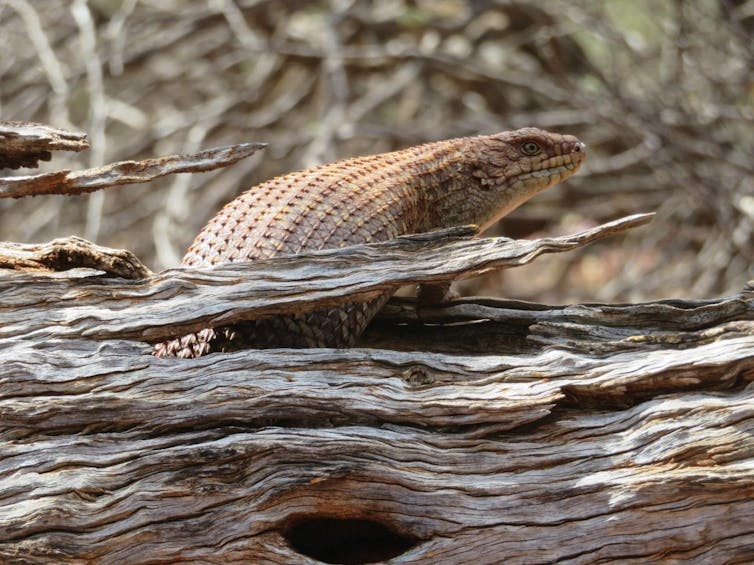 The meelyu or Western Spiny-tailed Skink is significant to the Badimia people and require translocation as part of mine site restoration and mitigation of population loss.
Holly Bradley, Author provided
The meelyu or Western Spiny-tailed Skink is significant to the Badimia people and require translocation as part of mine site restoration and mitigation of population loss.
Holly Bradley, Author provided
Unfortunately, Darryl Fogarty cannot remember the last time he saw the larger meelyu in the area. The introduction of European land management and feral species into Western Australia has upset the ecosystem balance — and this also has cultural consequences.
Preserving totemic fauna in their historic range can be a critical component of spiritual connection to the land for Indigenous groups in Australia.
In the past, this spiritual accountability for the stewardship of a totem has helped protect species over the long term, with this responsibility passed down between generations.
Before European colonisation, this traditional practice helped to preserve biodiversity and maintain an abundance of food supplies.
A strategic approach to future meelyu relocations from areas of active mining is crucial to prevent further population losses — for both ecological and cultural reasons.
Good mitigation translocation design
If we are to use mitigation translocation to shore up their numbers, we need effective strategies in place to boost the chance it will actually help the meelyu.
Good mitigation translocation design includes factors such as:
selecting a good site and understanding properly whether it can support new wildlife populations
having a good understanding of the animal’s ecological needs and how they fit with the environment to which they’re moving
using the right methods of release for the circumstances. For example, is it better to use a soft release method, where an individual animal is gradually acclimatised to its new environs over time? Or a hard release method, where the animal is simply set free in its new area?
having a good understanding of the cultural factors involved.
A holistic approach
A holistic approach to land management and restoration practice considers both cultural and ecological significance.
It supports the protection and return of healthy, functioning ecosystems — as well as community well-being and connection to nature.
Mitigation translocation could have a role to play in protection of culturally significant wildlife like the meelyu, but only when it’s well planned, holistic and part of a long term strategy.
Read more: Photos from the field: Australia is full of lizards so I went bush to find out why
Authors: Holly Bradley, PhD candidate, Curtin University

















