

Research reveals why pet owners keep their cats indoors – and it's not to protect wildlife
- Written by Lily van Eeden, Postdoctoral research fellow, Monash University
Cat owners are urged to keep their pet indoors for a variety of reasons, including protecting wildlife and preventing the spread of disease. But our research has found an entirely different motivator for containing cats.
Concern for their cat’s safety is the primary reason people keep cats inside. And people who allow cats to roam are also motivated by concern for the animal’s well-being.
Keeping domestic cats properly contained is crucial to protecting wildlife. Cats are natural predators – even if they’re well fed. Research last year found each roaming pet cat kills 186 reptiles, birds and mammals per year.
If we want more domestic cats kept indoors, it’s important to understand what motivates cat owners. Our research suggests messages about protecting wildlife are, on their own, unlikely to change cat owners’ behaviour.
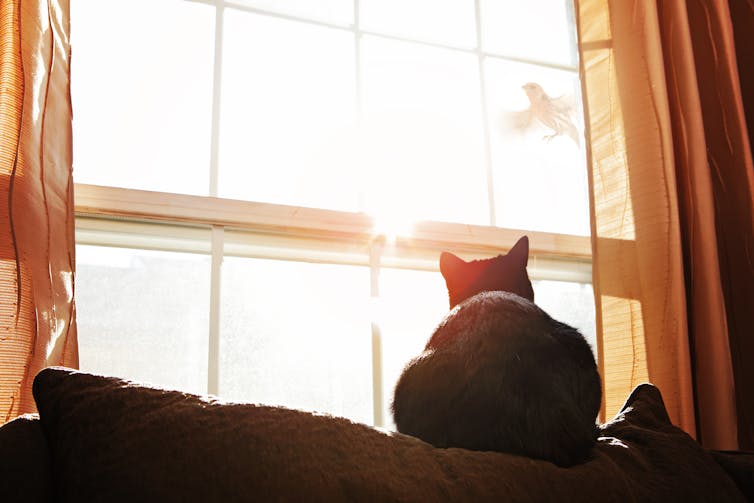 Cats are natural predators, and can kill many animals each year if left to roam.
Shutterstock
Cats are natural predators, and can kill many animals each year if left to roam.
Shutterstock
Why keep your cat indoors?
Cat containment involves confining the animals to their owners’ premises at all times.
In the Australian Capital Territory, cat containment is mandatory in several areas. From July next year, all new cats must be contained across the territory, unless on a leash.
In Victoria, about half of local councils have some form of cat containment legislation. Current revisions to Domestic Animal Management Plans could mean the practice becomes more widespread.
Read more: One cat, one year, 110 native animals: lock up your pet, it's a killing machine
Cats have long been part of human societies and play an important social role in their owners’ lives. But our affection for the animals means efforts to keep cats contained can be met with opposition.
Officials, conservation groups and others put forward a range of reasons for containing cats, including:
preventing cats from spreading diseases and parasites such as toxoplasmosis to both people and wildlife
reducing threats to wildlife, especially at night
reducing unwanted cat pregnancies
avoiding disputes with neighbours, including noise complaints, and cats defecating or spraying in garden beds and children’s sandpits
protecting cats from injury or death - such as being hit by a vehicle, attacked by dogs, snake bite and exposure to diseases and parasites.
So which argument is most persuasive? Our research suggests it’s the latter.
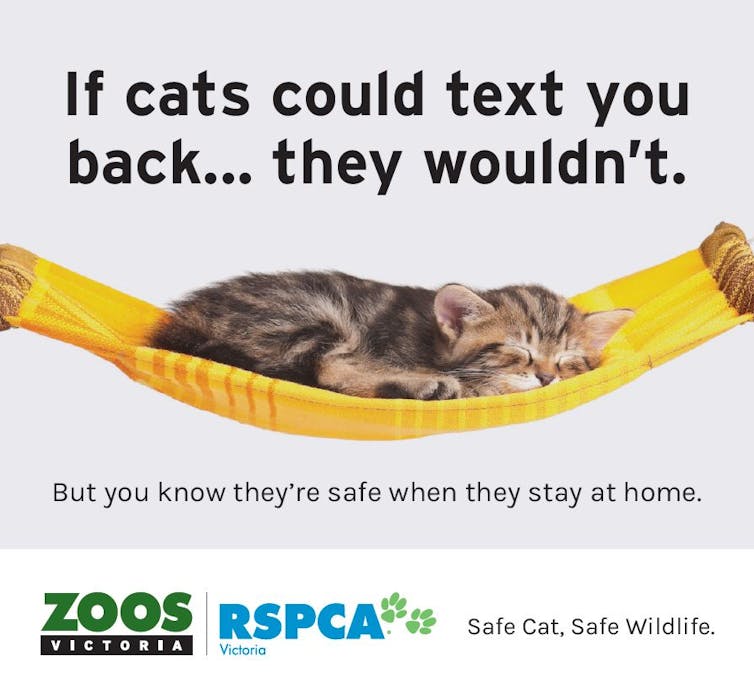 The Safe Cats Safe Wildlife campaign focuses on keeping cats safe.
Zoos Victoria.
The Safe Cats Safe Wildlife campaign focuses on keeping cats safe.
Zoos Victoria.
What we found
We surveyed 1,024 people in Victoria – 220 of whom were cat owners.
We found 53% of cat owners did not allow roaming. These people were more likely to hold concerns about risks to cats’ safety than cat owners who allowed roaming. They were also less likely to believe cats have a right to roam.
Some 17% of cat owners allowed their cats unrestricted access to the outdoors day and night, while 30% contained their cats at night but allowed some unrestricted outdoor access during the day.
Both cat owners and other respondents generally believed cat owners should manage their pet’s roaming behaviour. But for cat owners, concern about harm to wildlife was not a significant predictor of containment behaviour.
Instead, people who keep their cats contained were more likely to be worried that their cat might be lost, stolen, injured or killed.
It’s not that cat owners don’t care about native animals - only about one in ten cat owners said they’d never seriously considered how their cat affects wildlife. But our survey results show this isn’t a big motivation for keeping cats indoors.
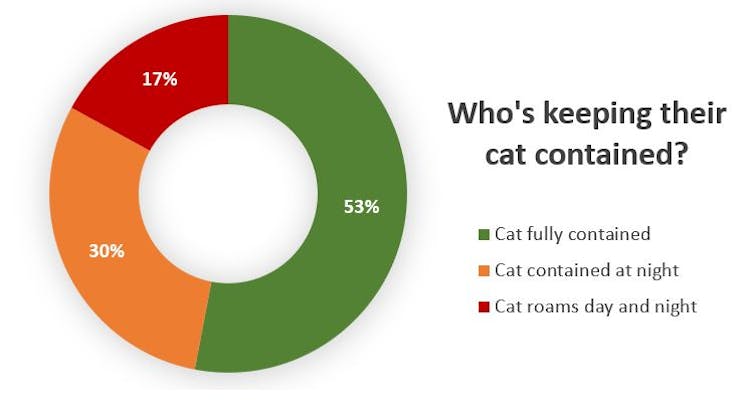 What Victorian cat owners are doing, based on our survey findings.
Author provided.
What Victorian cat owners are doing, based on our survey findings.
Author provided.
Roaming is dangerous
A roaming lifestyle can be risky to cats. A 2019 study of more than 5,300 Australian cat owners found 66% had lost a cat to a roaming incident such as a car accident or dog attack, or the cat simply going missing.
Despite the risks, people who let their cats roam are more likely to think the practice is better for the animal’s well-being – for example, that hunting is normal cat behaviour.
Owners who let their cat roam were more likely than those who contained their cat to believe their cat did not often hunt. While not all cats kill wildlife, those that do typically only bring home a small proportion of their catch. That means owners can be unaware of their cats’ impact.
Cat owners must be made aware of the risks of roaming and equipped with the tools to keep their cats happy and safe at home. Unfortunately, research shows many Australian cat owners are not providing the safe environment and stimulation their cat needs when contained.
Cat containment doesn’t have to mean keeping the animal permanently in the house – nor does it require building them a Taj Mahal on the patio.
Cats can be outside while supervised or walked on leash. You can also cat-proof your backyard fence to keep them in.
Resources such as Safe Cat Safe Wildlife help owners meet their cat’s mental, physical and social needs while keeping them contained.
Moonee Valley City Council partners with the Safe Cats Safe Wildlife campaign to promote responsible cat ownership.Changing containment behaviour
Our study shows cat containment campaigns can be more effective if messaging appeals to owners’ concern for their cats’ well-being. These messages could be delivered by trusted people such as vets.
Helping owners understand that cats’ needs can be met in containment, and giving them the tools to achieve this, may be the best way to protect wildlife.
Demonising cats is not the answer. The focus must shift to the benefits of containment for cats’ well-being if we hope to achieve a cat-safe and wildlife-safe future.
Read more: I've always wondered: can I flush cat poo down the toilet?
Authors: Lily van Eeden, Postdoctoral research fellow, Monash University

















