

Indigenous knowledge and the persistence of the 'wilderness' myth
- Written by Michael-Shawn Fletcher, Associate Professor in Biogeography, The University of Melbourne
According to the Oxford English dictionary, wilderness is defined as:
A wild or uncultivated region or tract of land, uninhabited, or inhabited only by wild animals; “a tract of solitude and savageness”.
Aboriginal people in Australia view wilderness, or what is called “wild country”, as sick land that’s been neglected and not cared for. This is the opposite of the romantic understanding of wilderness as pristine and healthy – a view which underpins much non-Indigenous conservation effort.
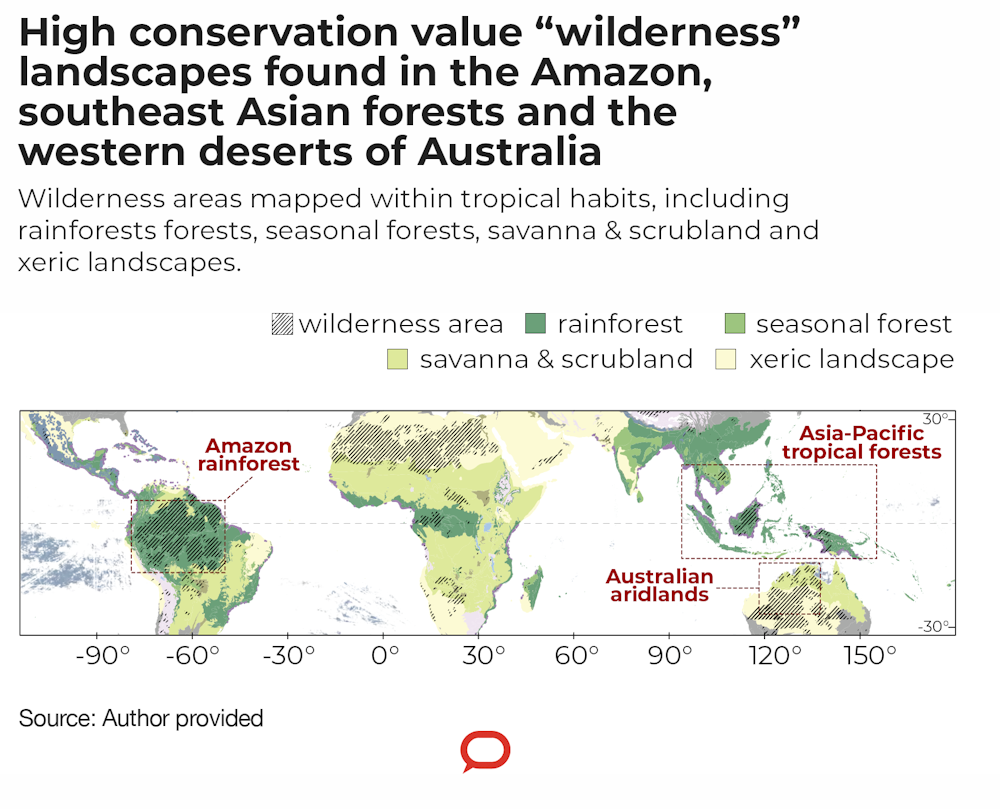
In a recent paper for the Proceedings of the National Academy of Science, we demonstrate how many iconic “wilderness” landscapes – such as the Amazon, forests of Southeast Asia and the western deserts of Australia, are actually the product of long-term management and maintenance by Indigenous and local peoples.
But this fact is often overlooked - a problem which lies at the heart of many of the world’s pressing environmental problems. Indigenous and local people are now excluded from many areas deemed “wilderness”, leading to the neglect or erasure of these lands.
 Frontiers of Ecology and Environment
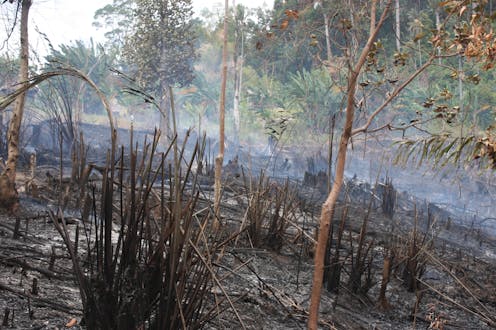
Similarly, the forests of Southeast Asia and the Pacific are some of the most biodiverse regions on Earth. These forests have been managed for thousands of years using rotational agriculture based on small-scale forest clearing, burning and fallowing. Scientific attempts to define the last remaining “wild places” falsely map these areas as wilderness.
Rather than being wild places, agriculture has actively promoted landscape biodiversity across the region, while supporting the lives and livelihoods of tens of millions of Indigenous and local peoples.
In the central deserts of Australia, areas mapped today as “wilderness” are the ancestral homes of many Aboriginal peoples who have actively managed the land for tens of thousands of years.
Removal of Traditional Owners in the 1960s had catastrophic effects on both the people and the land, such as uncontrolled wildfires and biodiversity loss. Unsurprisingly, a return of Aboriginal management to this region has seen a reduction in wildfires, a significant increase in biodiversity and healthier people.
Read more:
'The pigs can smell man': how decimation of Borneo's ancient rainforests threatens hunters and the hunted
Frontiers of Ecology and Environment
Similarly, the forests of Southeast Asia and the Pacific are some of the most biodiverse regions on Earth. These forests have been managed for thousands of years using rotational agriculture based on small-scale forest clearing, burning and fallowing. Scientific attempts to define the last remaining “wild places” falsely map these areas as wilderness.
Rather than being wild places, agriculture has actively promoted landscape biodiversity across the region, while supporting the lives and livelihoods of tens of millions of Indigenous and local peoples.
In the central deserts of Australia, areas mapped today as “wilderness” are the ancestral homes of many Aboriginal peoples who have actively managed the land for tens of thousands of years.
Removal of Traditional Owners in the 1960s had catastrophic effects on both the people and the land, such as uncontrolled wildfires and biodiversity loss. Unsurprisingly, a return of Aboriginal management to this region has seen a reduction in wildfires, a significant increase in biodiversity and healthier people.
Read more:
'The pigs can smell man': how decimation of Borneo's ancient rainforests threatens hunters and the hunted
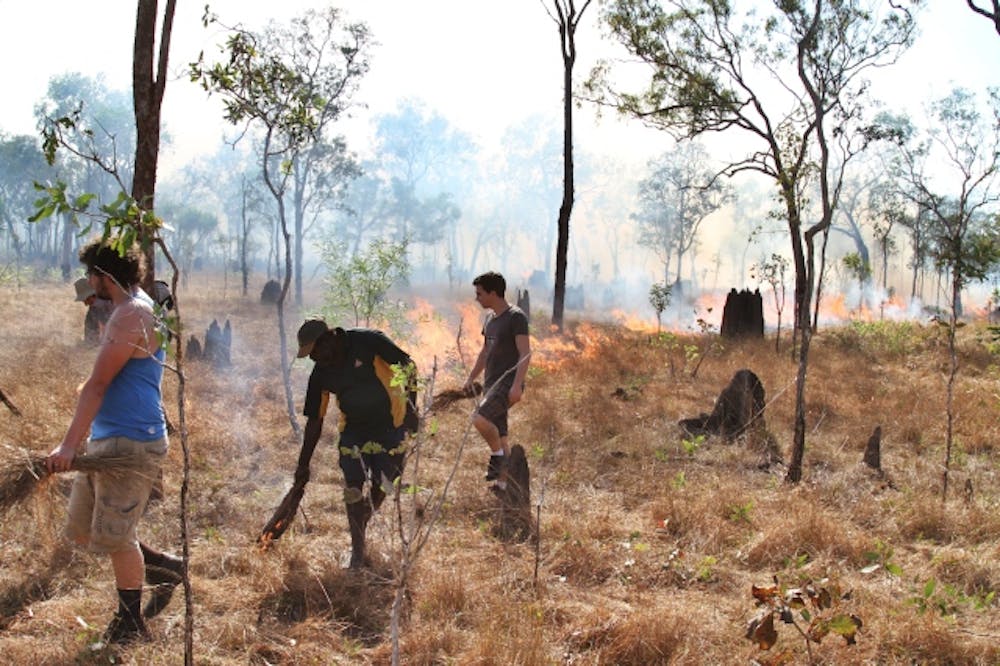 In central Arnhem Land, Michael-Shawn Fletcher burning with his students and Otto Campion Bulmaniya from the Arafura Swamp Ranger Aboriginal Corporation.
Supplied by author, Author provided (no reuse)
A way forward
By framing landscapes created and managed by Indigenous and local peoples as wilderness, we are denying the land the care it requires. The effects of this neglect are evident in the catastrophic wildfires and environmental degradation occurring in Australia, northwest America and the Amazon – all lands invaded and colonised by Europeans.
Climate change is now making these problems worse.
Science alone has failed to solve these problems. Imposing land management approaches developed in Europe have failed. The idea of wilderness is destructive, and must be abandoned. We need new ways of engaging with the world around us if we’re to live sustainably on this planet.
Indigenous and local peoples must be engaged in the full range of efforts that affect their lands. This includes developing and implementing environmental initiatives and policymaking, the production and execution of research, and environmental management.
There are models that can be followed, such as developing Indigenous and community-conserved areas, Indigenous-protected and -conserved areas, or similar rights-based initiatives that merge the science and technology with the power of Indigenous and local knowledge.
This is one way forward in effectively decolonising conservation and making the Earth healthy again.
Read more:
Australia, you have unfinished business. It's time to let our 'fire people' care for this land
Authors: Michael-Shawn Fletcher, Associate Professor in Biogeography, The University of Melbourne
In central Arnhem Land, Michael-Shawn Fletcher burning with his students and Otto Campion Bulmaniya from the Arafura Swamp Ranger Aboriginal Corporation.
Supplied by author, Author provided (no reuse)
A way forward
By framing landscapes created and managed by Indigenous and local peoples as wilderness, we are denying the land the care it requires. The effects of this neglect are evident in the catastrophic wildfires and environmental degradation occurring in Australia, northwest America and the Amazon – all lands invaded and colonised by Europeans.
Climate change is now making these problems worse.
Science alone has failed to solve these problems. Imposing land management approaches developed in Europe have failed. The idea of wilderness is destructive, and must be abandoned. We need new ways of engaging with the world around us if we’re to live sustainably on this planet.
Indigenous and local peoples must be engaged in the full range of efforts that affect their lands. This includes developing and implementing environmental initiatives and policymaking, the production and execution of research, and environmental management.
There are models that can be followed, such as developing Indigenous and community-conserved areas, Indigenous-protected and -conserved areas, or similar rights-based initiatives that merge the science and technology with the power of Indigenous and local knowledge.
This is one way forward in effectively decolonising conservation and making the Earth healthy again.
Read more:
Australia, you have unfinished business. It's time to let our 'fire people' care for this land
Authors: Michael-Shawn Fletcher, Associate Professor in Biogeography, The University of MelbourneRead more https://theconversation.com/indigenous-knowledge-and-the-persistence-of-the-wilderness-myth-165164

















