

Australia's 'enduring' offshore processing deal with Nauru
- Written by Savitri Taylor, Associate Professor, Law School, La Trobe University
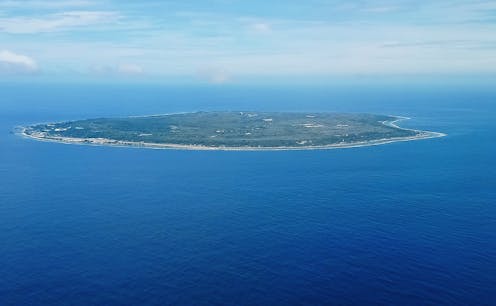
Late last month, Home Affairs Minister Karen Andrews and the president of Nauru, Lionel Aingimea, quietly announced they had signed a new agreement to establish an “enduring form” of offshore processing for asylum seekers taken to the Pacific island.
The text of the new agreement has not been made public. This is unsurprising.
All the publicly available information indicates Australia’s offshore processing strategy is an ongoing human rights — not to mention financial — disaster.
The deliberate opaqueness is intended to make it difficult to hold the government to account for these human and other costs. This is, of course, all the more reason to subject the new deal with Nauru to intense scrutiny.
Policies 20 years in the making
In order to fully understand the new deal — and the ramifications of it — it is necessary to briefly recount 20 years of history.
In late August 2001, the Howard government impulsively refused to allow asylum seekers rescued at sea by the Tampa freighter to disembark on Australian soil. This began policy-making on the run and led to the Pacific Solution Mark I.
The governments of Nauru and Papua New Guinea were persuaded to enter into agreements allowing people attempting to reach Australia by boat to be detained in facilities on their territory while their protection claims were considered by Australian officials.
By the 2007 election, boat arrivals to Australia had dwindled substantially.
In February 2008, the newly elected Labor government closed down the facilities in Nauru and PNG. Within a year, boat arrivals had increased dramatically, causing the government to rethink its policy.
After a couple of false starts, it signed new deals with Nauru and PNG in late 2012. An expert panel had described the new arrangements as a “necessary circuit breaker to the current surge in irregular migration to Australia”.
This was the Pacific Solution Mark II. In contrast to the first iteration, it provided for boat arrivals taken to Nauru and PNG to have protection claims considered under the laws and procedures of the host country.
Moreover, the processing facilities were supposedly run by the host countries, though in reality, the Australian government outsourced this to private companies.
Despite the new arrangements, the boat arrivals continued. And on July 19, 2013, the Rudd government took a hardline stance, announcing any boat arrivals after that date would have “have no chance of being settled in Australia as refugees”.
New draconian changes to the system
The 1,056 individuals who had been transferred to Nauru or PNG before July 19, 2013 were brought to Australia to be processed.
PNG agreed that asylum seekers arriving after this date could resettle there, if they were recognised as refugees.
Nauru made a more equivocal commitment and has thus far only granted 20-year visas to those it recognises as refugees.
The Coalition then won the September 2013 federal election and implemented the military-led Operation Sovereign Borders policy. This involves turning back boat arrivals to transit countries (like Indonesia), or to their countries of origin.
The cumulative count of interceptions since then stands at 38 boats carrying 873 people. The most recent interception was in January 2020.
It should be noted these figures do not include the large number of interceptions undertaken at Australia’s request by transit countries and countries of origin.
What this means is the mere existence of the offshore processing system — even in the more draconian form in place after July 2013 — has not deterred people from attempting to reach Australia by boat.
Rather, the attempts have continued, but the interception activities of Australia and other countries have prevented them from succeeding.
No new asylum seekers in Nauru or PNG since 2014
Australia acknowledges it has obligations under the UN Convention Relating to the Status of Refugees — and other human rights treaties — to refrain from returning people to places where they face the risk of serious harm.
As a result, those intercepted at sea are given on-water screening interviews for the purpose of identifying those with prima facie protection claims.
Those individuals are supposed to be taken to Nauru or PNG instead of being turned back or handed back. Concerningly, of the 873 people intercepted since 2013, only two have passed these screenings: both in 2014.
This means no asylum seekers have been taken to either Nauru or PNG since 2014. Since then, Australia has spent years trying to find resettlement options in third countries for recognised refugees in Nauru and PNG, such as in Cambodia and the US.
As of April 30, 131 asylum seekers were still in PNG and 109 were in Nauru.
Read more: Explainer: the medevac repeal and what it means for asylum seekers on Manus Island and Nauru
A boon to the Nauruan government
Australia has spent billions on Pacific Solution Mark II with no end in sight.
As well as underwriting all the infrastructure and operational costs of the processing facilities, Australia made it worthwhile for Nauru and PNG to participate in the arrangements.
For one thing, it promised to ensure spillover benefits for the local economies by, for example, requiring contractors to hire local staff. In fact, in 2019–20, the processing facility in Nauru employed 15% of the country’s entire workforce.
And from the beginning, Nauru has required every transferee to hold a regional processing centre visa. This is a temporary visa which must be renewed every three months by the Australian government.
The visa fee each time is A$3,000, so that’s A$12,000 per transferee per year that Australia is required to pay the Nauruan government.
Where a transferee is found to be a person in need of protection, that visa converts automatically into a temporary settlement visa, which must be renewed every six months. The temporary settlement visa fee is A$3,000 per month — again paid by the Australian government.
In 2019-20, direct and indirect revenue from the processing facility made up 58% of total Nauruan government revenue. It is no wonder Nauru is on board with making an “enduring form” of offshore processing available to Australia.
Read more: Cruel, costly and ineffective: Australia's offshore processing asylum seeker policy turns 9
‘Not to use it, but to be willing to use it’
In 2016, the PNG Supreme Court ruled the detention of asylum seekers in the offshore processing facility was unconstitutional. Australia and PNG then agreed to close the PNG facility in late 2017 and residents were moved to alternative accommodation. Australia is underwriting the costs.
Australia decided, however, to maintain a processing facility in Nauru. Senator Jim Molan asked Home Affairs Secretary Michael Pezzullo about this in Senate Estimates in February 2018, saying:
So it’s more appropriate to say that we are not maintaining Nauru as an offshore processing centre; we are maintaining a relationship with the Nauru government.
Pezzullo responded,
the whole purpose is, as you would well recall, in fact not to have to use those facilities. But, as in all deterrents, you need to have an asset that is credible so that you are deterring future eventualities. So the whole point of it is actually not to use it but to be willing to use it.
This is how we ended up where we are now, with a new deal with the Nauru government for an “enduring” — that is indefinitely maintained — offshore processing capability, at great cost to the Australian people.
Read more: Could the Biden administration pressure Australia to adopt more humane refugee policies?
Little has been made public about this new arrangement. We do know in December 2020, the incoming minister for immigration, Alex Hawke, was told the government was undertaking “a major procurement” for “enduring capability services”.
We also know a budget of A$731.2 million has been appropriated for regional processing in 2021-22.
Of this, $187 million is for service provider fees and host government costs in PNG. Almost all of the remainder goes to Nauru, to ensure that, beyond hosting its current population of 109 transferees, it “stands ready to receive new arrivals”.
Authors: Savitri Taylor, Associate Professor, Law School, La Trobe University

















