

Why Taiwan remains calm in the face of unprecedented military pressure from China
- Written by Wen-Ti Sung, Sessional Lecturer, Taiwan Studies Programme, Australian National University
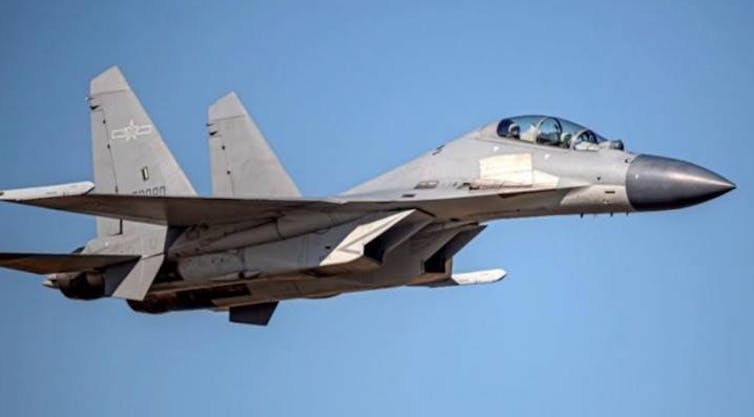
China has been flying a record number of military aircrafts into Taiwan’s “air defence identification zone” in recent days, heightening regional concerns about the risk of military escalation or even an outright war.
Taiwanese people are largely alert, but not alarmed. So, why are the Taiwanese not losing their minds over what seems to be intensifying “drums of war”?
It comes down to familiarity with China’s pattern of military pressure tactics, as well as a general alarm fatigue from decades of exposure.
Why is China flying so many jets near Taiwan?
Many Taiwanese see the Chinese military display as more of a show than a preparation for an all-out invasion. There are several reasons being China’s “show of force” in recent days, pointing to short- and medium-term goals.
Domestically, the military pressure serves Chinese President Xi Jinping’s propaganda and political agenda. Xi’s defining political idea is promoting the “China Dream” to his people, which partly entails becoming “a strong nation with a strong army”.
China had just had its National Day celebration on October 1, and a public show of force is a visual embodiment of that narrative. China’s nationalist Global Times newspaper even went so far as to call the flight incursions a form of National Day “military parade”.
Moreover, the Chinese Communist Party is at a key period in terms of its leadership reshuffle. Next month, it will hold its Sixth Plenum, an important meeting where party heavyweights will discuss and build consensus on forming a de facto shortlist for the next generation of party leadership (to be installed in late 2022).
At this critical juncture, as Xi faces significant internal dissent, a muscular show of force seems to be a natural instrument to generate pro-incumbent, rally-around-the-flag sentiment.
Xi will likely remain supreme leader no matter what. But such a nationalist display increases the chances his preferred proteges will be on the shortlist for other key positions just below him.
Shaping the China policy of Taiwan’s opposition party
Taiwan’s main opposition party, the Kuomintang (KMT), has also just elected a new leader after a party campaign focused primarily on Taiwan’s policy towards China.
The new chairman, Eric Chu, who ran on an American-friendly foreign policy platform, won a humble victory with 45% of the votes in a tight, four-way race. Chu has since promised to be an unifier who will listen to other voices in his party, and has pledged to renew stalled talks with China.
As such, Beijing has good reason to impose military pressure at this moment in the hope of nudging the KMT’s new policy in Beijing’s preferred direction.
Notably, while Beijing sent a total of 149 military jets into Taiwan’s vicinity from October 1–4, it reportedly sent only one on October 5 – the day the KMT’s new leader assumed office.
Military threat against Taiwan faces diminishing returns
Another reason why Taiwanese people are not very alarmed by the increasing number of Chinese warplanes is simply the law of diminishing impact over time.
People are used to this type of low-intensity Chinese military provocation. In fact, they been living in the near-constant presence of Chinese military and diplomatic pressure for over a quarter century.
In the run-up to Taiwan’s first direct presidential election in 1996, China’s People’s Liberation Army conducted massive missile tests in the waters near Taiwan, which strongly hinted at a possible invasion.
Read more: Taiwan: what election victory for Tsai Ing-wen means for the island's future
Since then, China has frequently staged military exercises around Taiwan, including flying military jets into the island’s vicinity. These are intended to underscore the risks of potential war and caution Taiwan against crossing Beijing’s “red lines”.
Chinese state television, for example, once published a video of the Zhurihe training drills of 2015, which included footage of Chinese soldiers assaulting a building that bore a remarkable resemblance to Taiwan’s presidential office.
Is China really in a hurry to invade Taiwan?
This long-standing Chinese strategy of brinkmanship theatre has been a double-edged sword. It has encouraged pragmatism in Taiwan’s pursuit of a stronger identity on the global stage, but it has also alienated many Taiwanese from Beijing.
For example, polls consistently show less than 10% of Taiwanese favour unification with China, and a negligible 2.7% self-identify as primarily “Chinese” in their national identity.
Then why does Beijing still resort to these alienating tactics, if unification is the ultimate goal?
One explanation is Beijing places a higher priority on deterring Taiwan’s further movement towards independence than promoting unification, so it is willing to trade the latter for the former. In other words, Beijing may simply not be as zealous about pursuing unification in the near-term.
Instead, keeping an eye on the long game, Beijing is willing to risk short- to medium-term costs in losing hearts and minds in Taiwan. The hope is, in time, it can eventually regain the initiative. For this reason, being able to deter further movement towards independence may be sufficient to buy China much-needed time.
Read more: Australia would be wise not to pound 'war drums' over Taiwan with so much at stake
So what is Beijing’s ultimate plan?
According to hawkish General Qiao Liang, the plan is “strategic patience”.
This means waiting until the cross-strait military balance tilts further in China’s favour, using the military option only when it can comprehensively overwhelm Taiwan and disincentivise or even deny American military intervention.
And politically, Beijing aims to use the gravity of its economy to attract Taiwanese youth opinion leaders and slowly build back Taiwanese support for eventual unification. In this approach, economic incentives replace soft power, which Beijing is lacking at the moment.
Read more: China does not want war, at least not yet. It's playing the long game
This is in line with Marxist logic, which is fundamental to Chinese communism. In this line of thinking, connections built on “infrastructure” (material and economic common interests) are longer-lasting than connections based on “superstructure” (ideational or emotional alignment).
The challenge for Taiwan and like-minded societies in the west is both to prove the resiliency of their shared liberal democratic values and build a concerted voice that prevents China from mistaking Taiwan for a soft target.
Only through closer cooperation with other like-minded democracies can Taiwan mitigate the risk of military escalation and ensure China’s development will remain peaceful into the future. This is ultimately in the interest not only of the region, but China itself.
Authors: Wen-Ti Sung, Sessional Lecturer, Taiwan Studies Programme, Australian National University



















