Traffic is complex, but modelling using deceptively simple rules can help unravel what's going on
- Written by: Yohan Kim, Research Principal, Institute for Sustainable Futures, University of Technology Sydney
This is the fourth article in our series, Moving the Masses, about managing the flow of crowds of individuals, be they drivers or pedestrians, shoppers or commuters, birds or ants.
Scientists, engineers and economists have used equations to solve real-world problems since the invention of basic addition and subtraction. Not sure how to price your apple harvest? Use a supply-and-demand equation to find the ideal price. It seems there’s an equation for everything in life.
Equations are great for modelling well-defined problems where the rules do not change, and as such have been the backbone of pure science. But in today’s ever-growing, fast-shifting society, many problems are too complex to model with a single equation. So how do we deal with complex phenomena such as traffic, the subject of this Conversation series? To that end, Descartes gave us a hint many years ago:
Divide each difficulty into as many parts as feasible and necessary to resolve it.
Agent-based modelling (ABM) is an approach that encapsulates this philosophy and has been gaining in popularity for the past decade. Instead of treating the problem as one entity, ABM looks at modelling the behaviour of each of the smaller elements (agents) within the system.
It is a bottom-up approach where macro outcomes are derived from the activities of individual micro actors. As the agents interact, you gain a better understanding of the system as a whole.
So how does this work for traffic?
Let’s take the example of a traffic jam. Conventionally, scientists have used sophisticated analytical approaches, such as equations, that treat traffic like a flow of liquid. Interestingly, we can replicate the same traffic phenomena by modelling individual cars with two simple rules:
If there’s a car in front of you, slow down.
If there aren’t any cars in front of you, speed up (while obeying the speed limit).
These rules are essentially descriptions of what a rational person would do while driving. One could presume that to cause a traffic jam we would need an additional factor such as police checks or traffic accidents. Traffic jams do not just happen by themselves – or do they?
It turns out that those two rules are enough to naturally cause a traffic jam. A traffic jam can occur purely out of internal interactions between cars, and not because of any external factor. In this phenomenon, a congestion “shockwave” travels in the direction opposite to the direction of the cars.
Researchers from several Japanese universities recreated this phenomenon with real cars back in 2008, as shown in the video below.
A shockwave traffic jam recreated.When an unexpected phenomenon results from the interactions between individuals (agents), this is called emergent behaviour. It is this unique property of agent-based modelling that gives it an advantage over conventional models.
Another benefit is that it is very intuitive to develop an agent-based model. Instead of having to understand the mechanics of traffic jams, all you need to do is define the rules that govern the behaviour of individual cars. It shouldn’t be too surprising that two high school students from Boston originally built the earlier traffic jam model more than 20 years ago.
A good example that demonstrates ABM’s intuitive nature is the modelling of flocking behaviour in birds. It’s fantastically difficult to model mathematically, but flocking behaviour can be replicated in agent-based modelling using three simple governing rules:
1. Separation: steer to avoid crowding local flockmates

2. Alignment: steer towards the average heading of local flockmates

3. Cohesion: steer to move towards the average position of local flockmates.

The resulting model is remarkably similar to real life. The three rules successfully bring out the emergent phenomenon of flocking behaviour.
Daniel Shiffman’s implementation of Craig Reynold’s Boids program to simulate flocking. Each bird steers itself based on rules of avoidance, alignment and cohesion.From playful toy to policy tool
In addition to traffic management, agent-based modelling has practical applications in other fields. For example, to understand how infectious diseases such as MERS spread through a city, the author has developed a large-scale ABM simulation that models each individual living in his home town, Suwon, in South Korea.
The governing rules are simple:
- In the daytime, individuals go to work (or school, depending on their age) and interact with their colleagues (or classmates).
- At night, individuals return home to spend time with their family.
- Individuals can become infected when interacting with a sick person.
Through this simple set of interactions, a vast network of secondary contacts is formed, through which a disease can spread. To ensure that the results represent the city accurately, we carefully selected each individual’s age, gender, family members, and home and work locations, to ensure that they matched regional census statistics on housing, labour and education.
The results revealed that prevention efforts should focus on key schools, where most of the disease spread takes place.
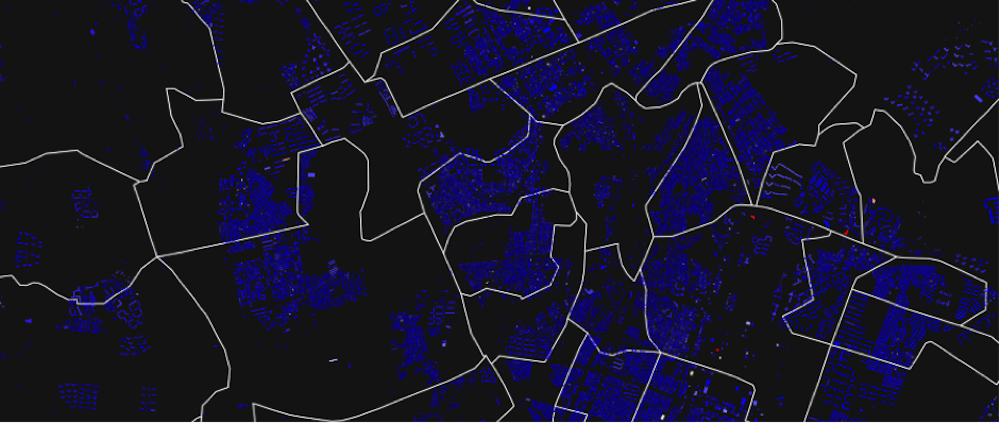 Close-up of Suwon city showing all residential buildings. Individuals spend their time with their family within each house, and interact with neighbours from nearby.
Author provided
Close-up of Suwon city showing all residential buildings. Individuals spend their time with their family within each house, and interact with neighbours from nearby.
Author provided
Beyond the above examples, ABM has practical applications in marketing, traffic management, and biomedical fields. As computational power increases, this modelling approach is limited only by imagination in its implementation and use.
You can find other articles in the series here.
Authors: Yohan Kim, Research Principal, Institute for Sustainable Futures, University of Technology Sydney