

Australia could 'green' its degraded landscapes for just 6% of what we spend on defence
- Written by Bonnie Mappin, PhD Candidate, Conservation Science, The University of Queensland
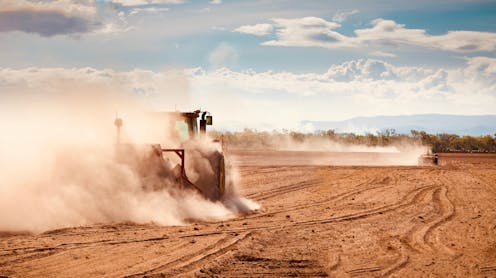
The health of many Australian ecosystems is in steep decline. Replanting vast tracts of land with native vegetation will prevent species extinctions and help abate climate change – but which landscapes should be restored, and how much would it cost?
Our latest research sought answers to these questions. We devised a feasible plan to restore 30% of native vegetation cover across almost all degraded ecosystems on Australia’s marginal farming land.
By spending A$2 billion – about 0.1% of Australia’s gross domestic product – each year for about 30 years, we could restore 13 million hectares of degraded land without affecting food production or urban areas.
Such cost-effective solutions must be implemented now if we’re to pull our landscapes back from the brink. This bold vision would transform the way we manage our landscapes, help Australia become a net-zero nation and create jobs in regional communities.
An ambitious agenda
Since European settlement, large areas of Australia’s native vegetation have been progressively cleared for agriculture and urban settlements. Australia’s environment remains under mounting pressure from land clearing, altered fire regimes and invasive species.
Our research shows that about one-fifth of Australia’s ecosystems have less than 30% coverage of healthy native vegetation. Below 30%, ecosystem services and biodiversity sharply declines. We calculate that 13 million hectares of land must be restored to reach the 30% threshold.
Targeted restoration of degraded ecosystems on less profitable agricultural land has enormous potential to alleviate these problems. Farmers can continue to produce valuable crops on their prime land, while rebuilding habitat and sequestering carbon on more marginal land.
Read more: The clock is ticking on net-zero, and Australia's farmers must not get a free pass
Almost half of the land requiring restoration is Eucalypt woodlands and almost a fifth is Acacia forests and woodlands. Areas in most need are:
- the Wheatbelt region of Western Australia
- Central Queensland
- Central West, Tablelands and Riverina areas of New South Wales
- Western Victoria
- the Eyre Peninsula and southeast South Australia.
Restoring native vegetation at selected sites would involve actions such as fencing to keep livestock away, pest removal, soil preparation and planting.
As well as direct restoration costs, our costings also included compensation payments to farmers and other landholders, for the cost of retiring the land from farming.
We identified the sites across Australia where revegetation would be most cost-effective. These are the places where land requires the least revegetation work and returns the lowest profit to farmers, thus minimising stewardship payments.
In practice, we recommend restoration sites be secured through voluntary arrangements with land holders.
Cost-effective conservation solutions
We estimate the required restoration would cost approximately A$2 billion annually for 30 years. To put this in perspective, it’s about 0.3% of the federal government’s annual spending last financial year and about 6% of what Australia spends annually on defence.
The restoration project would restore habitat and ecosystem services in our most degraded landscapes. It would expand threatened species’ habitat and re-establish ecosystem functions such as pollination and erosion control.
The revegetation would also help tackle climate change by drawing down carbon dioxide from the atmosphere and storing it. We estimate 913 million tonnes of greenhouse gases would be stored over 55 years.
After a decade of vegetation growth, 13 million tonnes would be stored annually – equal to 16% of the emissions reduction required under Australia’s Paris Agreement obligations.
We applied those figures to plausible carbon price scenarios where prices rise 5-10% per year from $15 per tonne, reaching $24-39 per tonne by 2030. If the carbon stored by the project was translated into carbon credits, the potential revenue could be between $12 billion and $46 billion.
The upper end of that estimate would more than cover the costs required to implement the plan. An intensive revegetation effort would also create jobs, mostly in rural areas.
Read more: Loved to death: Australian sandalwood is facing extinction in the wild
Success is possible
Australia’s environment laws have comprehensively failed to protect nature. This has been compounded by a lack of adequate funding for environmental management, threatened species protection and ecological restoration.
Without doubt, the national project we describe is ambitious. But existing projects are showing the way. In southwest Western Australia, for example, the Gondwana Link program has so far restored 13,500 hectares of marginal farmland, and also aims to connect 100,000 hectares of existing bushland.
Turning around the state of Australia’s environment requires big thinking and an even bigger government and public commitment. But as our research shows, restoring our degraded landscapes is both attainable and affordable.
Read more: Climate change is testing the resilience of native plants to fire, from ash forests to gymea lilies
Authors: Bonnie Mappin, PhD Candidate, Conservation Science, The University of Queensland

















