

Keeping workers COVID-safe requires more than just following public health orders
- Written by Stephen Duckett, Director, Health and Aged Care Program, Grattan Institute
So far in the pandemic, state public health advice has been front and centre of public messaging about protecting the community from the spread of COVID-19.
But merely following the public health orders won’t necessarily meet employers’ obligations to protect staff from COVID, especially as restrictions ease in the Eastern states.
Protecting employees from COVID is good for staff, of course, and also good for the organisation because it will reduce the potential for staff being off sick.
Vaccination alone won’t guarantee a COVID-safe workplace. Even double-vaccinated people can be infected. Vaccination reduces the chance of infection by between 60% (AstraZeneca) and 80% (Pfizer). And double-vaccinated people can also transmit the virus, although again at a much lower rate.
As part of the scientific advisory group OzSAGE, we’re issuing guidance to employers about creating COVID-safe working environments. We propose organisations follow a four-level hierarchy of COVID controls.
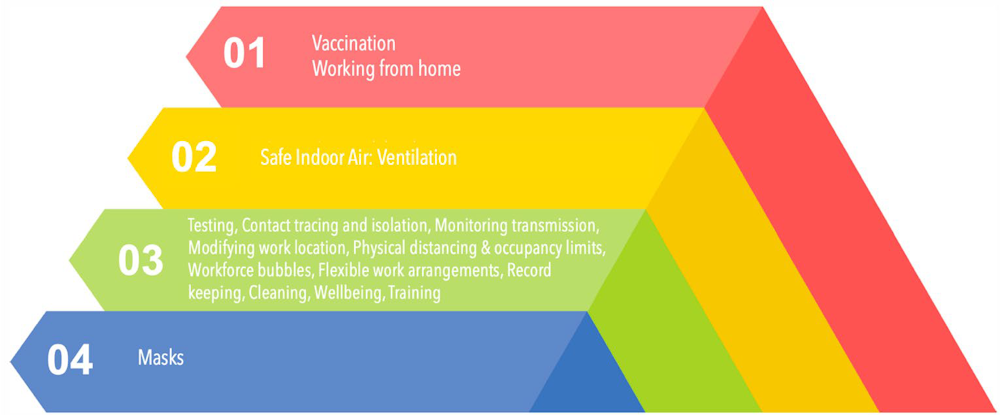
Level 1: vaccination and working from home
The most effective protections against COVID are vaccinating to reduce the risk of infection, and limiting interactions with infected people. These are the two standard public health measures seen in state public health orders.
Employers should encourage employees to get vaccinated by providing:
- leave or paid time off to get vaccinated
- reliable and up-to-date information on the effectiveness of vaccinations
- the details of the locations nearby where vaccinations are available
- on-site vaccination, if possible, for shift workers and those who can’t easily attend a GP or vaccine hub appointment
- incentives, such as additional annual leave days for vaccinated workers.
In some circumstances – especially where the organisation is responsible for caring for people at a higher risk of infection – mandatory vaccination of employees might also be considered.
Read more: If you're going to mandate COVID vaccination at your workplace, here's how to do it ethically
Staff should be encouraged to work from home if that’s possible, while risk of infection is still high. Working from home doesn’t eliminate the risk of COVID, but it eliminates the risk of contracting (and transmitting) COVID in the workplace.
Putting in place “hybrid” working arrangements reduces the number of people in the workplace at any one time, and therefore the risk of transmission.
Level 2: safe indoor air
State public health orders have essentially focused on density limits. These are important, but don’t guarantee good ventilation and clean air.
COVID spreads by aerosols. Respiratory aerosols from breathing and speaking accumulate in indoor spaces, resulting in increasing risk over time.
Poor ventilation (stagnant air) in public buildings, workplaces, schools, hospitals, and aged care homes contributes to viral spread.
Read more: Australia must get serious about airborne infection transmission. Here's what we need to do
Good ventilation is a key part of reducing the risk of COVID transmission.
As the number of people inside a space increases, CO₂ will increase to varying degrees, depending on the effectiveness of ventilation and the volume of the space. Measuring carbon dioxide (CO₂) is therefore a useful surrogate indicator to assess the relative infection risk of COVID in an indoor space.
It’s recommended employers invest in CO₂ monitoring and use that as a trigger to reduce occupancy and/or increase the provision of outdoor air and HEPA (high-efficiency particulate air) filtering to ensure the risk of COVID-19 is appropriately mitigated.
Having automated alerts (in non-HEPA filtered areas) from CO₂ monitors will prompt action to improve ventilation or leave the workplace.
Level 3: administrative measures
Organisations should be ready to manage COVID outbreaks – especially in New South Wales and Victoria, where public health contact tracing is at capacity.
Organisations might also use regular rapid antigen testing (where practical and feasible, considering cost and logistics), to prevent or limit outbreaks when people are shedding the virus but are asymptomatic.
Read more: Rapid antigen tests have long been used overseas to detect COVID. Here's what Australia can learn
The risk of an organisation-wide shutdown can be minimised by creating work bubbles – teams coming to work on different days – and other measures to reduce physical interactions.
Staggering work hours to reduce congregating at lift spaces is another useful, low-cost strategy.
Level 4: masks
COVID-19 is an airborne disease, so the use of masks is integral to reduce transmission and to offer some protection if there is any breakdown of other controls.
Masks are also essential because 30–70% of transmission may be asymptomatic: from infected people who look and feel well and may not be aware they are infected.
Basic cloth masks and surgical masks reduce the transmission of COVID. The effectiveness of masks increases when they fit snugly on the wearer’s face.
Read more: Evidence shows that, yes, masks prevent COVID-19 – and surgical masks are the way to go
Workers should be provided with appropriate fitted masks and should be trained in how and when to use them. At a minimum, where workplaces are in areas with community transmission of COVID, masks should be worn whenever workers are indoors.
Rates of COVID are still high in NSW, Victoria, and the ACT. Employers, especially in those jurisdictions, should review their work health and safety plans to ensure their workers and customers are properly protected.
This article was co-authored by occupational and environmental physician Karina Powers, engineer and scientist Kate Cole, Flinders University Professor Richard Nunes-Vaz, and other members of the OzSAGE advice for business working group.
Authors: Stephen Duckett, Director, Health and Aged Care Program, Grattan Institute

















