

How AI can guide course design and study choices to help graduates get the jobs they want
- Written by Tomas Trescak, Senior Lecturer in Intelligent Systems, Western Sydney University

Graduates entering an ever-more-competitive job market are often unaware of the skills and values they offer employers. The challenge is greater with emerging job roles that require certifications and both multidisciplinary skills and specialist knowledge, even for entry-level positions.
We seek to empower our graduates and maximise their career prospects. New research has enabled us to harness the power of artificial intelligence for a custom-designed course planning and recommendation system for students based on the skills their desired jobs actually require. We named these curriculum delivery models JobFit and ModuLearn.
Read more: Migration is a quick fix for skills shortages. Building on Australians' skills is better
JobFit: a career-driven curriculum
JobFit builds on a simple premise of informing students about the skills they will gain by completing a knowledge unit. This helps students to analyse skills gained from an individual study pathway and how these relate to career prospects.
Students can explore and experiment with various pathways. This “what if?” analysis is tailored to their career goals and knowledge preferences. The system monitors their study progress and proactively offers alternative pathways to maximise their acquisition of skills related to their goals.
We base the skills on recognised frameworks. For science, technology and business, we use the Skills for Information Age (SFIA) framework version 8, defining 121 skills, each on seven different levels.
For example, performing a basic risk assessment in an organisation requires “information security” skill at the lowest level. At the highest level it enables the person to design organisational and governmental policies assuring global information security.
Governments and organisations in Australia, United States, United Kingdom and European Union have created datasets using SFIA skills to define desired job profiles.
Drawing on these datasets, we designed a prototypical course-planning tool. (To login, please provide your email and role you would like to play in the system. A password is not required.) Western Sydney University students can use it to explore their skill compatibility with ICT job roles.
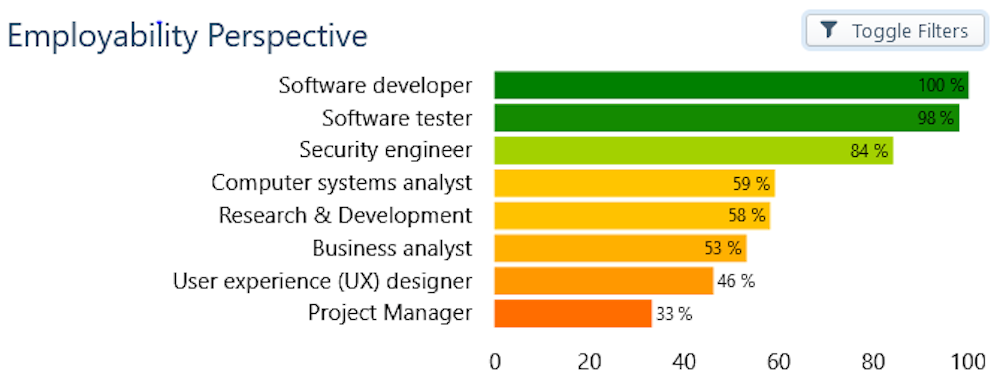
The chart above shows the compatibility with general role profiles, for Bachelor of ICT students considering junior-level positions. The video below shows the possibilities of this tool.
The author explains how students can match the skills they acquire with the jobs they desire.This approach has several benefits. First, students understand how their studies develop their skills. They can then set career-driven goals and make well-informed decisions about their study pathways.
Solid understanding of skills and knowing how to express these in CVs and cover letters are increasingly important. This is because human resource departments are adopting automated approaches to search for and filter out candidates, using algorithmic processing and text mining.
We can use SFIA to express skills in technology-related areas. However, it does not apply to other areas such as engineering, human sciences, law or medicine.
We are looking at acquiring data from an external partner to analyse and process required skills from live job offers across all industries. We will then be able to inform students on the quantity, variety and compatibility of actual job offers in any industry based on their knowledge profile.
This approach will also benefit curriculum designers facing the challenges of new subjects being rapidly introduced to maintain an advantage over competitors. The result is often an incoherent curriculum, particularly when it comes to meeting industry and employer needs.
A lack of understanding of what skills are desired in the job market and ad-hoc additions have led to programs that do not provide clear study pathways and relevance to work roles. Our model allows curriculum designers to analyse and validate their curriculum against job market needs.
Last, working with industry partners, we defined custom job profiles for the industry area of interest and locality. Students who target such custom skill sets are in a stronger position when applying for work with an industry partner.
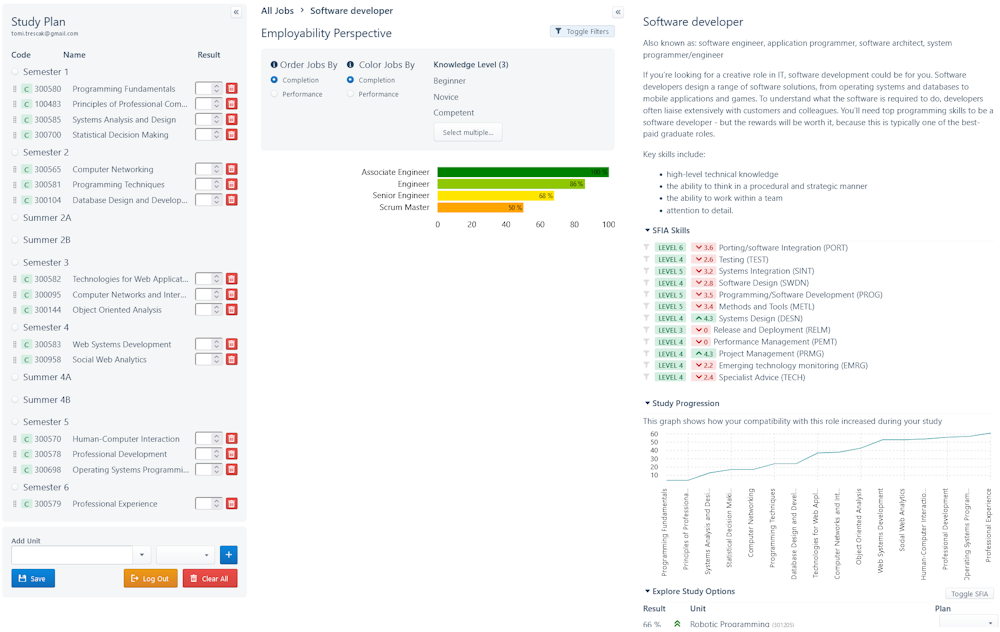 The system helps guide students in choosing units of study that provide skills to match their desired jobs.
Read more: How work-integrated learning helps to make billions in uni funding worth it
ModuLearn: promoting cross-disciplinary skills
Informing students on the skills they are acquiring is only half of the job. A student must also acquire all their desired skills in a relatively short period.
In undergraduate degrees, much of the course is typically pre-defined with core subjects. Students are often left with only one or two semesters to focus their knowledge on particular employers’ desired skill set. It’s even more of problem in shorter courses such as diplomas or certificates.
It’s likely too that a student’s faculty or school does not offer some critical skills. Students are often reluctant to study in a different school or faculty, fearing the challenge of a new environment.
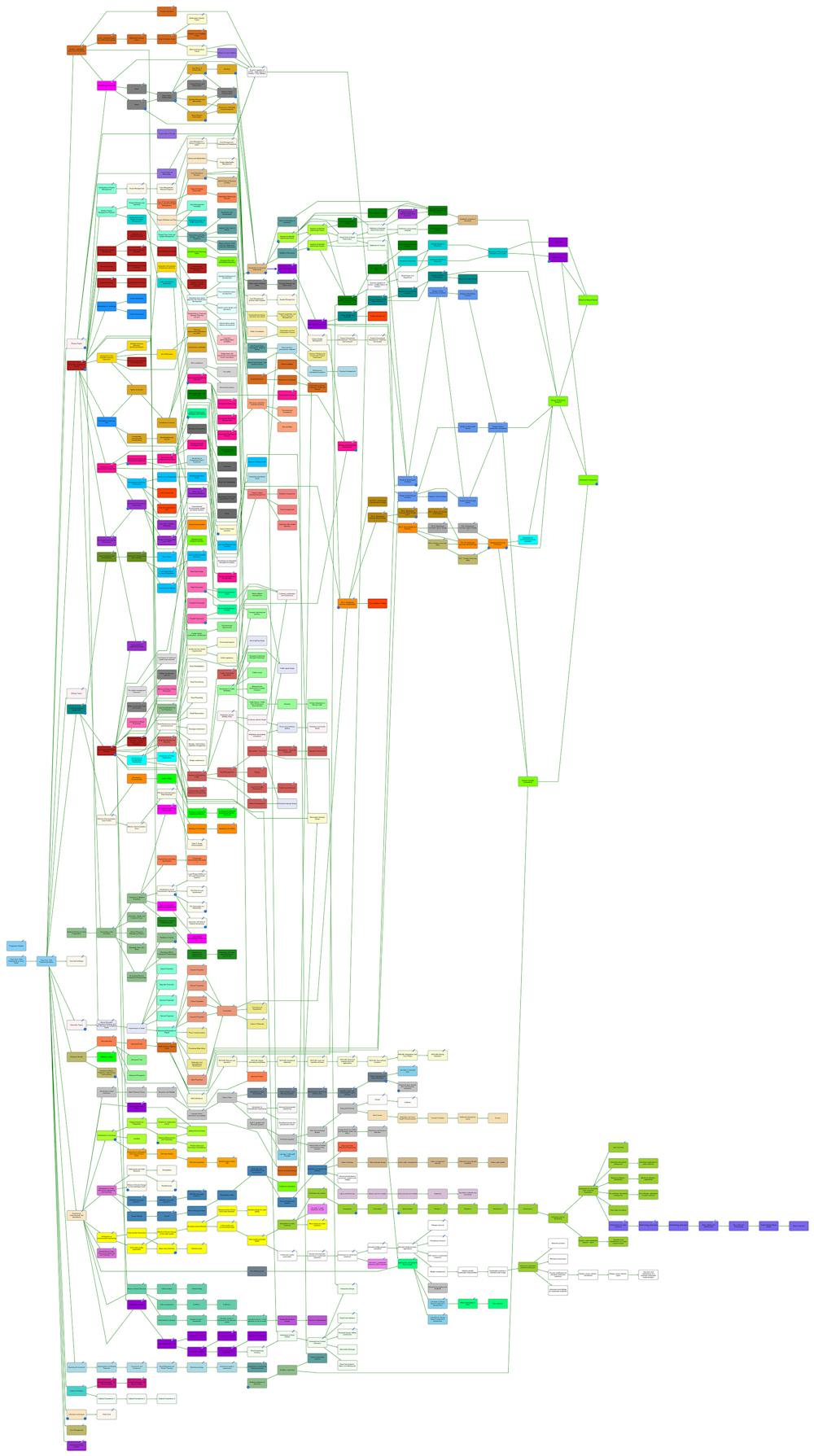 Charles Sturt University’s Topic Tree offers a dizzying array of choices, but artificial intelligence can help.
Charles Sturt University
Charles Sturt University’s Topic Tree offers a dizzying array of choices, but artificial intelligence can help.
Charles Sturt University
To overcome these issues, we looked at ways to increase the variety and number of knowledge units with diverse skills. We found inspiration in Charles Sturt University’s Engineering Topic Tree. It allows students to customise their degree by choosing from over 1,000 different topics. Topics are organised by disciplines, with well-organised prerequisites and pathways.
What this topic tree lacks is the backing of technology that allows students to easily explore all their options. We built on the topic tree idea and designed skill-informed modules. These are study units usually lasting two to eight weeks. Each module clearly defines the skills required as prerequisites and the skills it delivers.
An intertwined network of modules delivers fundamental and applied knowledge but each module requires less of a commitment from students than semester-long subjects. We hope in this way to encourage students to study across disciplines.
However, managing all the possible module combinations, prerequisites and user preferences is a significant technological challenge. This called for novel research, not just an application of existing AI approaches.
Working with the Artificial Intelligence Research Institute (IIIA) in Barcelona, we developed technological means to design and maintain a module-based curriculum for both curriculum designers and students. Delivery models can be adapted to different public or private financing options and educational standards, such as the Australian Qualifications Framework (AQF).
Curriculum development tends to lag behind technology development and shifting market needs. Ideally, curriculum development should be more responsive and future-focused rather than reactive. With smaller modules instead of semester-long subjects, it is possible to adapt much more quickly to ever-changing job market needs.
I would like to acknowledge the rest of our team, Professor Juan Antonio Rodriguez and Dr Filippo Bistafa from IIIA, Spain, Ms Lynn Berry, Professor Simeon Simoff and Professor Andrew Francis from Western Sydney University.
Authors: Tomas Trescak, Senior Lecturer in Intelligent Systems, Western Sydney University

















