

How a random sampling regime could help detect COVID and highlight infection hotspots
- Written by Stephen John Haslett, Emeritus Professor of Statistics, Massey University
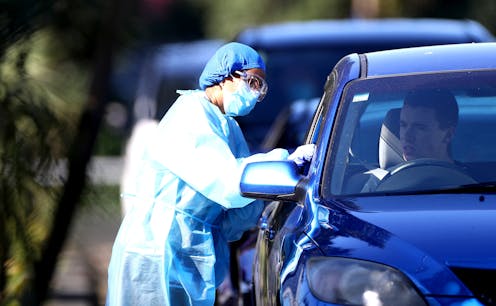
For the detection of community transmission of COVID-19, New Zealand currently relies on contact tracing, testing of self-selected people with symptoms and those with permission to travel between different alert levels, and surveillance testing of staff at businesses permitted to operate in higher alert levels.
Surveillance testing has picked up cases before they knew they were contacts of another infected person. But people who are only tested after they feel unwell may have already passed the virus on to several others. Others who have COVID-19 may not display symptoms.
As a supplement to current testing, we suggest a sound, properly designed random sampling regime of certain areas or workplaces to provide a cost-effective way to determine, with known probability, if there is any COVID-19 in a specified area or group.
The critical point is that such COVID Clearance Check surveys must be random.
Continued wastewater testing, contact tracing and community testing stations remain critically important. But they don’t provide any measures of accuracy because currently they don’t incorporate formal sampling designs.
Probability theory behind random sampling
A statistically designed random sampling scheme, based on as few as 100 people or households from key sub-populations, would give a very high probability of detecting if there are any COVID-19 cases. However, to determine this probability, it is critical the sampling is random.
Geographical locations could include certain neighbourhoods and wastewater catchment areas. Workplace sampling could focus on large businesses, rest homes, hospitals and prisons.
COVID Clearance Checks based on random sampling could shorten lockdowns, lessen social impact, save money and support businesses. Once Aotearoa’s borders reopen, they would provide critical information of known accuracy about infection hotspots.
Read more: COVID will likely shift from pandemic to endemic — but what does that mean?
The formal sampling scheme is based on probability theory, which provides the mathematical connection between COVID prevalence (p₀), sample size (n) and the probability of detecting the virus in the subpopulation (p).
Unless a subpopulation is very small, its size has little effect on the sample size required. For a simple random sample, which selects people or households essentially independently and with equal probability, the probability of detecting COVID is:
p = 1-(1-p₀)ⁿ
For example, for a 3% prevalence of COVID and a random sample of 100, the chance of detecting the virus is over 95%. A larger sample would be required to detect COVID at lower prevalence, for clustered random sampling schemes, or for higher levels of detection probability.
Instead of simple random sampling of households, systematic sampling (which selects households at a fixed interval in a list or along a route) could be used to simplify fieldwork without loss of accuracy.
Survey design and structured fieldwork would provide the mechanism for implementing the random selection of people and safe work conditions for the sampling team. For random sampling, this is now feasible because saliva tests have recently been approved by the Ministry of Health.
Using self-administered saliva tests would reduce close contact between field staff and household members, minimising the risk of spread.
How it would work
Examples where a COVID Clearance Check survey would be useful include towns or city suburbs, and households in catchment areas with positive wastewater results. Sampling areas around MIQ facilities, but not including them, would provide information on possible community transmission.
As a first step, the Ministry of Health would identify particular areas or groups of interest, and then randomly select a sample within it, using statistically sound methods, to ensure every person had a known non-zero chance of being included.
For area sampling, having pre-notified residents, field staff would drop off saliva tests at each sampled household. Household tests would then be collected, either for separate individuals or combined, using set safety protocols.
Any selected households which do not return test results would be contacted again to reduce non-response bias. Any detected cases would bring other current control mechanisms into play.
Detecting all cases in an area is different and more difficult than detecting whether there are any cases. Cases detected by COVID Clearance Check sampling provide a searchlight rather than fully illuminating the situation. Finding all cases would require much larger sample sizes, which is why such checks supplement rather than replace current surveillance methods.
Using well-designed and implemented random sampling schemes can be an effective, rapid and low-cost way of assessing whether there are any community cases, without testing thousands of people who are not necessarily those of greatest interest. When useful, such surveys can be repeated, using another sample from the same area or group.
As we are now all realising, keeping COVID-19 out of Aotearoa cannot be a long-term plan. Once vaccination rates are high and borders begin to reopen, COVID Clearance Checks using random sampling to monitor possible hotspots will become increasingly useful, even necessary, for surveillance.
Alistair Gray, at Statistics Research Associates, is also a member of the Ministry of Health COVID-19 Expert Advisory Network and has collaborated with us on this article.
Authors: Stephen John Haslett, Emeritus Professor of Statistics, Massey University

















