
Will the Evergrande crisis doom China's grandiose, big-spending football dreams?
- Written by: Ye Xue, Research Associate, Australian National University
A well-known Chinese idiom asks, “Can the eggs remain unbroken if the nest is destroyed?” (覆巢之下安有完卵). This saying implies that in a great disaster, no one escapes unscathed.
The question is quite pertinent for the ailing Evergrande Group – the second-largest property developer in China – and the ripple effects of its financial troubles for China’s grand ambitions in the sport of football.
Evergrande is owner of the football (soccer) team Guangzhou Evergrande FC, by far the most successful club in China. As such, the company and Chinese football have become intertwined – both financially and politically – and will rise and fall together.
This has flow-on effects for the government and its reliance on football to boost national pride to deflect criticism and achieve its broader goals. The Evergrande crisis suggests trouble is on the horizon.
The Evergrande effect
China has long used sport as a way to instill a sense of social cohesion, encourage patriotic citizenship and forge a shared national identity.
In recent decades, China has become a dominant force at the Olympics, and hosting the Summer Games in Beijing in 2008 was seen as one of the crowning achievements for the nation.
However, China has long been a laggard in the world’s most popular sport, football, which has been a source of constant embarrassment. China has only qualified for the FIFA World Cup once and has never scored a goal. Its chances of making the expanded field in the 2022 World Cup in Qatar appear slim.
To remedy this, the State Council, China’s cabinet, launched a major football development plan in 2015 aimed at boosting the country’s programs from the grassroots to elite levels. Evergrande Group has been the most passionate supporter of this campaign.
The company entered the football world in 2009 by taking over a club in the southern city of Guangzhou previously owned by a pharmaceutical company. Evergrande invested enormous financial resources in recruiting top domestic and international players and coaches, developing youth academies and upgrading its club facilities.
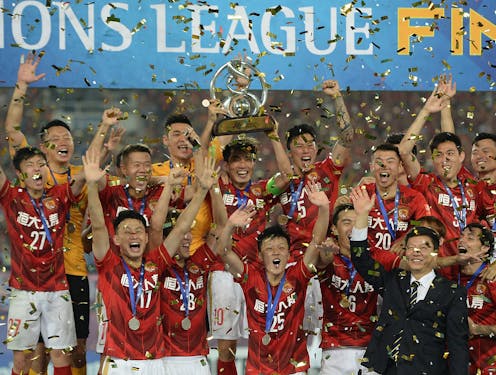
The club peaked in 2013 when it clinched titles in the Chinese Super League and the Asian Champions League under the leadership of legendary Italian coach Marcello Lippi.
The “Evergrande effect” boosted public interest in the league and laid the foundation for the central government to include football development as a key project of President Xi Jinping’s comprehensive economic, social and political reforms towards national rejuvenation.
Since then, the government has invested significant financial and reputational capital in the sport.
Read more: China's problem with property: the domino effect of Evergrande's huge debts
A football arms race
Guangzhou Evergrande’s success led other tycoons to invest in teams to boost their profile with both the Chinese public and the government. This triggered an intensified “arms race” to challenge Guangzhou Evergrande, with teams spending record transfer sums and outrageous wages to lure foreign talent to China.
Jiangsu Suning FC, owned by a major electronics retailer, for instance, hired ex-England coach Fabio Capello and signed Brazilian players Alex Teixeira and Ramires for nearly US$100 million (A$138 million) combined.
Altogether, the Chinese Super League spent 529 million euros (A$772 million) on players in the transfer market in the 2016-17 season – the most of any league in the world – while bringing in income of just 147 million euros (A$215 million).
Despite the increased competition, Guangzhou Evergrande maintained its position at the top of the league for the past decade. It has won the Chinese championship every year since 2011, bar two seasons in which it finished runner-up.
This caused a degree of hubris. In a postgame speech, the former CEO of the club, Liu Yongzhuo, asserted that “no other team can take the championship unless Evergrande gives it to you”.
In recent years, the club also started building a $US1.8 billion ($A2 billion) lotus-shaped stadium that would seat 100,000 fans – touted as the largest in the world. Construction on the half-built stadium appears to have stalled.
The bubble bursts
There is little doubt Chinese recruitment of elite players from the European leagues has raised the commercial value of the Chinese league. However, the expenditures quickly reached unhealthy levels.
With clubs running huge deficits, the Chinese Football Association stepped in with a 100% tax on foreign signings and then a salary cap this year. But it wasn’t enough to prevent the bubble from bursting.
This unsustainable spending made the Chinese clubs more vulnerable to the economic slowdown brought by COVID-19 than any other global football league.
Jiangsu FC, the reigning Super League champion, has been the biggest victim thus far, shutting down operations in March, just months after winning the title. It hadn’t paid its players for months.
In addition, 16 football clubs shut down operations in the lower-tier leagues in 2020 for financial reasons, with another six joining them so far in 2021.
Now, Guangzhou Evergrande is on the verge of collapse and is seeking a government bailout.
Evergrande’s crisis marks the end of a golden era in Chinese professional football history. It also vividly shows the abnormal political and commercial environment that has defined the Chinese league for the last decade.
Read more: Why the era of Chinese football clubs splashing big money on international stars is over
China’s national ambitions thwarted
China’s grand football ambitions on the international stage now appear to be doomed, as well.
In the early this year, Guangzhou coach Fabio Cannavaro admitted in a postgame press conference the club’ current objective is to “train players to provide strength to the Chinese national team” (为国养士), rather than compete for a title.
It is highly unusual for a football club to offer such extraordinary support to the national team. A statement like this would be inconceivable coming from the manager of a European team, where there is always a certain level of conflict of interest between clubs and national sides.
But, due to the political environment in Chinese football, it was unsurprising coming from Guangzhou Evergrande.
Guangzhou has always privileged the interests of the national team over its own corporate interests. In 2013, the club introduced new rules, which rewarded or fined players based on their performance with the national team. Evergrande Group also voluntarily subsidised part of Lippi’s salary when he was the head coach of China’s national team from 2016–19.
Read more: Can China's Super League help spur its global ambitions?
Furthermore, the club has been a major sponsor of China’s program to naturalise foreign players to compete for the national team. In 2019 alone, Evergrande paid 870 million renminbi (A$182 million) in transfer fees, salaries and resettlement costs for five naturalised players, contributed heavily to the club’s 1.94 billion renminbi (A$400 million) loss in 2019.
No other clubs were willing to shoulder such a burden for the national cause.
China’s football reform has, until now, resembled a sort of “Great Leap Forward”, with crony capitalist characteristics. Evergrande’s crisis likely signals the end of this experiment, which could have implications beyond sporting fandom.
The central government has made a point of prioritising and promoting Chinese football as a significant component of its efforts to strengthen social and national bonds. The failure of its most successful champion in this enterprise will inevitably damage this larger goal, compounding the political fallout of the Evergrande crisis.
Authors: Ye Xue, Research Associate, Australian National University