

COVID exposed our fractured national identity, but state-based loyalties were rising long before
- Written by Judith Brett, Emeritus Professor of Politics, La Trobe University
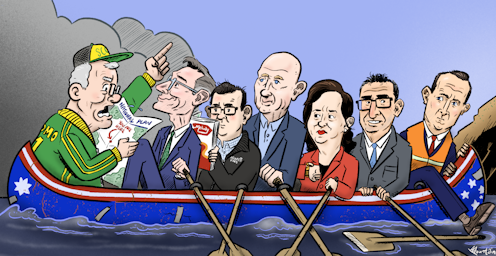
The formation of Australia’s federation in 1901 was both practical and sentimental. Pressing policy matters in the areas of immigration, trade and defence required the coordination of a federal government. As important was the growing nationalist feeling that the people in the different colonies were defined by the challenges and opportunities of the great south land. They were Australians, as well as Tasmanians, Queenslanders, Victorians and so on.
Nationalism is a modernising project, building identities and moral communities which transcend regional and parochial identifications. Compared with the regional identities of the old world, the colonial identities of Australia’s 19th century European settlers were weak, but they existed nonetheless.
The enthusiastic young men of the Australian Natives’ Association, which pushed hard for federation in the late 19th century, may have thought of themselves first and foremost as Australians, but colonial identities persisted after federation, due to their roots in the different histories, economies and social worlds of the six colonies. Time and again during the first decade of the new Commonwealth, Alfred Deakin, the country’s second prime minister, would conjure up the map of Australia and tell people they needed to think of themselves as Australians first and to approach political problems from a national perspective.
An intriguing historical question is when people’s identities as Australians transcended their state-based identities. I have always thought it was during the second world war. Prior to the war, the decisions and policies of state governments had greater effect on people’s day-to-day lives than those of the federal government. Health, education, transport, law and order, land management, local government, roads, sewerage, water and power were all state responsibilities. As yet, Commonwealth welfare responsibilities were limited and there was no federal income tax.
Read more: Politics podcast: Judith Brett on The Enigmatic Mr Deakin
When Australia was threatened by Japan, the federal government assumed primacy. In addition to responsibility for defence, the Commonwealth assumed the power to re-allocate resources, including labour, to support the war effort, as well as taxing people’s incomes.
The different experiences of the states and territories with the COVID pandemic and the closure of state borders raise the question of whether state-based identities are stronger now than they were, say, 20 years ago. I’d suggest three reasons this might be the case, based on historical observations, rather than hard quantitative data.
The first is that much of the colonies’ individual differences in political culture survived federation. Separatist sentiments have survived in Western Australia. Queensland, which is less dominated by its capital city than the other states, still has a strong strain of rural populism.
Sydney and Melbourne have also maintained their inherent political differences. In The Sydney Melbourne Book, political scientist James Jupp contrasts the reformist, Protestant, middle-class political culture of Melbourne with the hard-nosed materialism of Sydney. Melbourne was patrician, idealistic and internationalist; Sydney proletarian, masculinist and cynical.
For much of the 20th century, this made Victoria the natural home of the Liberal Party, until the early 1970s when Gough Whitlam lured a section of the moral middle class over to a social democratic Labor Party.
Victoria’s political culture is still more progressive than that of New South Wales, but this now tilts it towards Labor and the Greens rather than the Liberals. The Liberals’ centre of gravity, meanwhile, has shifted to the more proletarian and anti-intellectual culture of Sydney.
Read more: Queensland to all those #Quexiteers: don't judge, try to understand us
The second reason state-based identities might be strengthening is the differing impact of neoliberalism on our two levels of government. After the second world war, Australia had three decades of confident, government-led nation-building: the postwar immigration and Snowy Mountains schemes, the development of manufacturing, and the expansion of the nation’s universities and scientific capacities. The effort culminated in the cultural nationalism of the Whitlam government.
This nation-building momentum was stalled by the onset of stagflation in the mid-1970s, and it gradually petered out as governments turned to neoliberal remedies to restore economic growth.
A major casualty of neoliberalism has been the capacity of the federal government to deliver services, as it privatised and outsourced many of its responsibilities. Steering not rowing was the mantra. Government would pay the bills for the private sector to do the work.
In the September issue of The Monthly, John Quiggin ponders how the Commonwealth government of 50 years ago would have handled the pandemic. Back then, it operated quarantine facilities, had a Department of Works that was able to expand them as needed, owned an airline that could have flown Australians home, ran a network of repatriation hospitals and owned the Commonwealth Serum Laboratories.
Above all, mid-century federal governments had the confidence and capacity to lead. They were, writes Quiggin, far better equipped to deal with the pandemic and would have seen themselves as having the obvious responsibility to do so. Quarantine management would not have been handballed to the states, and the vaccine rollout would have been less shambolic.
Pretty well the entire political class subscribed to the neoliberalism of the 1970s and ‘80s, but state governments have been far less successful than the federal government in offloading their core responsibilities, such as health, education, policing and emergency services. Hence, state governments have retained more capacity. As they have become more effective in these regards, and the federal government less so, people have been drawn back into their orbit. Differences between the states in people’s political experiences have been enhanced, along with people’s sense of the distinctiveness of their state.
The third reason Australians’ state-based identifications may have strengthened is the development of the two-speed economy since the 1980s. The reduction of tariffs since the 1980s damaged the economies of the manufacturing states, especially Victoria and South Australia, which turned to services such as education and tourism. At the same time, mining boomed in Queensland, Western Australia and parts of NSW. People in the different states have experienced very different economies. Horizontal fiscal equalisation, the transfer of resources between jurisdictions, softened the impact of this on the service delivery capacities of the states, but we were not all in the same economic boat.
The political impact of this has played out most obviously and destructively in the inability of our federal governments since 2000 to develop a coherent response to climate change. Coal has been weaponised, with effective policy held to ransom by mining electorates, especially in Queensland.
At the 2019 election, the number of Australians voting for Labor and the Greens was marginally higher than the number voting for the Coalition, although this did not translate into a majority of seats. In Queensland, for example, the Coalition won 23 of the 30 seats. In the winner-takes-all commentary, election victories are interpreted as telling us something about all Australians, the country at large. But they don’t.
Perhaps I am speaking as a Victorian here, but for the past decade or so I have been feeling more strongly identified with Victoria and its progressive politics, as Labor loses federal elections in Queensland and Western Australia. COVID has simply strengthened a pre-existing feeling.
The author will be appearing on a panel to discuss federalism in the time of COVID on Friday, October 22, as part of Australian Catholic University’s Friday Forum series. Please email IHSS@acu.edu.au for more information.
Authors: Judith Brett, Emeritus Professor of Politics, La Trobe University

















