

Australia's prison rates are up but crime is down. What's going on?
- Written by Rick Sarre, Emeritus Professor of Law and Criminal Justice, University of South Australia
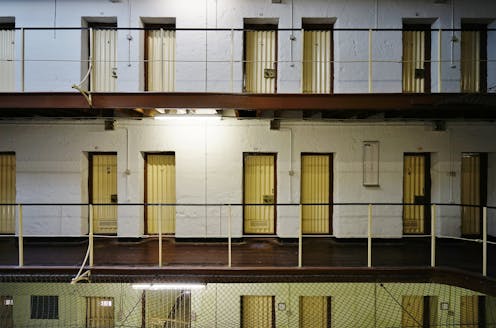
Imprisonment rates in Australia are currently the highest they have been in a century, despite a significant fall in crime, and the Productivity Commission is stepping in to determine why.
The commission is due to release research around imprisonment rates in coming weeks, suggesting this key component of the criminal justice system is not providing value for money.
It also recognises the efficiency of our prisons is important. Apart from the expense involved, they are supposed to provide justice and keep our community safe. And yet for a substantial part of the prison population, there is a “prison-crime-prison” revolving door.
Let’s look at the figures.
It’s not a crime wave
The rate of offending in Australia fell by 18% in the decade to 2020. Over the same period, the imprisonment rate rose by 25%. There are now more than 40,000 Australians in prison. Put simply, crime is down, but more and more people are being incarcerated.
As commissioner Stephen King explains, the rise in incarceration rates over the past 20 years had come principally as a result of “tough on crime” government policies. This has cost taxpayers about $13.5 billion more than if the imprisonment rate had remained steady.
He notes Australia is “out of line” with other developed countries in this respect.
[United Nations] data shows the growth in our imprisonment rates since 2003 was third highest in the OECD, exceeded only by Turkey and Colombia […] These numbers wrongly suggest some sort of Australian ‘crime wave’.
So why is crime falling?
One could be forgiven for assuming crime is falling now precisely because more people are being incarcerated. Is there perhaps a causal link?
There are two clear reasons why this is not the case:
There are many other reasons why crime rates can fall. Those studying the long-term drop in crime in western democracies since the mid-1990s say these include, economic prosperity, good policing strategies, demographics (in 1995, the last of the baby boomers turned 35, the age at which criminality drops away significantly), welfare support, and cheaper, better security devices.
There is no consistent relationship between crime rates and imprisonment rates. Indeed, there have been crime drops in jurisdictions where the rate of imprisonment has remained the same or declined.
Let’s look more closely at this.
The Queensland example
Queensland provides a good case study. From 2003 to 2012, the state’s imprisonment rate fell at the same time as violent and property crime rates were in decline.
Other countries, such as Finland, enjoy a very low crime rate and a very low imprisonment rate at the same time.
Conversely, until the mid-1990s, the United States had a very high crime rate and continues to have a very high imprisonment rate. But when New York, New Jersey and California reduced their prison populations by some 25% in recent years, their crime rates generally declined at a faster pace than the national average.
True, longer sentences may reduce the rates of some crimes simply by shutting perpetrators out of the crime market for a while. But this can be subject to diminishing returns. That is, money spent on extra prison beds will eventually exceed any savings that may have been made by having less crime.
Jail is not the only option
The Productivity Commission says the question facing policymakers now is whether our “current prison policy is providing the best value outcomes for Australia”. If it is not, what are the alternatives?
The commission notes there are several other options for low-risk offenders, such as home detention, especially if they are linked to mental health and drug and alcohol services.
Read more: How a maximum security prison offers a pathway to academic excellence and a PhD
There is also the argument put forward by theorists such as criminologist Elliott Currie that a secure community is built on equality of opportunity and the development of strong social capital, which simply means creating more resilient and more vibrant communities that leave no-one behind. This would include building and embedding culturally-safe programs that are led by First Nations communities.
Just imagine what could have been achieved if $13.5 billion had been spent on these initiatives thereby limiting the chances that people will turn to crime, or continue to offend, rather than on custodial services.
Spending justice dollars differently
In summary, prison sentences, necessary as some may be, are a blunt (and largely counter-productive) instrument in the fight against crime.
It would be far better if we applied our minds to finding more efficient ways to spend our criminal justice dollars. As criminal justice scholar Bronwyn Naylor has written, imprisonment is a political choice. It’s worth repeating her call to invest “much more in schools, families and communities, and much less in prisons”.
Wise words indeed.
Authors: Rick Sarre, Emeritus Professor of Law and Criminal Justice, University of South Australia
Read more https://theconversation.com/australias-prison-rates-are-up-but-crime-is-down-whats-going-on-170210

















