

How to support a person with dementia as lockdowns ease
- Written by Lee-Fay Low, Professor in Ageing and Health, University of Sydney
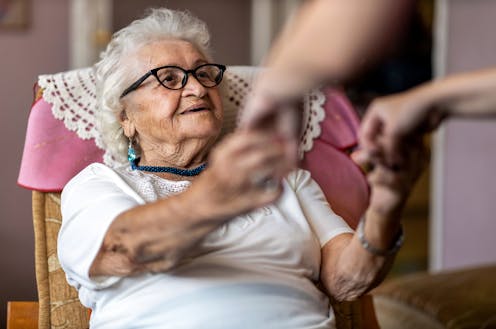
Lockdowns lasting months in some states have seen tight restrictions on visitors to nursing homes. So as lockdowns ease, and if you’re vaccinated, you might be planning a happy reunion with your friend or family.
If your loved one has dementia, you might be wondering if their symptoms have worsened in lockdown, or if they remember who you are.
Here’s what to look out for on your first visit after lockdowns end, and how to support your loved one after that.
Read more: Why people with dementia don't all behave the same
Expect some decline
Lockdowns can result in decline in people with dementia, particularly those living in nursing homes.
Research from lockdowns in 2020 showed people with dementia had more trouble thinking and problem solving. Their behaviour and mood worsened. Some studies showed people were less able to do things around the home or look after themselves.
Keeping mentally, physically and socially active helps people with dementia maintain their brain and thinking. But in lockdown, when people with dementia did less, they exercised their brains and bodies less.
Read more: How best to celebrate Christmas with a person with dementia
Lockdowns not only meant a ban on visitors to nursing homes, but limited stimulation from group activities, such as concerts, visits from schools and bus outings.
During lockdowns, nursing home residents (more than half have dementia) also got worse in terms of their thinking and well-being.
Residents sometimes didn’t understand why they couldn’t move freely around the nursing home, and why their loved ones had stopped visiting. This led to increases in behaviours, such as agitation.
After lockdowns began, there has been an increase in prescriptions of psychotropic medications reported internationally. These medications are used in nursing homes to manage behaviours such as aggression and agitation.
The first visit can be difficult
Some families might be worried about their first visit in several months to a person living with dementia.
They might be concerned their loved one has gotten worse, or scared they won’t recognise them.
But it may help to think of visits as providing really important mental stimulation and human connection for your loved one, even though visits might be difficult emotionally for you.
Introduce yourself: “Hi Dad, it’s Ali”, if it looks like your loved one can’t quite place who you are or your name.
Read their reactions to you. If they need time to warm up to you (which might be disappointing if you are close), chat with someone else who is there. The person might enjoy your company even if they aren’t actively participating in the conversation at first.

Then invite them to participate in the conversation by asking them their opinion: “How is the dog going?” or “I’m looking forward to going to the hairdresser, how about you?”.
Prepare an activity to do together based on their interests. You could walk in the garden, browse a magazine about the royal family, sing along to a favourite album.
If it’s a noisy gathering, find a quiet spot for one-on-one conversation, as the person may have trouble focusing when there are several people talking at once.
Read more: Five tips on how to talk to kids about dementia
Let them know when you’ll be back
Because of your long separation, your loved one might be quite emotional or clingy when you are leaving.
Let them know when you’ll be coming again. You can write this down in their calendar, or on a card to give them. You can also tell the nursing home staff so they can remind them.
You can also leave a visual reminder of your visit. This could be a card or photograph, or some flowers with a note.
If possible, get back into a visiting routine.
 You could leave some flowers and card as a physical reminder of your visit.
Shutterstock
You could leave some flowers and card as a physical reminder of your visit.
Shutterstock
If you notice a decline
Families are more likely to notice small or marked changes in their loved one’s abilities if they have not seen them for several months. That might mean noticing early signs of dementia or worsening symptoms if they’ve already been diagnosed with it.
So this can be a delicate conversation to have with your loved one.
Many people can be defensive or in denial about changes, put it down to “old age”, and are afraid about having dementia.
You might need to have the conversation several times to get them to see the doctor. Call the National Dementia Helpline on 1800 100 500 for advice.
Read more: How to check if your mum or dad's nursing home is up to scratch
In the longer term, consider rehab
Rehabilitation helps people with dementia. So it’s worth looking into what support services your loved one might need.
A psychologist can help with strategies to manage memory and thinking; an occupational therapist can help with doing day-to-day things around the house; an exercise physiologist or physiotherapist can help with mobility; and a speech pathologist can help with communication.
Family carers can talk to their loved one’s dementia specialist, or ask their GP for a Chronic Disease Management Plan for some subsidised rehabilitation sessions.
If you’re not the main carer
If you’re not the main family carer, make sure that person has some support. Ask how they are feeling and what support you can offer.
Carers have been providing more help during lockdowns to people with dementia living in the community. That’s because there have been fewer services on offer, and as people with dementia needed help to comply with restrictions.
Offer to spend some time with the person with dementia so the carer can have a break. Or take the carer out for a meal and some social time now restrictions have eased.
Authors: Lee-Fay Low, Professor in Ageing and Health, University of Sydney
Read more https://theconversation.com/how-to-support-a-person-with-dementia-as-lockdowns-ease-169462

















