

'It was the best five years of my life!' How sports programs are keeping disadvantaged teens at school
- Written by Eibhlish O'Hara, Research Associate, Edith Cowan University
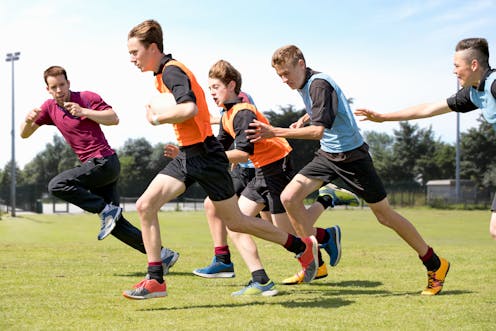
Participation in specialist sport programs keeps teenagers from low socioeconomic backgrounds at school and boosts their maths grades. This is what I found in my PhD study.
Being engaged in learning can set people up for success in the rest of their life. This is why experts see it as one of the main goals of early adolescence.
Students tend to be engaged with school in the primary years, but their engagement decreases in secondary school. So educators are trying to find ways to help students maintain that early engagement.
My PhD research explored the influence of specialist sporting programs on the educational outcomes of students attending schools in low socioeconomic areas of Perth. Specifically, I was interested in how participation in these programs affected the students’ academic performance and level of school engagement.
What are specialist sports programs?
Students who participate in specialist sporting programs specialise in one sport in place of a range of elective subjects in years 7-10. Enrolment is open to all students, including those who live outside a school’s catchment area, and selection is generally based on:
a high level (or potentially high level) of sporting ability and coachability
a positive attitude toward sport and school (in primary school)
a good record of behaviour and attendance.
The selection criteria are a way for the school to clearly communicate their expectations from the very beginning. They are about encouraging the continuation of students’ positive behaviours into secondary school, rather than trying to solve the problem of disengagement down the track.
Specialist sport programs are available in a variety of forms across Australia (including South Australia, Western Australia and Queensland). Some take an elite pathway approach, while others focus on participation. They are increasingly being developed in both public and private schools.

On average, schools allocate around four hours of class time per week to specialist sports programs. In years 7-10 this time is split evenly between practical and theoretical work. In years 11 and 12 there is roughly a 70-30% practical-theoretical split.
Practical sessions focus on developing skills and students’ fitness levels. Theoretical sessions cover topics such as biomechanics and physiology, rules and tactics, and nutrition and sport psychology.
What my study showed
Broad claims are made regarding the positive influence of the programs. For example, Western Australia’s education department states specialist sport programs can:
develop character, teach technical skills and self-discipline, and nurture a love of sport […] and […] enable children to compete at the highest levels and develop their skills as athletes both on the field and in the classroom.
But there has previously been no research on these programs in Western Australian schools to support this assertion.
Only two studies have investigated the influence of specialist sports programs on students’ academic achievement. Both were conducted in the United Kingdom and examined final year students’ academic performance in the GCSE (General Certificate of Secondary Education). Students attending specialist program schools had better scores than those attending non-specialist schools. The improvement in scores over time was greater at schools with a high percentage of students from low socioeconomic backgrounds.
Read more: Move it, move it: how physical activity at school helps the mind (as well as the body)
Mine is the first study to examine the link between early adolescents’ academic achievement and engagement with school, and participation in specialist sports programs in Australia.
My study involved seven secondary schools and students in years 7-10, in low socioeconomic areas of Perth.
A total of 68 specialist sports students gave access to their school grades for each subject over the period of a year and 73 students completed a survey measuring their level of engagement with school.
I also interviewed 11 students and three parents, as well as five teachers and three graduates of the programs.
To analyse programs’ effects on student grades, I assigned each grade a number (A = 5, B = 4, C = 3) – essentially a better grade was assigned a higher number). I then compared the mean grade for each subject, each year. At the baseline measurement, the mean grade for maths was 3.08 (a C grade). At the follow-up a year later it was 3.30. Although it was still a C grade, statistical analysis deemed this a significant improvement.
 There was some improvement in the maths scores of students who were part of the programs.
Shutterstock
There was some improvement in the maths scores of students who were part of the programs.
Shutterstock
Mean grades in all other subjects – English, science, society and environment, and health and physical education – remained stable. Students’ level of engagement with school also remained stable over the period of a year.
What students said
Many students said the program was the reason they attended school each day, and the reason they applied effort to their education.
One male student said:
I didn’t want to come to [school] unless I got into the [program].
A parent said:
There are a lot of kids that the only reason they’re still at school is because of the program – it gives them a reason to go [to school].
Both male and female students felt participation in a specialist sports program positively influenced their engagement with school.
A female student said:
It’s fun […] it’s energetic and you just have a great time doing it.
And a male graduate told me:
It was the best five years of my life!
Only male students discussed specific aspects relating to engagement, such as attendance, behaviour and academic achievement. One said:
It made me think, it’s going to affect your appearance in the program […] it’s made me think harder in maths and like […] English and stuff like that so […] I moved up from a C to a B in English from thinking about the program, and if I didn’t think about the program, I would still have been on a C kind of thing.
This is significant as previous research has revealed gender differences in school engagement levels with girls generally being more engaged than boys.
There are limitations
There were two main limitations to this study: the lack of a comparison group and the possibility of self-selection bias. Despite my best efforts to recruit both specialist and non-specialist students, not enough non-program students provided informed consent to conduct a valid statistical comparison.
All schools with a specialist sports program located in low socioeconomic areas of WA were invited to participate, but only seven agreed. So it is possible only schools in which the specialist sports teacher was proactive and proud of the program’s accomplishments agreed to be involved in the research.
Read more: Missing out on PE during lockdowns means students will be playing catch-up
That said, for the schools involved in the study, specialist sports programs provided students with a supportive learning environment.
It is important educators consider the students’ individual needs and interests in designing specialist sports programs. And they should be open to further developing other specialist programs — whether that be in other sports or other interest areas.
Authors: Eibhlish O'Hara, Research Associate, Edith Cowan University

















