

The '97% climate consensus' is over. Now it's well above 99% (and the evidence is even stronger than that)
- Written by Steve Turton, Adjunct Professor of Environmental Geography, CQUniversity Australia

Despite the overwhelming evidence, it’s still common to see politicians, media commentators or social media users cast doubt on the role of humans in driving climate change.
But this denialism is now almost nonexistent among climate scientists, as a study released this month confirms. US researchers examined the peer-reviewed literature and found more than 99% of climate scientists now endorse the evidence for human-induced climate change.
That’s even higher than the 97% reported by an influential 2013 study, which has become a widely cited statistic by both climate change deniers and those who accept the evidence.
Why has the needle evidently shifted even more firmly in favour of the evidence-based consensus? Or, to put it another way, what happened to the 3% of researchers who rejected the consensus of human caused climate change? Is this change purely because of the growing weight of evidence published over the past few years?
Unpicking the polls
We must first ask whether the two studies are directly comparable. The answer is yes. The latest study has reexamined the literature published since 2012, and is based on the same methods as the 2013 study, albeit with some important refinements.
Read more: Consensus confirmed: over 90% of climate scientists believe we're causing global warming
Both studies searched the Web of Science database – an independent worldwide repository of scientific paper citations – using the keywords “global climate change” and “global warming”. However, the recent study added “climate change” to the other two keyword searches, because the authors found that most climate-contrarian papers would not have been returned with only the two original terms.
The 2013 study examined 11,944 climate research papers and found almost one-third of them expressed a position on the cause of global warming. Of these 4,014 papers, 97% endorsed the consensus position that humans are the cause, 1% were uncertain, and 2% explicitly rejected it.
A 2015 review examined 38 climate-contrarian papers published over the preceding decade, and identified a range of methodological flaws and sources of bias.
One of the reviewers commented that “every single one of those analyses had an error – in their assumptions, methodology, or analysis – that, when corrected, brought their results into line with the scientific consensus”.
For example, many of the contrarian papers had “cherrypicked” results that supported their conclusion, while ignoring important context and other data sources that contradicted it. Some of them simply ignored fundamental physics.
The 2015 reviewers also made the important point that “science is never settled and that both mainstream and contrarian papers must be subjected to sustained scrutiny”. This is the cornerstone of the scientific method, and few if any climate scientists would disagree with this statement.
Separating the human influence from the natural
The recently published Intergovernmental Panel for Climate Change (IPCC) Synthesis Report, says “it is unequivocal that human influence has warmed the atmosphere, ocean and land”, and warns that the Paris Agreement goals of 1.5℃ and 2℃ above pre-industrial levels will be exceeded during this century without dramatic emissions reductions.
In reaching this conclusion, it is important to distinguish between changes caused by human activities altering the atmosphere’s chemistry, and climate variability caused by natural factors.
These natural variations include small changes in the Sun’s energy output due to sunspots and solar flares, infrequent volcanic eruptions, and the effects of El Niño weather patterns in the Pacific Ocean.
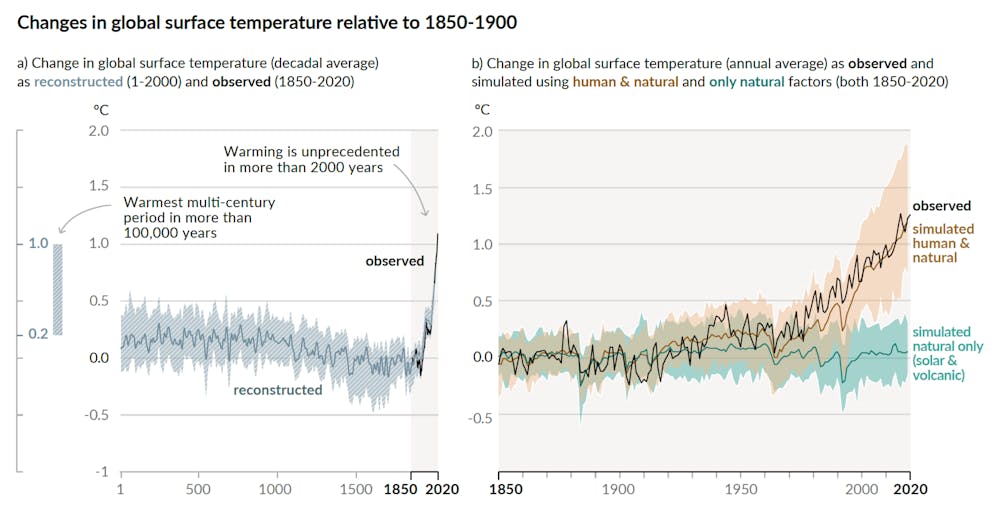
Excluding these natural variations, Earth’s surface temperature was generally stable from about 2,000 to 1,000 years ago. After that, the planet cooled by about 0.3℃ over several centuries, before the advent of fossil fuel-based industrialisation in the 1800s.
One study identified 12 major volcanic eruptions from 100 to 1200 CE, compared with 17 eruptions from 1200 to 1900 CE. Hence, heightened volcanic activity over roughly the past 800 years was associated with a general global cooling before the industrial revolution.
Current rates of global warming are unprecedented in more than 2,000 years and temperatures now exceed the warmest (multi-century) period in more than 100,000 years. Global average surface temperature for the decade from 2011-20 was about 1.1℃ higher than in 1850-1900. Each of the past four decades has been warmer than any preceding decade since 1850, when reliable weather observations began.
Read more: 99.999% certainty humans are driving global warming: new study
Researchers can separate human and natural factors in the modern global temperature record. This involves a process called hindcasting, in which a climate model is run backwards in time to simulate human and natural factors, and then compared with the observed data to see which combination of factors most accurately recreates the real world.
If human factors are removed from the data set and only volcanic and solar factors are included, then global average surface temperatures since 1950 should have remained similar to those over the preceding 100 years. But of course they haven’t.
The evidence, and the scientific consensus on it, are both clearer than ever.
Authors: Steve Turton, Adjunct Professor of Environmental Geography, CQUniversity Australia

















