

Can selective breeding of 'super kelp' save our cold water reefs from hotter seas?
- Written by Cayne Layton, Postdoctoral fellow and lecturer, University of Tasmania
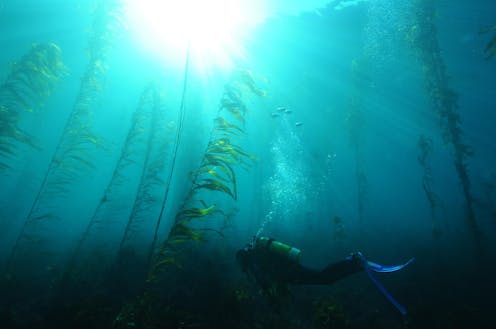
Australia’s vital kelp forests are disappearing in many areas as our waters warm and our climate changes.
While we wait for rapid action to slash carbon emissions – including the United Nations climate talks now underway in Glasgow – we urgently need to buy time for these vital ecosystems.
How? By ‘future-proofing’ our kelp forests to be more resilient and adaptable to changing ocean conditions. Our recent trials have shown selectively bred kelp with higher heat tolerance can be successfully replanted and used in restoration.
This matters because these large seaweed species are the foundation of Australia’s Great Southern Reef, a vast but little-known temperate reef system and a global hotspot of biodiversity.
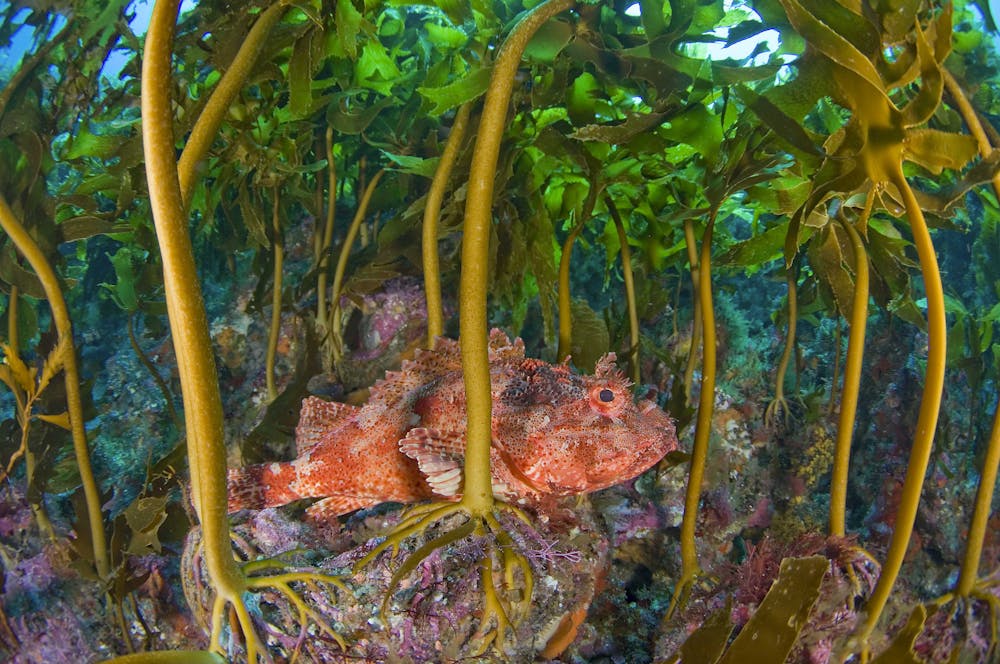
The reef’s kelp forests run along 8000 km of Australia’s southern coastline, from Geraldton in Western Australia to the Queensland border with New South Wales. These underwater forests support coastal food-webs and fisheries. Think of the famous mass-spawning of Australian Giant Cuttlefish off Whyalla, the rock lobster and abalone fisheries, or our iconic weedy and leafy seadragons.
Unfortunately, these seas are hotspots in the literal sense, with the nation’s southeast and southwest waters warming several times faster than the global average and suffering from some of the worst marine heatwaves recorded.
These increasing temperatures and other climate change impacts are devastating our kelp, including shrinking forests and permanent losses of golden kelp (Ecklonia radiata) on the east and west coasts, and staggering declines of the now-endangered giant kelp (Macrocystis pyrifera) forests in Tasmania.
Read more: Australia's 'other' reef is worth more than $10 billion a year - but have you heard of it?
We need novel measures to buy time for climate action
Australian researchers are leading the way to try to find ways of future-proofing our critical ocean ecosystems, such as kelp forests and coral reefs. In part, that’s because climate change is hitting our ecosystems early and hard.
Climate change is moving much faster than kelp species can adapt. In turn, that threatens all the species that rely on these forests, including us.
If climate change wasn’t happening, we could try to halt or reverse the losses of kelp forests by using traditional restoration methods. But in a world getting hotter and hotter, that is futile in many cases. Even if we slash carbon emissions soon, decades more warming are already locked in.
If we want to keep these forests of the sea alive, we must now consider cutting-edge methods to help kelp survive current and future ocean conditions while governments pursue the urgent goal of reducing emissions.
How to future proof an underwater forest
Together and separately, we’ve been exploring techniques to speed up the natural rate of evolution to boost kelp resilience. Along with other researchers, we’ve put several techniques to the test in the real world, with promising results. Others remain hypothetical.
At present, there are several broad approaches to future-proofing restoration work. These include:
Genetic rescue focuses on enhancing the genetic diversity of genetically compromised populations to boost their potential to adapt to future conditions. This involves planting and restoring a mix of kelp from disconnected populations of the same species. Improved genetic diversity can boost the ability of these forests to respond to change. We expect this approach to be especially useful in areas where climate change poses a limited threat at present.
Assisted gene flow strategies introduce naturally adapted or tolerant kelp individuals into threatened populations to increase their ability to survive specific threats, like hotter seas. This could help kelp forests in areas affected by climate change now or in the near future. In these situations, the genetic rescue technique could be counterproductive if the new genetic diversity introduced isn’t able to cope with the heat.
Selective breeding is a well-known agricultural technique, and can be used to identify the best kelp to use in these cases. In short, we try to identify kelp with naturally higher tolerance, and then use these as the basis for restoration efforts. These can be transplanted into ailing kelp forests. Trials are presently underway in Tasmania using giant kelp. Early results are exciting, with the largest ‘super kelp’ growing over 12 metres high a year after being planted.
In the future, we may have to explore more cutting-edge strategies to deal with the changing conditions. These include:
Genetic manipulation. This technique extends what is possible with selective breeding by directly manipulating genes to enhance the traits or characteristics that might further boost kelp’s ability to thrive in hotter waters.
Assisted expansion is when species with little chance of survival are relocated to better but novel locations, assuming these exist. This technique could also see new species of kelp being planted to replace existing species, guided by the need to protect the forest ecosystem as a whole, rather than save specific species.
Read more: Underwater health check shows kelp forests are declining around the world
 Co-author Adjunct Professor Melinda Coleman working on kelp genomics as part of her selective breeding research.
Photo by Alejandro Tagliafico, Author provided
Co-author Adjunct Professor Melinda Coleman working on kelp genomics as part of her selective breeding research.
Photo by Alejandro Tagliafico, Author provided
Are these approaches ethical?
Each of these techniques – tested or untested – pose challenging ethical questions. That’s because we are not undertaking traditional conservation, where we work to restore a historic kelp ecosystem. Instead, we are modifying these ecosystems in the hope they can better cope with conditions at the extremes of their current survival limits.
That means we must move carefully, weighing potential downsides like genetic pollution and maladaptation (accidental poor adaptation to other stressors) against the probability of further kelp forest destruction from doing nothing.
Such future-proofing interventions could be well suited to areas already hit hard by severe kelp forest losses, those that will be threatened in the near future, or where kelp losses would be particularly damaging environmentally, socially, or economically.
What is certain is that communities that live and rely on our southern coasts must now talk about what they value from kelp forests, and how they want them to look and function into the future.
Our view is that traditional approaches focused on recreating previous ecosystems are likely to be increasingly challenging, given the rate and scale of ongoing disruption in our oceans.
It is crucial that we do not restore nostalgically for ocean conditions which are quickly changing, but instead, work to ensure the long-term survival of these spectacular underwater forests while we wait for rapid action to reduce carbon emissions.
Authors: Cayne Layton, Postdoctoral fellow and lecturer, University of Tasmania

















