

Specks of dust on the microscope slide? No, we are looking at the building blocks of our genome
- Written by Jenny Graves, Distinguished Professor of Genetics and Vice Chancellor's Fellow, La Trobe University
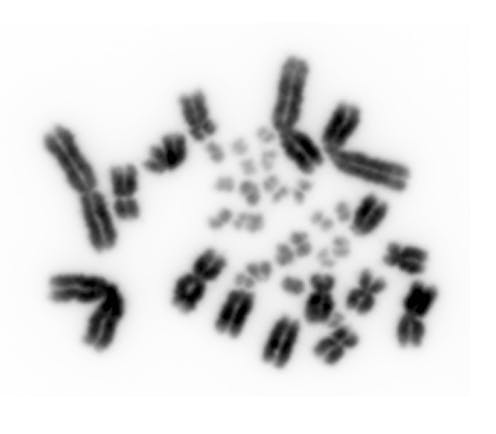
If you look at cells from a human or other mammal under a microscope, you’ll see big fat molecular complexes called chromosomes that contain our DNA. If the cells are from a bird or reptile, you’ll see a few of these chunky chromosomes but also a flotilla of tiny specks that look like broken-down pieces of chromosomes or even specks of dust.
Those specks turned out to be tiny chromosomes, but their significance has been a mystery for decades. I assembled a talented team of young genome scientists to show that these “microchromosomes” are almost identical, and they represent the ancient chromosomes of a spineless animal ancestor that lived 684 million years ago.
The human genome and human chromosomes
The human genome comprises about 3 billion base pairs of DNA, each one like a rung on a long, twisted ladder. If you stretched the whole genome out, it would be about 1 metre long. It contains about 20,000 genes and a lots of repetitive sequences of DNA with few known functions.
Our genome is broken up into 23 bits. We can see these bits when a cell divides into two, because during this process the DNA condenses with proteins into chromosomes (literally “staining bodies”) which we can see under the microscope. We have two copies of the genome in each of our cells (one from our mum and one from our dad), so we see 46 chromosomes in each cell.
Read more: Did sex drive mammal evolution? How one species can become two
Other mammals have pretty much the same set of genes on a similar length of DNA, but it is broken up differently. Some animals have lots of small chromosomes (there is a South American rat with 51) and others have a few big ones (the swamp wallaby has only 5).
Surprisingly, other higher vertebrates (birds and reptiles), though they have somewhat smaller genomes (1 or 2 billion base pairs) have pretty much the same sets of genes – as do frogs and even fish. The genomes of all vertebrates are amazingly similar.
The story of microchromosomes
When we look at the chromosomes of birds, turtles and squamates (snakes and lizards), however, we see big differences from those of mammals. They have between six and nine normal-looking chromosome pairs, but also lots of tiny elements that at first were thought to be degraded bits of chromosome or even dust on the microscope slide.
However, it proved that these elements were present in a constant – and even – number. Most birds have 62, representing 31 pairs of tiny “microchromosomes”.
Although microchromosomes are tiny, they have the same ends (telomeres) and attachment points (centromeres) as larger chromosomes. Curiously, they seem to hang out together in the centre of the cell.
Read more: Tick, tock... how stress speeds up your chromosomes' ageing clock
The real surprise came when it became possible to sequence bits of chicken microchromosome DNA and check out the genes they contained. It turned out that chick microchromosomes carry a big share of the genes and contain far fewer repetitive sequences than the large “macrochromosomes”. In fact, about half the chicken genes lie on microchromosomes. This implied that microchromosomes are important parts of the bird genome.
But the mystery remained. Why are there two such distinct size classes of chromosomes in birds and other reptiles? And why do you always see microchromosomes huddled together in the centre of the cell?
Microchromosomes are highly conserved across birds and reptiles
Thanks to huge improvements in DNA sequencing technology, there are now well-assembled end-to-end or “telomere-to-telomere” sequences of many birds and reptiles.
In our new work, we have lined up DNA sequences of macro- and microchromosomes between several birds, turtles and squamates. We see startling similarities in the sequences.
Emus and pigeons are only distantly related to chickens, as birds go, but they have virtually the same chromosomes. Turtles and squamates have fewer microchromosomes than birds, but the ones they do have are very similar within each group.
When we compared sequences between emus, turtles and squamates, we saw a high degree of homology in microchromosome DNA sequences stretching over the nearly 300 million years since these species last shared a common ancestor. Turtles and squamates each carry different subsets of emu microchromosomes. We could see the lost microchromosomes; they had fused with each other or with macrochromosomes.
This suggested that 31 bird microchromosomes was present in the genome of a common ancestor of birds and reptiles about 300 million years ago, and turtles and squamates independently lost different subsets of these.
We used new techniques to reveal which bits of DNA are physically closest to which in the DNA tangle of a non-dividing cell. This showed that microchromosomes play tag with each other, and not with macrochromosomes.
This gives molecular reality to the old observations that microchromosomes lie close together in bird and reptile cells. It looks like microchromosomes form a compartment in the cell that might help the genes work together.
Microchromosomes are ancient genetic elements
As it turns out, microchromosomes go back far, far further than the ancestral reptile: all the way to the tiny chromosomes of a very distantly related animal called the amphioxus or lancelet. Lancelets are small fish-like invertebrates that last shared a common ancestor with vertebrates 684 million years ago, long before the spine evolved.
Lancelets have a very small genome (520 million base pairs) cut up into 19 tiny, gene-dense chromosomes. This genome was duplicated twice during the evolution of the fish that gave rise to animals with four limbs (tetrapods).
Read more: It looks like an anchovy fillet but this ancient creature helps us understand how DNA works
We found that most emu microchromosomes aligned with a single lancelet chromosome, or sometimes with two. So the tiny lancelet chromosomes have survived almost unchanged as bird and reptile microchromosomes. The rest of the vertebrate genome is made up of copies of these chromosomes, diluted with enormous amounts of repetitive DNA.
This means that the tiny lancelet chromosomes, represented today by bird and reptile microchromosomes, were the original building blocks of vertebrate genomes.
Mammal genomes have gone mad
Some reptile and bird groups seem to have lost all or most of their microchromosomes. We show that, in these exceptional genomes, microchromosomes fused with each other (as in crocodiles) or with macrochromosomes (as in eagles and their relatives).
But mammals are the real exceptions. They have no microchromosomes. When we lined up emu sequence against the human and koala genomes (representing the marsupial and placental branches of the mammal family tree), we could find only small patches of homology with microchromosomes, scattered all over the genome.
However, in monotremes (egg-laying mammals that represent a third, and the oldest, branch of mammals), we saw that four platypus chromosomes are composed entirely of fused microchromosomes.
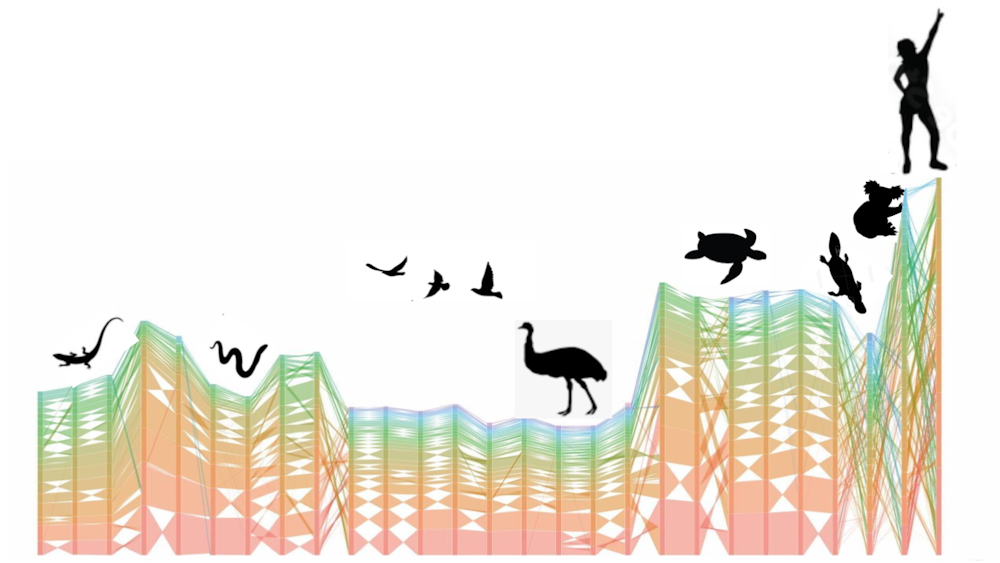
This implies that microchromosomes fused together into large blocks in a reptile-like mammal ancestor more than 200 million years ago. The chromosomes stayed that way in monotremes. But in our own lineage (therian mammals that diverged into marsupials and placental mammals), blocks of micro- and macrochromosomes were rearranged, obliterating their origins.
After this rearrangement, marsupial chromosomes stayed quite conserved, 19 large blocks of genes being shifted around in simple ways. However, the chromosomes of placental mammals have gone quite mad, rearranging multiple times in many lineages. Such dizzying chromosome variation is unusual in vertebrates.
So the tiny microchromosomes of birds and reptiles are really the “normal” chromosomes rather than our big, fat mammal chromosomes that are scrambled and inflated by repetitive DNA sequences.
Authors: Jenny Graves, Distinguished Professor of Genetics and Vice Chancellor's Fellow, La Trobe University




















