

the danger of using pseudolegal arguments against COVID-19 rules
- Written by Sarah Moulds, Senior Lecturer of Law, University of South Australia
Don’t want to take a COVID test, wear a mask or get vaccinated? It’s pretty easy to find advice telling you you’re legally entitled to say no. Unfortunately, this advice is very bad.
The COVID-conspiracy ginger group Reignite Democracy Australia, for example, claims to have “been working with lawyers” to provide template letters “you can use in situations where your personal rights are being encroached on”.
These letters state it is illegal for an employer or business to ask you to get tested, wear a mask or show proof of vaccination under the Australian Constitution and the Commonwealth Biosecurity Act 2015.
They suggest you cite Section 60, Subsection (2) of the Act and demand your employer provide a “human biosecurity control order”. They even suggest threatening legal action using the following words:
If you take any action to terminate or otherwise restrict my employment, you will be in breach of my employment contract and I reserve my rights to take legal action against you for your unlawful termination.
Similar advice is being spread on Facebook, Telegram and other social media channels. Other grounds cited for an employee or customer refusing to comply with COVID-related rules include the Federal Privacy Act 1988, human rights charters, anti-discrimination acts, the Nuremberg Code, statements by Australia’s Fair Work Ombudsman, and even “common law”.
All these arguments are flawed. They are what is known as “pseudolaw” – a mixture of real and fantasy legal ideas. Relying on them is most likely to make a situation worse. They might be enough to overwhelm or confuse a shop assistant, but they won’t stand up in court.
The consequences may include losing your job, putting yourself in a position where you may be arrested, spending money on fruitless legal cases, and incurring thousands of dollars in fines.
Mixing fact and fantasy
The term pseudolaw describes any statement that claims to represent a valid law but is actually false or “pretend”. This often involves squishing together real bits of law with false claims.
The Privacy Act 1988 (Cth), for example, is a real law that imposes rules on federal government agencies when it comes to handling personal information. But there’s nothing in the act that makes it unlawful to ask a customer to use a contact-tracing form when entering a shop.
The Australian Constitution does preclude “civil conscription” in Section 51(xxiiiA).
But this is about the federal government having the power to legislate on the provision of medical and dental services (as well as other forms of welfare) but not being able to force doctors and others to provide such services. It doesn’t stop federal or state governments proclaiming mask or vaccine mandates.
The Commonwealth Biosecurity Act does state that a biosecurity control order from an authorised biosecurity officer is needed to compel an individual to do something, such as undertake vaccination. But this does not not override or contradict state or territory health directions that mandate vaccinations in specific workplaces or other settings. Those directions are authorised by emergency management laws or public health acts, which coexist with federal biosecurity legislation.
Australia’s Disability Discrimination Act 1992 makes it unlawful to disadvantage another person or treat them differently because of a physical disability or even a disease. But it doesn’t mean a business can’t deny you entry if you refuse to show proof of vaccination. Businesses are generally entitled to set whatever conditions of entry they want, provided those conditions are reasonable, don’t discriminate on grounds such as sex or ethnicity, and are imposed to comply with other laws.
A lot like pseudoscience
While pseudolaw has probably been around as long as law, one of its most common expressions in recent decades has been the “sovereign citizen” movement, which essentially argues that individuals do not have to comply with laws they disagree with.
One Nation senator Malcolm Roberts used sovereign citizen arguments in a 2011 affidavit he sent to Prime Minister Julia Gillard, arguing he was exempt from the carbon tax and claiming compensation of A$280,000. Former One Nation senator Rod Culleton has also used sovereign citizen arguments, such as in his petition to Queen Elizabeth about the Australian government being illegitimate since 1973.
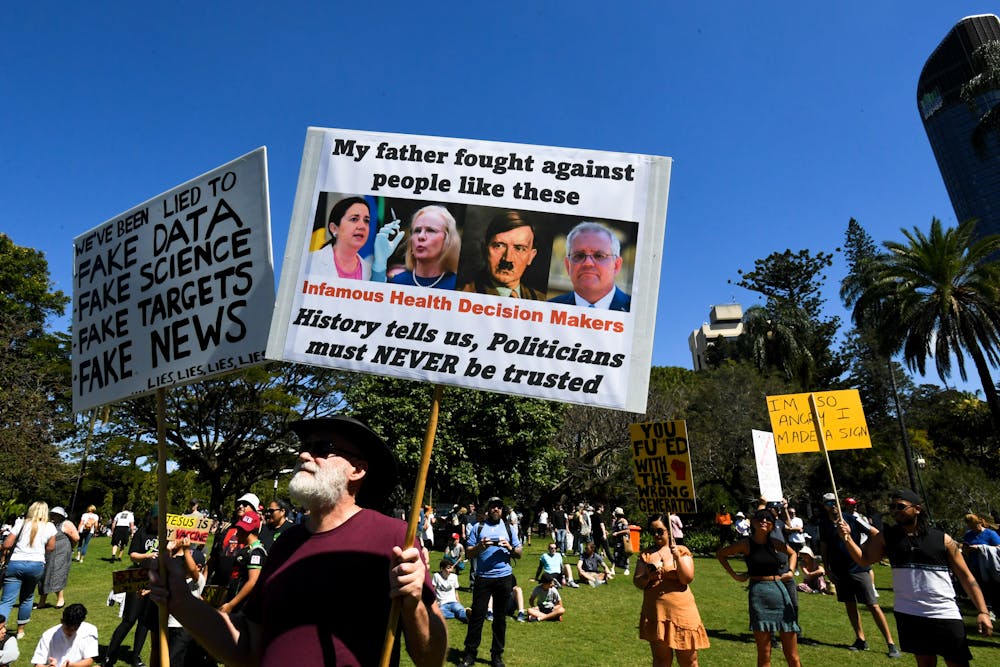 Protesters express opposition to lockdowns, COVID-19 tests, mask mandates and vaccine mandates at the Botanic Gardens in Brisbane, August 21 2021.
Dave Hunt/AAP
Protesters express opposition to lockdowns, COVID-19 tests, mask mandates and vaccine mandates at the Botanic Gardens in Brisbane, August 21 2021.
Dave Hunt/AAP
The attraction of these “personal sovereignty” arguments among those who fear COVID tests, masks and vaccines should hardly be surprising. Indeed, pseudolaw shares much ground with pseudoscience. As US lawyer Colin McRoberts has put it:
They both appeal to people’s natural fondness for self-reliance and secret knowledge. The path from curiosity toward self-destruction probably starts for many with curiosity about strange but compelling ideas – what if some of it were really true, and what’s the harm in believing it when you aren’t sick or in legal trouble? When the cost of error is low, the fact that snake oil doesn’t work is not particularly relevant. But once the believer starts to rely on it in the real world, the spiral has begun.
Pseudolaw also uses similar methods to pseudoscience. McRoberts credits believers with being “typically intelligent and motivated, and capable of constructing complex edifices that sound superficially credible”. But this artifice and the ability to overwhelm those without legal training can easily mislead people into believing the actual arguments have legal merit.
Real consequences
Relying on pseudolaw can give rise to serious legal consequences. Using them in a letter or document can cause harm and distress not only to the recipient but to your own case. If they lead to a genuine legal response or to court proceedings, they could potentially results in fines or penalties for falsifying documents.
Which is presumably why Reignite Democracy Australia includes the following disclaimers with its pseudolegal letters:
Keep in mind that some employees might not take this well and could actually fire you if you choose not to wear a mask/get a test. You would then need to decide how to move forward from there. Please take this into consideration.
In other words, before doing something that could result in you losing your job or incurring a large fine, you should get real legal advice. Consult your union, or a citizens’ legal advisory agency, or a lawyer you can trust.
Authors: Sarah Moulds, Senior Lecturer of Law, University of South Australia

















