

Voter ID is a bad idea. Here's why
- Written by Graeme Orr, Professor of Law, The University of Queensland
The Morrison government is pushing legislation to mandate voter ID at polling places. Contrary to some critics, what it proposes will not create US-style “voter suppression”. But it is still an unnecessary idea at an inappropriate time.
Countries like Australia, New Zealand and the United Kingdom (until now at least) do not require electors to show ID to vote. Many other systems do.
Insecurity about security is a conservative trope. So it is natural for political conservatives, temperamentally, to favour voter ID, with the argument being it is an “integrity” measure. Social democrats, on the other hand, are more trusting and concerned to ensure everyone can and does vote.
The Australian proposal lists an array of documents as acceptable ID. Photo ID such as a driver’s licence is not mandatory; a credit card or utility bill would suffice. “Documents” in law now include electronic records, which is important given how few people receive paper utility bills.
If an elector does not bring ID, or it is rejected (say for a misspelled name), they are to be offered a “provisional” vote. That is a rigmarole involving extra forms and delays. But it is a buffer - imagine a remote voter driving an hour to a polling station having forgotten their wallet.
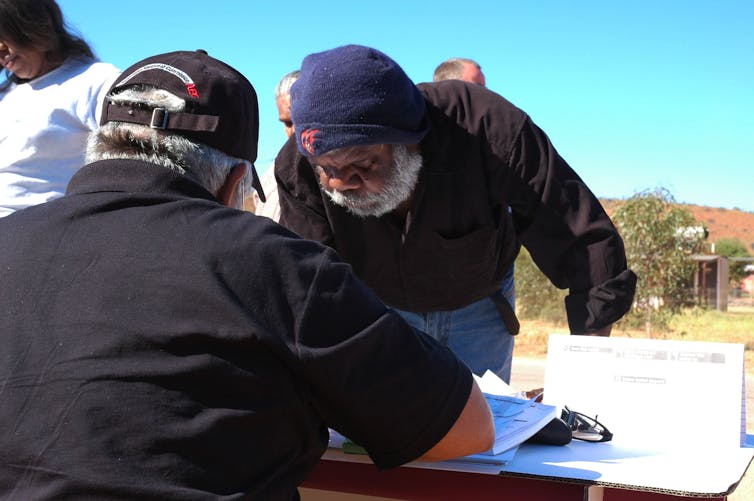
Young people, the very elderly and Indigenous people are all less likely to have such ID. To address the latter, a document from an Indigenous land council or similar agency will also count. When the LNP in Queensland briefly introduced voter ID in 2013-15, it was clear remote electors were more likely to have problems with ID.
Cost in the time of COVID
The UK Cabinet Office estimates voter ID there will cost in the order of £20 million (A$36.7 million) per election. That is for mandatory photo ID. The direct cost in Australia will be less, if not insignificant. The Australian Electoral Commission will need to mail proof of enrolment to each elector as one form of ID.
There are also indirect costs. The most obvious is in training - and trying to ensure consistency among tens of thousands of casual poll workers. Inevitably, some forms of ID will be accepted in some polling places and not others. Think of bills on cracked mobile screens, or cards with minor differences to the name on the electoral roll.
Most of all, with Australia reopening, COVID will be spreading across states that have never had a real wave. Voter ID will add to processing time for millions of electors. Those whose ID is rejected will have to join separate queues to make a fussy “declaration” vote.
Finally, those declaration votes enter a black box. Unlike some US states, electors are not told whether their provisional vote was ever accepted into the count. This in itself will hamper, not enhance, trust.
One group of electors will not need to produce ID: postal voters. Asking (predominantly older) postal voters to scan or copy ID is a step too far, as they already sign and witness forms to vote.
What does the Constitution say?
On voting “rights”, next to nothing. But in 2007, the High Court implied a universal franchise for Australian citizens. Then, in 2010, it struck down the early closing of electoral rolls as an undue burden on the ability to vote.
In doing so, it said parliament cannot impose such burdens without evidence. The “evidence” to support voter ID is the intuition that voters should produce ID. The benefit of voter ID is said to be enhancing perceptions of integrity.
This may be a fair call in the abstract. Yet in reality, Australia has high levels of trust in our independent and thorough electoral processes. Any lack of trust buzzes around parties as hierarchical entities, their funding and accountability, not electoral administration.
Perceptions of risk can also be circular, if not manipulated. By playing up integrity risks, regardless of actual evidence, you can generate concerns that you then use to justify new rules. (We also see this in debates about electoral donations.)
As long as the law allows electors without ID to cast a declaration vote without excessive palaver, the High Court will not veto voter ID. In any event, the law cannot be challenged before it is implemented. Any plaintiff claiming to be affected before the election will likely be rebuffed with “go and organise ID”.
Read more: From robo calls to spam texts: annoying campaign tricks that are legal
Voter ID cuts across compulsory voting
Most of all, voter ID is a dull idea in a country that has required people to enrol to vote for 110 years, and to turn out to vote since 1924.
Quite why we need voter ID is not clear. Most European countries do. But they have national ID cards. That is, every citizen, equally, has official ID. Such ID is something liberals in Australia fought against.
Ultimately, electoral integrity comes from having the most thorough roll and the highest turnout possible. Australia has a good record here, thanks to compulsion and direct enrolment laws.
Short of evidence of rogue electors impersonating other voters, voter ID is an unnecessary bureaucratic requirement, at an inappropriate point in a pandemic.
Authors: Graeme Orr, Professor of Law, The University of Queensland
Read more https://theconversation.com/voter-id-is-a-bad-idea-heres-why-170777

















