

As Papua New Guinea struggles with COVID, Australia must step up its 'vaccine diplomacy'
- Written by Tony Walker, Vice-chancellor's fellow, La Trobe University
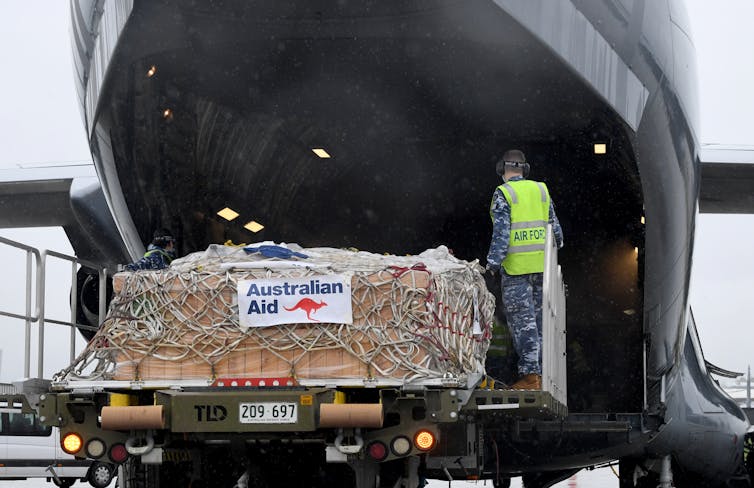
As our nearest neighbour, Papua New Guinea, struggles to contain a rampaging COVID outbreak, the question arises of how much Australia is doing to help. Is the emergency assistance Australia offers enough in a country whose health infrastructure was already under siege before the pandemic?
An ancillary question is whether Canberra’s “vaccine diplomacy” in the Indo-Pacific is losing ground against an aggressive Chinese push to make available its Sinovac and Sinopharm vaccines across the region.
This is a classic case of a health emergency meeting soft diplomatic power in Australia’s own strategic backyard.
China has distributed more than 1 billion doses of its vaccines to some 100 countries, with a particular focus on Asia and the Pacific. Something like 400 million doses have been distributed in Southeast Asia and around 300,000 in the Pacific.
Australia’s contribution in its own region stands at about 6 million doses of its AstraZeneca stockpile. But there is much work to be done: just 1.7% of adults in PNG are fully vaccinated.
Read more: The Pacific went a year without COVID. Now, it's all under threat
The Morrison government insists it is doing all it reasonably can to help its neighbour in what are dire circumstances for a country beset with development issues.
Zed Seselja, minister for international development and the Pacific, says in an interview that Australia has been “moving heaven and earth” to assist PNG with the supply of vaccines and has deployed Australian Medical Assistance Teams (AUSMAT) to help on the ground.
Late last month, Canberra despatched its sixth AUSMAT to PNG since the COVID-19 crisis began, to help lift the flagging vaccination rates.
This contrasts with Fiji where more than 80% of the eligible population – those over 18 – has been fully vaccinated with Australian assistance.
While the comparison between Fiji (population 900,00) and PNG (8 million) may not be fair, in the sense that the former is facing nowhere near the development problems and geographical constraints of the latter, the contrast between the two could hardly be more telling.
No-one pretends getting vaccines to remote areas in PNG, wide swathes of which lack electricity and, therefore, refrigeration for vaccine storage, is anything but a huge challenge. However, overlaying the PNG situation is the problem of vaccine hesitancy – perhaps better described as “vaccine phobia”.
According to a survey among university students, just 6% believed they needed to get vaccinated. One explanation for the level of vaccine hesitancy among educated Papua New Guineans is a low level of confidence in PNG’s public institutions, according to former Australian ambassador to Port Moresby Ian Kemish.
Perhaps most troubling of all is that many Papua New Guineans have developed a fatalistic belief that COVID is just another health challenge to add to the litany of other serious problems facing the country, including maternal mortality, malaria and tuberculosis.
Health professionals on PNG’s COVID-19 front line paint a disturbing picture of the challenges they are facing.
Dr Glen Liddell Mola, professor of medicine and a veteran gynaecologist and obstetrician in PNG, describes an overflow of patients into “tent wards” in the car park of Port Moresby General Hospital as medical facilities struggle to cope with the influx of COVID-19 sufferers. He told me:
I am 50 years into medical practice and not many illness scenarios challenge or frighten me anymore; but watching young people die from severe COVID disease had a very big impact on me. They literally die from laboured breathing respiratory failure: they just do not have the strength to take another breath.
Seselja says the government is mindful of the huge health challenges facing PNG, but levels of vaccine hesitancy are “very, very high”.
Sejelsa defends the government against suggestions it could have done more. He points out that since the COVID-19 crisis hit in early 2020, Australia has allocated $532.2 million to the countries of the Indo-Pacific to access and roll out vaccines.
It has made a $130 million contribution to the global World Health Organisation-managed COVAX facility as its share of a vaccine procurement program for less developed countries. Australia has pledged $100 million under the Quad Vaccine Partnership with the US, Japan and India to support vaccine delivery in Southeast Asia. Australia is also sharing 40 million vaccine doses with the region from its own AstraZeneca stockpile.
Of that 40 million stockpile, 2.2 million has gone to Indonesia, 1.5 to Vietnam, 861,000 to Fiji, 577,850 to Timor-Leste, 213,000 to the Solomon Islands and 144,970 to PNG, among others.
Asked why more vaccines had not gone to PNG, given its proximity to Australia and Australia’s own historical responsibilities, Seselja replied:
PNG’s absorptive capacity for vaccines is just not there.
He would seem to have a point. PNG recently “re-gifted” 30,000 doses to Vietnam because it could not deploy them before their use-by date.
Diplomatic competition in the Pacific has been reflected in testy moments between Canberra and Beijing. At one stage, China accused Australia of interfering with its attempts to supply vaccines to the region.
In July, China’s nationalist Global Times berated Canberra for “sabotaging” China’s aid programs with Pacific nations using “political manipulation” to interfere in vaccine rollouts.
The newspaper said Australia had been “planting” consultants in PNG to obstruct the authorisation of Chinese-supplied vaccines. A Chinese Foreign Ministry spokesman said:
Some people in Australia use the vaccine issue to engage in political manipulation and bullying, which is a disregard for the life and health of Papua New Guinea people, goes against the basic humanitarian spirit, seriously interferes with the overall situation of global co-operation against the pandemic.
Seselja rejects China’s claims, saying it is “absolutely not the case”.
All that said, vaccine diplomacy competition between Canberra and Beijing is evident in efforts by the former to counter China’s attempts to increase its influence among Pacific nations.
Finally, Australia’s COVID assistance program should be set against its annual aid allocations to PNG and the Pacific more generally as part of its Pacific “Step-Up” policy.
In 2020-21, Australia allocated $491.1 million in aid to PNG, or more than 10% of its total $4 billion aid budget. This was slightly less than Port Moresby received in 2019-20 due to completion of work on an undersea cable between PNG and the Solomon Islands.
PNG’s allocation accounts for about half of funds provided to Pacific island countries. On top of the annual aid budget, Canberra set aside $304.7 million over two years for what it called the COVID-19 Response Package for the Pacific and Timor-Leste.
These funds are being deployed, but it is in Australia’s interests to do more to help PNG.
Authors: Tony Walker, Vice-chancellor's fellow, La Trobe University

















