

Mountain biking gives this Tasmanian town a sustainable future. Logging does not
- Written by Richard Buning, Lecturer in Tourism, School of Business, The University of Queensland
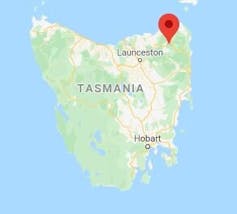
In the late 19th century it was tin mining that drove the economic life of Derby, about 100 km from Launceston in north-eastern Tasmania. But the mine has long closed. From a peak of more than 3,000, by the 2016 census Derby’s population was 178, with a 20% unemployment rate.
What has saved Derby from becoming another mining ghost town is finding a more sustainable mountain resource: mountain biking.
This transition could be considered a role model for the world, a story of hope for mining communities seeking to transition away from unsustainable resource extraction to something more about maintaining balance with nature.
But there’s something competing against this vision. As in many parts of Tasmania, and elsewhere, the forests through which the Blue Derby Trail Network trails have been built are still threatened by logging.
Origins of the the Derby venture
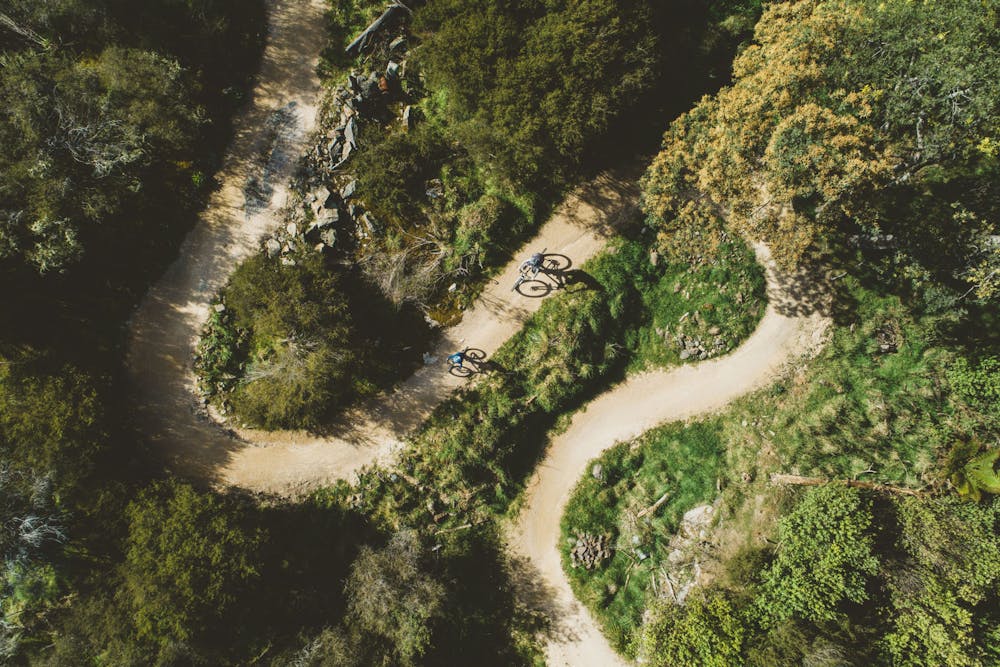
In 2015, with funding from the federal government, two local councils (Dorset Council and Break O'Day Council) opened the first 20 km section of the Blue Derby Trail Network, a system of mountain-bike trails that now extends 125 km through temperate old-growth rainforest, catering to a range of skill levels and riding styles.
There are easy trails such as “Crusty Rusty”, a “mostly undulating” track with two crossings of the local Cascade River. There are extremely difficult trails, such as “23 Stitches”, 800 metres of “fast, descending jump trail, littered with dirt jumps, rollers and tabletops”.
The 23 Stitches, rated ‘extremely difficult’The attractions of Blue Derby Trail Network were quickly acknowledged by interstate and international mountain-bike enthusiasts. By 2017 Dorset Council mayor Greg Howard was boasting the trails were attracting 30,000 visitors a year, with the initial investment of $3.1 million returning $30 million a year.
Turmoil amid renewal
Logging of Tasmania’s public forests is overseen by the state-owned business known as Sustainable Timber Tasmania (previously Forestry Tasmania). It manages 816,000 hectares of public forest designated as “Permanent Timber Production Zone land”. This area represents about 12% of Tasmania’s total land area and 24% of its forests.
Each year Sustainable Timber Tasmania is required to extract 137,000 cubic metres of sawlogs from these forests. It maintains a “Three Year Plan” for what parts of Tasmania it is going to log. It updated this document in July 2021.
This plan includes logging two coupes (CC105A and C119A) covering 85 hectares that border the Blue Derby Trail Network by the end of the year. A third coupe, covering 40 hectares, is scheduled for clear-felling in 2022.
Local views on this logging are mixed. Dorset Council mayor Greg Howard has said it won’t make any difference to the mountain bike trails. Conservationists and others are more defiant. Local conservation group Blue Derby Wild has organised protests) involving cyclists, hikers and activists.
Read more: Trails on trial: which human uses are OK for protected areas?
This battle between logging and outdoor recreation in Derby exemplifies the conflict between extraction and conservation affecting communities across Tasmania, Australia and the world.
The value of mountain bike tourism
This week more than 180 Tasmanian tourism businesses signed an open letter calling for the state government to end logging in native forests. The letter says:
Brand Tasmania promises an island at the bottom of the world where ancient forests and wild rivers await to reconnect people to their wild side, through nature based tourism experiences found nowhere else on earth.
Mountain biking has become an increasingly valuable part of this tourism mix since the late 1990s, when communities in iconic destinations such as Moab, Utah and Whistler, British Columbia began building mountain-bike trails.
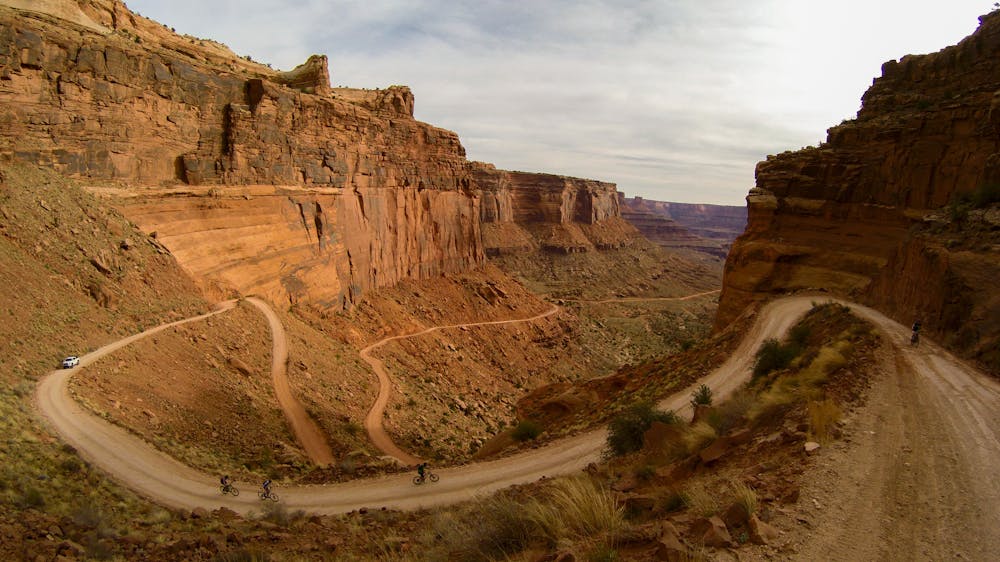 Mountain biking in Canyonlands National Park, near Moab, Utah.
Shutterstock
Mountain biking in Canyonlands National Park, near Moab, Utah.
Shutterstock
While the size and value of the industry internationally is difficult to assess, mountain bike tourists are typically affluent. They travel an average 12 nights a year, spending US$130 to US$23O each day of their visit. A study published in March 2021 (commissioned by the group AusCycling and funded by the federal government’s Building Better Region Fund), estimates Australia’s mountain bike market is worth about A$600 million a year, supporting more than 6,000 jobs.
How does the mountain-bike tourism compare with the value of logging? Again, while there are no studies that directly quantify this, comparisons between logging and ecotourism more generally point strong to the latter. A study on the economic contribution of ecotourism versus logging in the Wet Tropics of Queensland area, for example, found ecotourism was worth up to ten times more than logging.
In Tasmania, the tourism industry directly employs about 21,000 poeple, compared with about 2,500 in logging (at the time of the 2016 census).
Clear-cut choice
Derby has been pioneer in mountain-bike tourism. Communities looking to emulate its success include Harcourt in Victoria, York in Western Australia. and Mogo in New South Wales – which is also battling logging plans threatening the mountain bike trails.
Read more: Don't hike so close to me: How the presence of humans can disturb wildlife up to half a mile away
Mountain bikers predominantly seek out destinations based on the quality of the trail systems, the attractiveness of the terrain and appeal of the natural scenery. But just as important is support from the local community and politicians.
In Derby the choice between logging and sustainable tourism should be clear-cut. Mining didn’t last. Nor can logging. Long-term protections are needed now.
Authors: Richard Buning, Lecturer in Tourism, School of Business, The University of Queensland

















