Research reveals Australians are shy about expressing political views on social media
- Written by: Caroline Fisher, Assistant Professor in Journalism, University of Canberra
Are you anxious about expressing your political views online? If so, you are not alone. Australians are more worried about this than citizens in many other countries.
According to new research, almost half of Australians are worried about what their friends, family and colleagues will think of them if they express their political views on social media. This is an important contribution to understanding the changing nature of the Australian public sphere and the way citizens moderate their behaviour in different media settings.
The finding is contained in the latest Digital News Report: Australia 2018, released by the University of Canberra today.
The online survey of 2026 Australian news consumers found 41% say they tend to think very carefully about expressing their political beliefs openly on the internet because it could get them in trouble with authorities. 45% worry it could change the way their family, friends, colleagues and acquaintances could think about them.
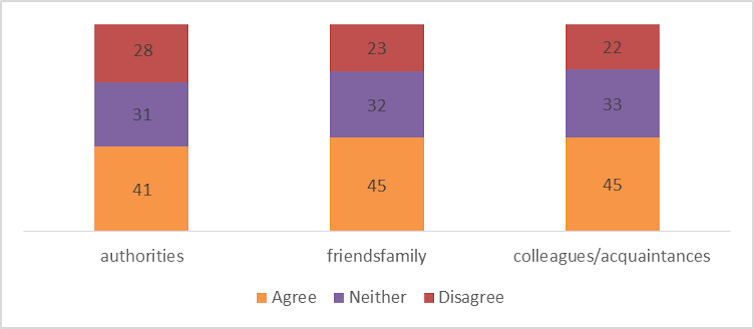 Figure 1: Concern about expression of political views on social media.
Digital News Report Australia 2018
Figure 1: Concern about expression of political views on social media.
Digital News Report Australia 2018
This is especially the case among young people. Two-thirds (61%) of 25- to 34-year-olds said they were careful about expressing their political views because this could make colleagues or acquaintances think differently about them. They were also worried about friends and family (58%) and authorities (57%).
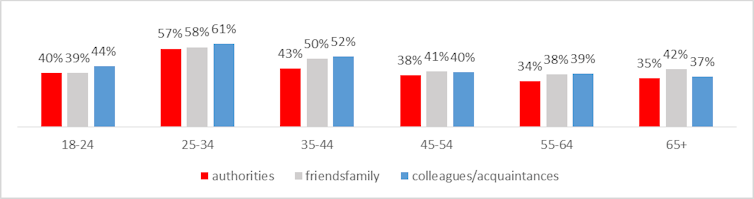 Figure 2. Proportion concerned that openly expressing their political views online might change the way others think about them by age.
Digital News Report Australia 2018
Figure 2. Proportion concerned that openly expressing their political views online might change the way others think about them by age.
Digital News Report Australia 2018
Left-wing-oriented news consumers were also more worried about expressing their views on line than those with a right-wing bent.
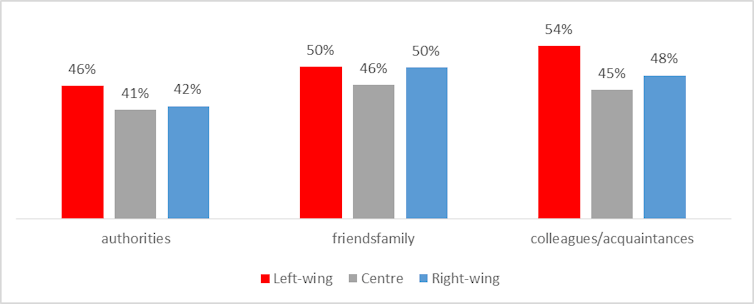 Figure 3: Political orientation and reluctance to express political views on social media.
Digital News Report Australia 2018
Figure 3: Political orientation and reluctance to express political views on social media.
Digital News Report Australia 2018
The level of worry about this in Australia is also higher than in other countries. Of the 37 countries who participated in the survey, the global average of concern about expressing political views on social media was 38%, compared to 45% in Australia.
Why should this be the case? There are several possible reasons. Australians are early adopters of social media and heavy users of it, especially amongst younger people. Because of this, they understand the online environment and are aware of trolling and how combative it can be. Therefore, they might opt to not reveal their political beliefs to avoid attracting negative responses online.
Read more: Australians born overseas prefer the online world for their news
Their familiarity with social media might also mean they are more careful about managing their reputation in the digital publishing environment. Alternatively, they might simply want to preserve social media for social interaction and not spoil it by engaging in political discussion. It might also simply signal that for many young social media users who have a lower interest in news, they prefer to keep social media “social”, and not a place for political debate.
The report also shows that people who are more worried about expressing their political views tend to choose messaging apps over open social media platforms such as Twitter and Facebook. Those who are worried what colleagues or acquaintances might think are twice as likely to use WhatsApp or Facebook Messenger than those who are not worried.
Internationally, messaging apps are increasingly being seen as a safe place for free expression and sharing news. This was found to be the case in authoritarian countries such as Turkey or Malaysia, where WhatsApp use for news was as high as 30% and 54%, respectively.
While Facebook use for news appears to have slowed in Australia over the past three years (2016: 45%, 2017: 39%, 2018: 41%), other social media and messaging apps have become more popular for news in the past 12 months: YouTube (15-20%), Facebook Messenger (8-11%), Snapchat (2-5%), WhatsApp (7-10%).
For 36% of Australians aged 18- to 24-year-olds, social media platforms are now the main source of news. 72% of news consumers in this age group use their phones to access online news, which is also the main way they access social media.
Overall in Australia, there has been a 6% increase in the use of social media/blogs for news, rising from 48% in 2017 to 54% in 2018. This bucks the international trend of a decline in social media use for news across the majority of other countries in the survey.
In addition to the increase in using social media to access news, there has been a jump in mobile phone use. Almost 60% of Australian news consumers are now using their smartphones to access news. Further, 36% of news consumers say their mobile phone is the main device they use to access news. This is a 6% increase from last year.
Read more: Most young Australians can’t identify fake news online
This is not the case in all parts of the country. The digital divide is affecting how regional Australians access news. News consumers in regional Australia are less likely to use their mobile phones (56%) to access news compared to those in major cities (61%). They are also more likely to rely more on offline platforms, particularly television news, and twice as likely than urban dwellers to rely on local and regional newspapers for news. This suggests internet connectivity may be a factor in accessing news online for people in regional Australia.
Despite the differences between regional and urban parts of the country, Australians are embracing online news at a rapid pace and beginning to leave traditional platforms behind. For the first time, access to online news (82%) has overtaken traditional offline sources (79%). This is a significant shift, one that will be closely monitored in next year’s report.
Digital News Report: Australia is produced by the News & Media Research Centre (N&MRC) at the University of Canberra and is part of a global annual survey of digital news consumption in 37 countries, commissioned by the Reuters Institute for the Study of Journalism at the University of Oxford. The survey was conducted by YouGov at the end of January/beginning of February 2018. In Australia, this is the fourth annual survey of its kind produced by the N&MRC.
Authors: Caroline Fisher, Assistant Professor in Journalism, University of Canberra