

Get Back review – Peter Jackson's TV series is a thrilling, funny (and long) treat for fans
- Written by David McCooey, Professor of Writing and Literature, Deakin University
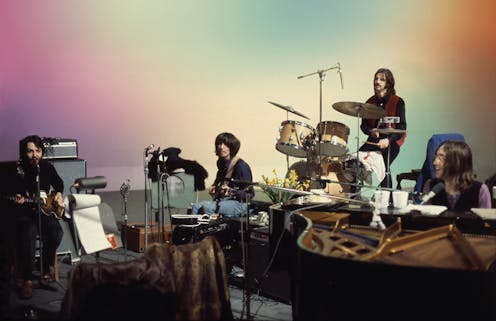
The Beatles’ Get Back project, undertaken in January 1969, has finally been completed. Again.
For most of the last 50 years it has been known as Let it Be, a film and LP record released in 1970. The project, conceived by Paul McCartney, was originally intended to be a television special documenting the band’s preparation for a live concert (their first in two and a half years). Because of the performance element, the Beatles decided to get back to their roots and only develop material that could be played without adding overdubs.
As it happened, the concert didn’t go ahead, the Beatles famously deciding instead to play a short unannounced gig on the roof of their headquarters. The TV special became a feature film, and the audio was handed over to the “wall of sound” producer, Phil Spector (leading to controversial results).
Meanwhile, in the early 1980s, the Beatles withdrew the film version (a fly-on-the-wall documentary directed by Michael Lindsay-Hogg) from circulation.
Lindsay-Hogg’s Let it Be is remembered as a portrait of a band in the process of breaking up. And indeed, George Harrison did briefly quit the band early into the four-week project, though Lindsay-Hogg’s documentary does not cover this episode.
Let it Be was seen as a downer in part because the Beatles, especially Lennon, were keen to trash it in the light of the band’s breakup (which occurred just weeks before the release of Let it Be, both film and album). As Lennon said in December 1970, the shoot was “hell”, and Spector was “given the shittiest load of badly recorded shit”.
Read more: Paul McCartney's The Lyrics: an extraordinary life in song
A different tenor
While the newly released The Beatles: Get Back, directed by Peter Jackson, covers Harrison’s departure and return, Jackson’s film is tonally different from Lindsay-Hogg’s. According to Jackson, the dour account of Let it Be is inaccurate, since there is much “joy” and friendship evident in the 60 hours of film and 150 hours of audio tape that has been sitting in a vault for half a century.
Much of this audio has long been available as bootlegs, informing written accounts of this period of the Beatles’ history. The audio without the video, however, doesn’t always tell the whole story.
While Jackson and his team haven’t shied away from the moments of friction, ennui, and aimlessness experienced by the band, the tenor of Get Back is more upbeat than Lindsay-Hogg’s version (though there is perhaps more levity in that film than Jackson or its reputation allows).
But Get Back is not just a recut of Let it Be; it is a documentary in its own right, a film about the making of a film. Lindsay-Hogg is now a character in the drama of trying to work out what the project is about, and how it will end.
Unlike the cinema verité style of Let it Be, Get Back gives much-needed context in the form of titles naming the protagonists and songs, as well as explaining what is happening. The use of a day-by-day countdown to the live performance gives the otherwise shapeless events a sense of narrative and even tension.
Get Back was to be a feature film with a theatrical release, but COVID-19 led to a rescheduling and reconceptualising of the work, so that it became a documentary for Disney+. Recent reports were that the series would be a three-part series with a six-hour running time.
The climactic rooftop concert
As it turns out, that running time is closer to eight hours. (Let it Be is a mere 80 minutes long.) Almost all of these eight hours show the Beatles at work on a sound stage (at Twickenham Film Studios) or in an ad hoc recording studio (put together in the Beatles’ Apple headquarters, when – after Harrison’s walkout – it was decided that Twickenham wasn’t conducive to creativity).
The Apple studio is clearly more pleasant, and the tone is further lightened when the Beatles are joined by an outsider, their old friend Billy Preston, on keyboards (a crucial moment for the project).
There is nevertheless something of a hermetic feel to most of Get Back, so that when the Beatles and Preston head up to the rooftop to play in public – the cinematic “payoff” that the band and Lindsay-Hogg had been looking for throughout the project – there is a palpable sense of release.
And the famous rooftop concert, presented with creative use of split screen, is stunningly good (and is also, for the first time, presented in its 42-minute entirety).
After the countless run throughs and takes of the same songs over the preceding weeks (as well as numerous covers and early Beatles tunes), the sense of energy and the quality of playing gives the film the climactic moment that it needs, complete with police officers demanding, albeit politely, that the Beatles stop breaching the peace of London’s West End.
Cigarettes, cups of tea, and white bread
Get Back is very different from Let it Be in part due to Jackson’s editing, especially his use of montage, which produces a dynamic, sometimes frenetic, energy. Beyond these stylistic elements, Get Back is notable as a technical feat.
It looks and sounds astonishingly good, not something that was ever said about Let it Be. Jackson and his technical team have employed the kind of film restoration techniques used in his war documentary They Shall Not Grow Old (2018).
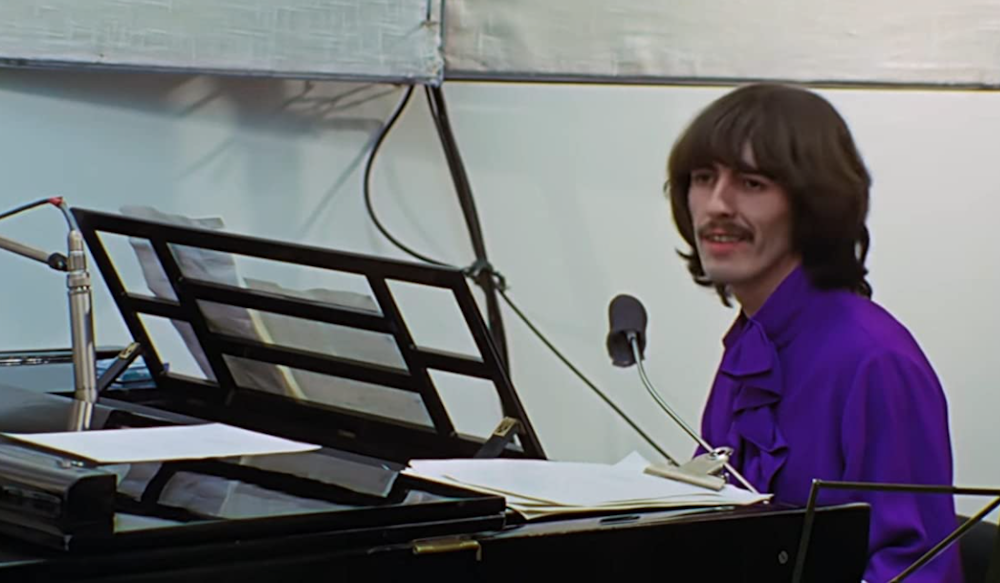
The vision in Get Back is beautifully saturated, sharp, and less grainy than Lindsay-Hogg’s film. Harrison and Starr, in their sartorial splendour, often resemble their cartoon equivalents from Yellow Submarine (1968).
If there is anything unvarnished about Jackson’s film it is the sight of people apparently living off cigarettes, cups of tea, and white bread. Also notably “historical” is the homosocial nature of the project; almost all of the active participants are men. Even Yoko Ono, who sits beside Lennon throughout, is almost entirely silent (save for her vocal participation in a couple of impromptu jams).
While the film has been painstakingly restored, the soundtrack has been almost remade. Much of the audio was recorded on mono quarter-inch tape. Jackson’s technical team used machine learning to effectively “remix” these mono tapes, allowing Jackson to hone in on individual voices masked by other sound sources (voices or musical instruments).
 John Lennon in Get Back.
Walt Disney Pictures, Apple Corps, WingNut Films
John Lennon in Get Back.
Walt Disney Pictures, Apple Corps, WingNut Films
Read more: Revolution 50: The Beatles’ White Album remixed
This is an extraordinary technological breakthrough, allowing key conversations to be heard properly for the first time, and for the remixing of the play throughs and rehearsals of songs, which weren’t being recorded as “takes” on the eight-track system.
Get Back is a treat for any Beatles fan. It’s a reminder, too, if one is needed, that some classic songs were recorded for the project. (Given that McCartney supplied at least three of these classics – Let it Be, The Long and Winding Road, and Get Back – it’s unsurprising that he has long been unsatisfied with the way they were originally showcased.)
But Jackson’s film isn’t all sweetness and light. Lennon, for instance, is dismissive of Harrison’s I, Me, Mine, and he makes a throwaway joke about Bob Wooler, a Liverpool disc jockey whom Lennon assaulted in 1963. Also notable is the relative absence of George Martin, who largely hands production duties to his sound engineer, Glyn Johns, surely a sign that Martin found something amiss with the project.
And indeed numerous sequences show a band lacking focus and discipline. Get Back, then, is unquestionably a mixed bag: thrilling, compelling, and funny, but also sometimes just a little boring.
In this, Jackson has been true to the original project. His extraordinary TV series is essential viewing for anyone interested in popular music.
Authors: David McCooey, Professor of Writing and Literature, Deakin University

















