

80 years on, the attack on Pearl Harbour offers lessons for today
- Written by Patricia A. O'Brien, Visiting Fellow, Department of Pacific Affairs, Australian National University; Adjunct Fellow, Center for Strategic and International Studies, Washington DC; Adjunct Professor, Asian Studies Program, Georgetown University
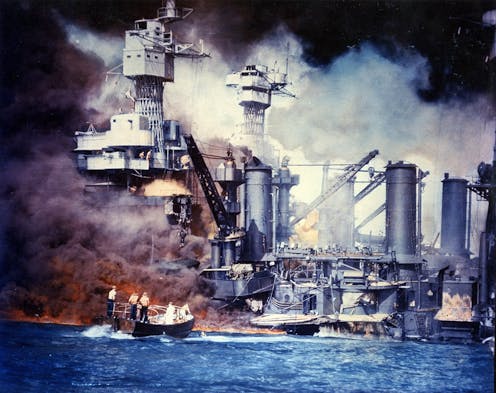
“Pacific Ablaze” read Australian papers on December 8 1941, as the world learned about the monumental events that unfolded only hours before. Japan had simultaneously declared war against the United States and Great Britain, then immediately launched stunning attacks spanning 6,400 kilometres (and the international date line) from Singapore to Hong Kong, Malaya, Bangkok, Guam and the Philippines.
The most iconic attack was on Pearl Harbour. Within the US territory of Hawaii (where it was still December 7), Japanese forces decimated the immense naval base, drawing the US into the second world war that had begun in 1939.
The attack opened the war’s Pacific theatre, spanning the entire ocean. It brought untold devastation, loss and change to the Pacific’s remotest islands and its densest population centres.
Eighty years on, the prodigious history triggered on the “day which will live in infamy” is being revived in increasingly ominous ways.
Japan’s opening attacks triggered a cascading crisis of events. After the December 7 and 8 attacks, Australians were told that halting Japan’s southward expansion “all depends on Singapore”. Singapore fell in a matter of days, on February 15 1942. Prime Minister John Curtin described this event as “Australia’s Dunkirk”, leaving it wide open to invasion. New Guinea was then attacked on February 16.
Read more: The war in the Pacific: fighting the good fight, or something else
Three days later, the war came to Australia’s mainland. Darwin was bombed for the first time on February 19, killing more than 230 people and destroying infrastructure.
Bombing raids across northern Australia followed, as did acute fears of Japanese submarine attacks along the industrial and heavily populated east coast. These fears were realised with attacks in Sydney Harbour in May and Newcastle in June 1942.
The arrival of American troops reversed Australia’s desperate situation. The first of nearly 1 million who rotated through Australia (then with a population of 7 million) began arriving in December 1941.
In the wake of the Pacific-wide attacks of December 7 and 8, Curtin recognised Australia’s grave defence vulnerabilities premised on deeply flawed British imperial plans. He declared “Australia looks to America” as its only hope against invasion.
The arrival of American troops ensured Australian soil would not be the battleground for defeating Japan. Instead, Pacific islands from the Alaska Territory’s Aleutian Islands, Kiribati, the Solomon Islands, Australia’s colonies of Papua and New Guinea to Japan’s former mandated territories colonies, like the Northern Marianas, saw four years of slaughter.
The blood-letting finally ended with the war’s greatest mass-casualty events of all, the US atomic bombs dropped on the Japanese cities of Nagasaki and Hiroshima in August 1945.
Throughout the war, Australia (first Melbourne and then Brisbane) served as America’s headquarters for prosecuting the war against Japan. The countless bonds forged in war were only solidified after the war’s end with the rapid escalation of the Cold War and the outbreak of proxy wars in the Pacific region involving the US and its allies against Communist Russia and China. These were most notably in Korea (1950-1953) and then Vietnam (1965-1975).
Throughout the postwar era, the 1951 ANZUS Treaty served as the basis for the US and Australian relationship. During these decades, the Pacific islands faded into the geopolitical background, though they were littered with the war’s still deadly refuse. But China’s growing influence from the mid-2000s slowly reignited Australian and US attention to the Pacific Islands.
In 2021 we have seen an intense recalibration of the US-Australia relationship. The surprise September 2021 announcement of the AUKUS agreement between the US, Australia and the UK has led to an avalanche of debate about northern attacks on Australia from an Asian power (this time China), submarines and the Pacific’s nuclear legacies.
Read more: The AUKUS pact, born in secrecy, will have huge implications for Australia and the region
Then, on November 29 2021, the US Defence Department announced in its global posture review that it will concentrate military activities and infrastructure in Australia and select Pacific Islands.
There’s no question the US and the UK are returning to the Pacific at levels not seen since the second world war. The AUKUS agreement, initiated by the Morrison government, encapsulates the escalating tensions due to China’s troubling acts. These include its rhetorical and trade war with Australia, aggressions towards Taiwan, military expansion in the South China Sea and its deepening influence in the Pacific islands as a suspected veiled means to project its military power.
Australia’s prime minister and, most recently, defence minister have conjured up the Pacific War, saying “we live in the echoes of the 1930s”, citing “mistakes” that led to the war.
China has lashed back, criticising the Australian government for super-charging fears that history is repeating at a terrifying scale and pace.
The 80th anniversary of the Pearl Harbour attack is an opportune moment to take stock and think about some lessons of history. Here are some to consider.
Australia, the US and Britain were all woefully unprepared for Japan’s belligerence from late 1941. Securing Australia’s defences now is sensible, if not overdue.
However, addressing this security need does not have to be accompanied by the beating of war drums or the fracturing of other vital alliances, as with the Morrison government’s diplomatic “own goal” with France over the submarine deal scuttled by the AUKUS agreement. With AUKUS, the Biden administration got a taste of Australia taking the diplomatic lead – an enraged France withdrew its US ambassador for the first time in history. One of the vital mistakes that led to war was the failure of diplomacy.
The Pacific war was ruinous. It caused unimaginable suffering to Japan’s populace both in a defeated Japan and living around the Pacific region. Immediately after Pearl Harbour, Japanese people were “rounded up” into internment camps and their personal assets stripped.
In the case of Hawaii, where one-quarter of the population in 1941 was of Japanese descent, they lived under harsh military law. Pacific Islanders, whose islands were war fronts, also suffered immeasurably from the conflict.
Australian and American soldiers and their families also sustained terrible losses. For many who survived the war, its horrors never ceased.
For China, the war began years before 1941, in the 1930s, with Japanese aggression and a crushing invasion epitomised by searing events, like the 1937 Rape of Nanking.
The brutality and devastation sparked by the Pearl Harbour attacks should not fade from the minds of politicians from all sides. Eighty years on, there remain powerful lessons to be learned.
Authors: Patricia A. O'Brien, Visiting Fellow, Department of Pacific Affairs, Australian National University; Adjunct Fellow, Center for Strategic and International Studies, Washington DC; Adjunct Professor, Asian Studies Program, Georgetown University
Read more https://theconversation.com/80-years-on-the-attack-on-pearl-harbour-offers-lessons-for-today-171953

















