

Modern Australian
The Times

we asked fast-fashion shoppers how ethical concerns shape their choices

  • Written by Tara Stringer, PhD Candidate, Queensland University of Technology
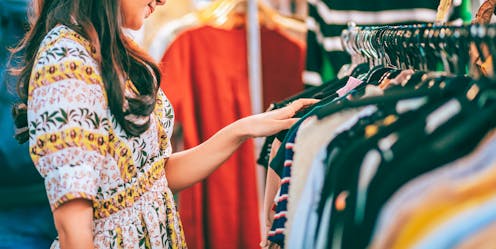
we asked fast-fashion shoppers how ethical concerns shape their choices

You’ve found the perfect dress. You’ve tried it on before and you know it looks great. Now it’s on sale, a discount so large the store is practically giving it away. Should you buy it?

For some of us it’s a no-brainer. For others it’s an ethical dilemma whenever we shop for clothes. What matters more? How the item was made or how much it costs? Is the most important information on the label or the price tag?

Of the world’s industries that profit from worker exploitation, the fashion industry is notorious, in part because of the sharp contrast between how fashion is made and how it is marketed.

There are more people working in exploitative conditions than ever before. Globally, the garment industry employs millions of people, with 65 million garment sector workers in Asia alone. The Clean Clothes Campaign estimates less than 1% of what you pay for a typical garment goes to the workers who made it.

Clean Clothes Campaign/The Conversation, CC BY-ND Some work in conditions so exploitative they meet the definition of being modern slaves – trapped in situations they can’t leave due to coercion and threats. But their plight is hidden by the distance between the worker and the buyer. Global supply chains have helped such exploitation to hide and thrive. Do we really care, and what can we do? We conducted in-depth interviews with 21 women who buy “fast fashion” – “on-trend” clothing made and sold at very low cost – to find out how much they think about the conditions of the workers who make their clothes, and and what effort they take to avoid slave-free clothing. Well-known fast-fashion brands include H&M, Zara and Uniqlo. Read more: Four Corners’ forced labour exposé shows why you might be wearing slave-made clothes What they told us highlights the inadequacy of seeking to eradicate exploitation in the fashion industry by relying on consumers to do the heavy lifting. Struggling to seek reliable information on ethical practices, consumers are overwhelmed when trying to navigate ethical consumerism. Out of sight, out of mind The 21 participants in our research were women aged 18 to 55, from diverse backgrounds across Australia. We selected participants who were aware of exploitation in the fashion industry but had still bought fast fashion in the previous six months. This was not a survey but qualitative research involving in-depth interviews to understand the disconnect between awareness and action. Our key finding is that clothing consumers’ physical and cultural distance from those who make the clothes makes it difficult to relate to their experience. Even if we’ve seen images of sweatshops, it’s still hard to comprehend what the working conditions are truly like. Garment workers sew clothes at a factory in Huaibei, Anhui province, China.
Garment workers sew clothes at a factory in Huaibei, Anhui province, China. Xie Zhengyi/AP

As Fiona*, a woman in her late 30s, put it: “I don’t think people care [but] it’s not in a nasty way. It’s like an out of sight, out of mind situation.”

This problem of geographic and cultural distance between garment workers and fashion shoppers highlights the paucity of solutions premised on driving change in the industry through consumer activism.

Who is responsible?

Australia’s Modern Slavery Act, for example, tackles the problem only by requiring large companies to report to a public register on their efforts to identify risks of modern slavery in their supply chains and what they are doing to eliminate these risks.

While greater transparency is certainly a big step forward for the industry, the legislation still presumes that the threat of reputational damage is enough to get industry players to change their ways.

The success of the legislation falls largely on the ability of activist organisations to sift through and publicise the performance of companies in an effort to encourage consumers to hold companies accountable.

Read more: Modern Slavery Bill a step in the right direction – now businesses must comply

All our interviewees told us they felt unfairly burdened with the responsibility to seek information on working conditions and ethical practices to hold retailers to account or to feel empowered to make the “correct” ethical choice.

“It’s too hard sometimes to actually track down the line of whether something’s made ethically,” said Zoe*, a woman in her early 20s.

Given that many retailers are themselves ignorant about their own supply chains, it is asking a lot to expect the average consumer to unravel the truth and make ethical shopping choices.

Confusion + overwhelm = inaction

“We have to shop according to what we care about, what is in line with our values, family values, budget,” said Sarah*, who is in her early 40s.

She said she copes with feeling overwhelmed by ignoring some issues and focus on the ethical actions she knew would make a difference. “I’m doing so many other good things,” she said. “We can’t be perfect, and I can only do so much.”

Other participants also talked about juggling considerations about environmental and social impacts.

“It’s made in Bangladesh, but it’s 100% cotton, so, I don’t know, is it ethical?” is how Lauren*, a woman in her early 20s, put it. “It depends on what qualifies as ethical […] and what is just marketing.”

Comparatively, participants felt their actions to mitigate environmental harm made a tangible difference. They could see the impact and felt rewarded and empowered to continue making positive change. This was not the case for modern slavery and worker rights more generally.

Fast fashion is a lucrative market, with billions in profits made thanks to the work of the lowest paid workers in the world.

Read more: Fashion production is modern slavery: 5 things you can do to help now

There is no denying consumers wield a lot of power, and we shouldn’t absolve consumers of their part in creating demand for the cheapest clothes humanly – or inhumanly – possible.

But consumer choice alone is insufficient. We need a system where all our clothing choices are ethical, where we don’t need to make a choice between what is right and what is cheap.

The names of study participants have been changed to protect their anonymity.

Authors: Tara Stringer, PhD Candidate, Queensland University of Technology

Read more https://theconversation.com/i-can-only-do-so-much-we-asked-fast-fashion-shoppers-how-ethical-concerns-shape-their-choices-172978

Why Material Handling Hose Is Critical for Industrial Efficiency

A high-performance material handling hose is an essential component in industries that transport abrasive, dry, or bulk materials on a daily basis...

How to Choose the Right Lawyer in Melbourne for Your Situation

Choosing legal support can feel difficult, especially when the stakes are personal or business-related. The right lawyer in Melbourne should underst...

Hoteliers Look to Clever Value Adds to Increase Revenue

The Australian hospitality industry is still in recovery mode after a notoriously rough patch in recent years. While there has been a post-COVID tra...

Moving to Queensland? Here’s How to Prep Your Car for the Big Move North

There’s no sign of the northern migration slowing down, with thousands of southerners fleeing from chaotic lifestyles and cooler climates for a brig...

Diesel Shortage to Impact Trades and Contractors

Strait of Hormuz blockage affecting all major parts of trades and construction Trades and construction across residential, commercial and industria...

Why Holiday Home Owners Turn to Rental Management Agents

The Allure — and the Reality — of Renting Out Your Property Owning a holiday home is a dream for many Australians. Whether it's a beachside sha...

Why Finding Reliable Doctors In Bundoora Is Important For Long-Term Health

Access to quality healthcare plays an important role in maintaining overall wellbeing and managing health concerns early. Trusted Doctors in Bundoor...

Understanding the Different Types of Car Services: Minor vs Major

When it comes to car maintenance, one of the most important things every vehicle owner should understand is the difference between a minor and a maj...

How Superannuation and TPD Insurance Work Together

Superannuation is an essential part of financial planning in Australia. It is designed to provide individuals with income during retirement, helping...

Tiny Towns funding granted for Mt Hotham and Mt Buller upgrades

Alpine Resorts Victoria (ARV) has welcomed funding support from the Victorian Government’s  Tiny Towns Fund, with both Mt Hotham and Mt Buller se...

Locksmith Services: Why Professional Security Solutions Matter More Than Ever

Security is a critical concern for homeowners, businesses, and vehicle owners alike. Whether it involves protecting a property, replacing damaged lo...

Why Tooth Fillings Are Important For Protecting Damaged Teeth

Cavities and minor tooth damage are common dental problems that can worsen if left untreated. Professional tooth fillings help restore damaged teeth, ...

The Connection Between Visibility and Driver Confidence

Operating a vehicle safely requires an immediate, uncompromised stream of visual information from the surrounding road environment. A driver's decis...

Important Things To Know Before Starting An SMSF Setup

Planning for retirement requires careful financial decisions, and many Australians are now looking for more direct control over how their superannua...

Why Retail Cleaning Plays a Key Role in Customer Experience and Business Success

Professional retail cleaning services are an essential part of maintaining a welcoming, safe, and professional environment for customers and staff...

Simple Ways to Make a Commercial Property More Appealing to Buyers

Selling or leasing a commercial property isn’t just about listing the square metres, taking a few photos and waiting for the right person to appea...

What Café Owners Should Know Before Upgrading Their Display Setup

A café display fridge does a lot more than keep cakes cold and sandwiches fresh. It quietly shapes the way customers browse, the way staff move beh...

Creating a Backyard That Feels Comfortable All Year Round

A great backyard doesn’t need to be huge, expensive or perfectly styled. Most of the time, the spaces people actually use are the ones that feel e...
















