

Graduates lose pay advantage in tougher times, but overall workforce entrants seem surprisingly satisfied
- Written by Roger Wilkins, Professorial Fellow and Deputy Director (Research), HILDA Survey, Melbourne Institute of Applied Economic and Social Research, The University of Melbourne

Around 400,000 people under the age of 25 leave full-time education and embark on their careers each year. The latest HILDA Survey Statistical Report, released today, shows how they have been faring since 2001. Full-time work has become harder, and the pay advantage university graduates enjoy has decreased. Yet, overall, new recruits to the workforce remain at least as happy with their jobs as they have been over the past two decades.
Over most of this century, and probably much of the 20th century, getting a foothold in the labour market and progressing up the career ladder has been a significant challenge for these young people.
Today, about 40% find full-time work in their first year out of full-time education. A further 35-40% get part-time work.
Their median hourly earnings are about two-thirds of median earnings of all workers. But, because many don’t have full-time jobs, their median weekly earnings are just over half those of the median worker.
Five years after entering the workforce, about 85% are employed, two-thirds of them full-time. Earnings have also increased relative to the median worker five years after entry, but remain about 10% lower.
The educational attainment of young new entrants has increased considerably since 2001. The proportion with a university degree has increased from 15% in the early 2000s to 23% in recent years. The proportion who did not complete high school has halved from 24% to 12%.
Poorer rewards for better qualifications
Despite having better qualifications, young people’s employment outcomes and trajectories have not improved at all. Indeed, since the boom years before the global financial crisis (GFC), there has been a marked deterioration.
Full-time employment in the year of labour market entry has fallen from 50% to 41%. Unemployment has risen from 8.4% to 11.2%. Full-time employment rates in the following years have similarly fallen.
Read more: 1 in 4 unemployed Australians has a degree. How did we get to this point?
The fall was most dramatic between the pre-GFC boom years (2004-2007) and the 2012-2015 period, and has been especially large for university graduates.
Those graduating in the pre-GFC boom years had a full-time employment rate of 68%. This fell to 53% for those graduating between 2012 and 2015.
In the boom years, graduates’ median earnings were 97% of overall median earnings in the year after graduation. By 2012-15, that proportion had fallen to only 82%.
There has since been a slight improvement. Some 56% of those who graduated between 2016 and 2018 were employed full-time in the year following graduation. However, outcomes for graduates were still considerably down on the early years of this century.
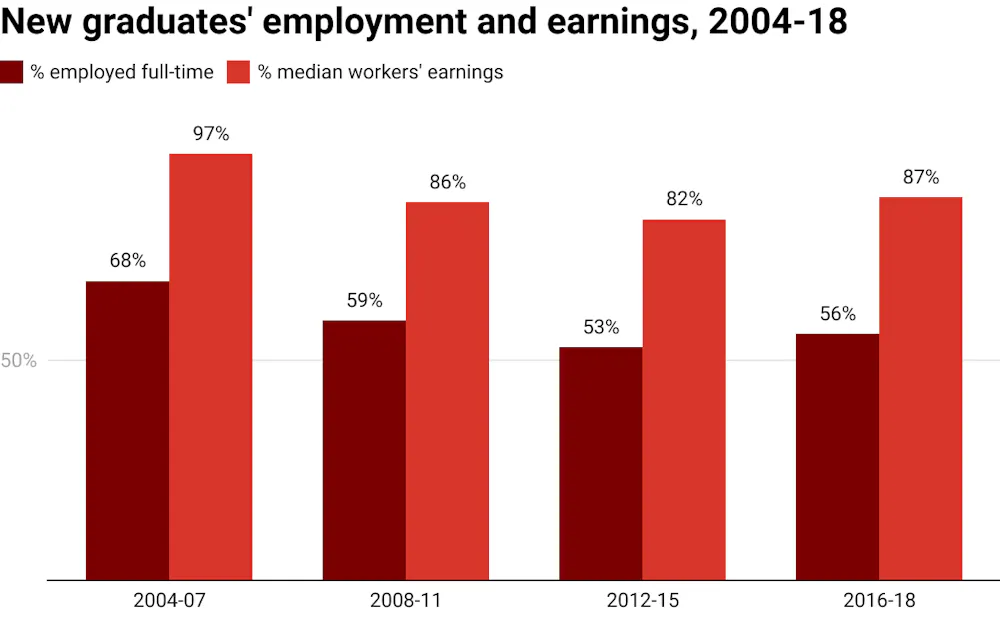
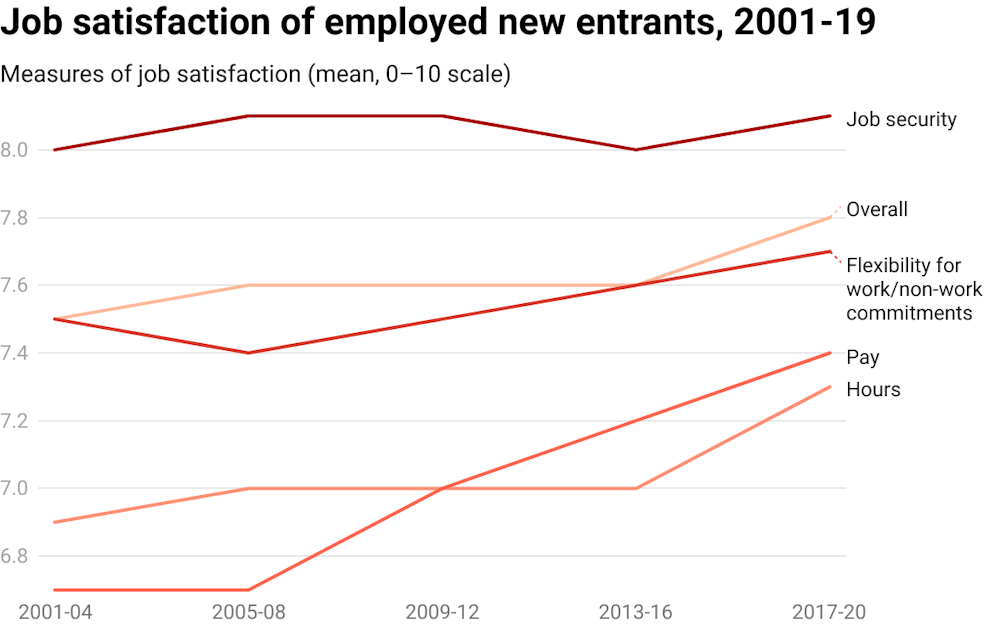 Chart: The Conversation. Data: HILDA Survey 2021, CC BY
It is of course possible that job quality has on average improved. Aspects that come to mind include job security, flexibility to balance work and non-work commitments, job demands, autonomy and task variety.
However, it remains somewhat perplexing that, on a 0-10 scale (0 represents complete dissatisfaction and 10 complete satisfaction), average satisfaction with pay has increased from 6.7 to 7.4 between early this century and recent years. Similarly, average agreement of workers with the statement that they are fairly paid has risen from 4.4 to 4.9 on a 1-7 scale (1 corresponds to strong disagreement and 7 to strong agreement).
Objectively, pay has declined for new entrants relative to the broader workforce, particularly for university graduates. It therefore seems new entrants’ expectations have been recalibrated to reflect the harsher reality of the modern labour market.
Still, it is hard to understand why subjective assessments of jobs have improved in the context of objective data to the contrary. Perhaps young new entrants have lowered their expectations too much.
Authors: Roger Wilkins, Professorial Fellow and Deputy Director (Research), HILDA Survey, Melbourne Institute of Applied Economic and Social Research, The University of Melbourne
Chart: The Conversation. Data: HILDA Survey 2021, CC BY
It is of course possible that job quality has on average improved. Aspects that come to mind include job security, flexibility to balance work and non-work commitments, job demands, autonomy and task variety.
However, it remains somewhat perplexing that, on a 0-10 scale (0 represents complete dissatisfaction and 10 complete satisfaction), average satisfaction with pay has increased from 6.7 to 7.4 between early this century and recent years. Similarly, average agreement of workers with the statement that they are fairly paid has risen from 4.4 to 4.9 on a 1-7 scale (1 corresponds to strong disagreement and 7 to strong agreement).
Objectively, pay has declined for new entrants relative to the broader workforce, particularly for university graduates. It therefore seems new entrants’ expectations have been recalibrated to reflect the harsher reality of the modern labour market.
Still, it is hard to understand why subjective assessments of jobs have improved in the context of objective data to the contrary. Perhaps young new entrants have lowered their expectations too much.
Authors: Roger Wilkins, Professorial Fellow and Deputy Director (Research), HILDA Survey, Melbourne Institute of Applied Economic and Social Research, The University of Melbourne 
















